Crossing the threshold of the synagogue, you need to touch the mosus attached to the scraping - a case in which the parchment with a passage of the Torah is invested. (Photo of Mesus at the entrance to the synagogue and the prayer hall)
- Prayers in the central synagogue of Kiev occur 3 times a day according to the schedule (on the main page)
Sugar for prayer (where to get?)
Usually there is a special rack or cabinet for the storage of prayer books in the synagogue. If it is not visible, you can approach and ask anyone who prays.
Have you been late for prayer? (what to do)
Like any delay, the delay is not welcome. But if you still did not have time at the beginning of the prayer, it does not mean that you cannot go to the prayer hall. Come in ashamed, no one will condemn you. You need to take a prayer book and look at the pointer on which page everyone is now reading/ where they are read now. If you need to go before the prayer end, you can get out of the prayer hall without drawing attention.
Saturday - Shabbat
On Saturday, you can not do everyday affairs, talk about them and make agreements, also, on Saturday does not work a kosher shop (located near the synagogue).
One of the harshest Saturdays is the ban on lighting fire, so smoking is also forbidden.
- According to Jewish law, a man can only touch a woman if he is his closest relative (mother, sister, daughter) or wife, so when meeting between a man and a woman is not accepted to press her hand, hug and kiss.
Clothing to visit the synagogue should be worthy and tidy. It is not customary to visit a synagogue in shorts or a tracksuit.
Women
According to Jewish law, the hair of a married woman should be covered. It can be a wig, scarf or any other headdress. According to the laws of Jewish modesty, it is not customary to visit the synagogue in open outfits, women's hands should be covered with sleeves. Traditionally, it is not customary that a woman walks in the pants, so it is better to come in a synagogue in an elongated skirt or dress that closes her knees.
Men
Men can only be in the synagogue with their head covered. Most often, a stack is put on the head, although it can be any other headdress.
- Generally, it is necessary to cover the head, according to the Jewish tradition, not only in the synagogue: it is a sign of recognition of the power of the b-ha, whose will is often impossible to grasp with reason.
- The rules of conduct in the synagogue are subject to understandable logic and are quite obvious. In the synagogue, as in any other place, it is necessary to behave with dignity, not to interrupt the speech of the rabbi, not to interfere with loud conversations to conduct prayer, etc.
- Earlier, synagogues, intended for prayer, met, and then in this room could not even talk about things, but nowadays almost all synagogues are built with the condition that they can do in everyday life.
From ancient times to this day the synagogue is called "Beit-Kneset" in Hebrew, which literally means "House of Assembly". The word "synagogue" comes from the Greek word synagoge ("fees") that means the same as the word "king" in Hebrew: "Fees".
In all Talmud, the synagogue is only once called "Beit Tfila" - "Prayer House". The name "Beit -Kneset" emphasizes that the synagogue is something more than just a public prayer room.
Історія виникнення синагог
Час виникнення синагог точно не відомий. Більшість істориків вважають, що вони виникли після руйнування Першого храму (586 р. до н.е.) і початку вавилонського полону. Євреї, вигнані до Вавилону, стали збиратися в будинках один у одного, щоб разом молитися і вчити Тору. Пізніше було збудовано спеціальні будівлі для молитви – перші синагоги.
Коли вавилонські вигнанці повернулися на Батьківщину і звели Другий Єрусалимський храм, вони збудували ряд синагог і в Ерец Ісраель. Джерела часів Другого Храму свідчать, що тоді синагога була навіть на Храмовій горі.
Другий храм відродив єврейське життя в Палестині, але багато євреїв залишилися у Вавилоні. Для них синагога зберегла свою роль духовного центру, місця молитви та вивчення закону.
Коли римляни зрівняли із землею Другий Храм, синагога стала цитаделлю віри, - місцем, де євреї збиралися, навчали Закону, молилися. Траплялося й так, що під час нападів ворогів синагога ставала цитаделлю у буквальному значенні цього слова.
The time of synagogue is not known. Most historians believe that they arose after the destruction of the first temple (586 BC) and the beginning of Babylonian captivity. The Jews expelled to Babylon began to gather in homes to pray and teach the Torah together. Later, special prayer buildings were built - the first synagogues.
When the Babylonians returned to their homeland and erected the second Jerusalem temple, they built a number of synagogues in Eretz Israel. The sources of the time of the second temple indicate that then the synagogue was even on a temple mountain.
The second temple revived Jewish life in Palestine, but many Jews remained in Babylon. For them, the synagogue retained its role as a spiritual center, a place of prayer and the study of the law.
When the Romans led the second temple with the earth, the synagogue became a citadel of faith - a place where the Jews gathered, taught the law, prayed. It also happened that during the attacks of enemies, the synagogue became a citadel in the literal sense of the word.
For scattered Jewish communities, the synagogues have become the center of social, political and cultural life of the Jewish people.
*Synagogue- This is first and foremost a place for prayer. Judaism attaches great importance to public prayer. The synagogue is the place where the community is gathering for prayer.
*Study the torah- This is first and foremost a place for prayer. Judaism attaches great importance to public prayer. The synagogue is the place where the community is gathering for prayer.
There is a custom that reaches ancient times, on Saturdays and holidays to speak with conversations on the topics of the week section of the Torah or with any problems of Jewish legislation, usually related to the upcoming holiday. Such a conversation (drasha) is conducted by one of the most knowledgeable members of the community or a specially invited rabin. In addition, on Saturdays, after morning or daily prayer, synagogues usually gather groups to study the Torah and Hasidite.
*Library - Traditionally, a synagogue should have books of Jewish teachings. It is considered a very pious act to buy books for such a library. In almost any synagogue, you can find the Pentateuch with commentaries, the Mishnah, the Talmud, the works of Rambam, the complete Shulchan Aruch, as well as hundreds or even thousands of other books. Every member of the community has the right to use these books.
[accordion-11]
No certain architectural forms have been ordered for the synagogue. It can be a modest building, even a room in a house that is used for other purposes, and a gorgeous structure in any architectural style.
*The law requires that the synagogue's premises have a window. Talmud warns against prayer in a room without windows: people need to see the sky. When entering the house, there should be a lobby, passing which a person leaves the thoughts and concern of the material world, adjusts to prayer.
*The building is oriented to Jerusalem
Synagogues located in Jerusalem are focused on the temple mountain. The Talmud requires that those who pray to turn to Jerusalem when reading one of the most important prayers - Amida. Any synagogue, small or large, modest or gorgeously decorated, should be properly equipped.
The place of the rabbi
Next to Aron Akodesh is a rabbi. On the other hand, Aron Akodesh is given a place for Hazan or invited speaker. All these details are integral components of the interior decoration of the synagogue, but in the other interiors of different synagogues are very diverse. Restrictions only apply to people's images.
Aron Acodesh - The wardrobe where there are scrolls
Near the wall opposite the entrance, where all who pray are facing, is Aaron A -code - a wardrobe or a niche where scrolls are stored; It is covered with a curtain called "parish". Aaron Akodesh is a symbolic likeness of the repositories of the tables with the Ten Commandments to the Saints of the Saints of Jerusalem Temple. The closet contains scrolls - the most sacred heritage of the synagogue. Usually Aron Kodesh is placed near the wall facing Erets -Israel (in Israel - towards Jerusalem).
"NEW Tamid" - Non -savage
Over Aron Akodesh is located "NEW Tamid -" Unaddressed Lamp ". It used to be an oil candle. Now it is usually a candle -like lamp. NEW Tamid always burns, symbolizing the menor, oil lamp of the temple. There was seven wgs in Menor from which he burned constantly.
Bima
In the center of the synagogue is an exaltation called "Bima". From this elevation reads the Torah, it is installed table for a scroll. Bima is reminiscent of the plate from which the Torah was read in the temple.
"Ours' Our" - Department for women.
Midrash tells that when the Jews gathered near the Sinai Mountain to receive the Ten Commandments, men and women were standing separately. There was also a separate apartment for women in the temple of Jerusalem. The synagogue for women is also given a special place - "Ezrat" (the female half). "Ezrat" can be located on the gallery, on the balcony (in the temple of the ward for women was located above) or in a prayer hall behind a special curtain called "Mexico City" - a partition. In the explanation of this tradition, Rav Lau, the former Chief Rabb of Israel, writes: "A person in the synagogue should be distracted from prayer. It is said in Tora:" Know, before who you stand. " Communication with the creator.
The encyclopedia of Brokhaus and Efron states that Meir Brodsky is the founder of the sugar factory dynasty, Alexander Schora's great-grandmother-Rabin from Zhovkva, the author of the famous religious and philosophical treatises. Meira and his wife Miriam, who lived in the town of Zlatopol, had five sons: Abram, Zelman, Isaac, Israel and Joseph. Abram left Zlatopol in 1858 and first moved to St. Petersburg, becoming the Tsarskoe Selya merchant of the 1st Guild, and then to Odessa. Immediately with his wife Hayai, four sons and three daughters since 1860, Israel lived, who became the most successful descendant of Meir Schora. In December 1865, he filed an application for transferring him from Odessa merchants to Kiev. Then only Jews-merchants of the 1st guild-those who owned capital for 100 thousand rubles-had the right to reside in Kiev. Others could stay in the city for no more than three days. Israel Brodsky found his first sugar mill in 1846 in the village of Lebedin, not far from Zlatopol. Subsequently, he opened the Odessa plant, purchased Kagarlytsky and Koryukivsky, took the long -term lease of Raygorod and headed the Tomashiv sugar factories.
Well -known politician and public figure Sergey Witte, well acquainted with Israel Brodsky, wrote about him: “It was a very respectable old man who resembled the Biblical Patriarch. He was extremely rich. I had repeatedly talk to him, have purely business conversations, and he always made the impression of a person extremely intelligent, but almost completely ignorant. "
The Kiev period of life and activity of Israel Brodsky is marked by significant charitable activities. In the book "Kiev now and before", which was published in 1888, we read: "In addition, in this part of the city (the new then Lukyanivka district) attracts the attention of a Jewish hospital built for money donated by IM Brodsky - near 150 thousand rubles. In addition to construction and equipment, Israel Brodsky donated 50 thousand, percent of which went to the maintenance of this medical institution - 3 thousand rubles a year. The hospital served not only Jews but also patients of other nationalities. More than 40 thousand rubles, Israel Brodsky, has allocated for the construction of a craft school, where children from poor Jewish families studied at his expense. Israel Brodsky did not limit his generous charity of Israel Brodsky. As a member of many Christian societies and organizations, he annually sacrificed hundreds of thousands of rubles for their activities. His sons Lazar and Lion also worked in family business. In the early 1900s, they already managed six joint-stock companies, which included 10 sugar factories and 3 refinery in Kyiv, Chernihiv, Poltava, Odessa, Podolsk and Kursk provinces.
The success of the Brodsky factories was due to excellent social conditions. Treatment of workers, their training, well -established household support - all these services were paid at the expense of the Society of Sugar Plants, where more than 10 thousand people worked, who produced a quarter of the Russian refinement. It is interesting that the brothers inherited from the father not only a commercial gift, but also a sensitivity to public needs. Sugar breeders of the region, led by Brodsky, asked the government to regulate sugar production with a guaranteed government rate. In response to a positive attitude to the request, they expressed their willingness to donate for public needs. St. Petersburg granted the request, and the industrialists collected about a million rubles for the construction of the Kiev Polytechnic Institute, the contribution of Lazar Brodsky was 100 thousand.
In addition, the brothers allocated 18 thousand rubles to students. Israel Brodsky has never advertised his charity, but emphasized: "I do not give because I want to give, but because I realize what should and should be given." His sons also acted. They significantly expanded the hospital built by their father. In 1895, Lazar Brodsky became the first head of the Society for Fighting Infectious Diseases. At his expense, a bacteriological institute was built on a Bajikova Hill. For the outstanding services in the field of charity Lazar Brodsky, the Order of St. Stanislav II degree and St. Anne II degree was awarded.
Kiev is difficult to imagine without structures that were built or expanded with the participation of Brodski: it is the obstetric clinic of St. Vladimir University on Bibikov Boulevard (now a hospital on Shevchenko Boulevard), a hospital of society for chronically ill children on Kozlovskaya Street. (now - National Museum), Trinity People's House of Literacy Society (now the Operetta Theater), Board of the Red Cross Society (Mazepa Street, 2 - Polyclinic), Podolsk Women's Gymnasium (Pokrovskaya Street, 4 - now Lyceum "Podil"), P. About the floor elevator on the Post Square (now the Book Choir of the National Library) and a number of others.
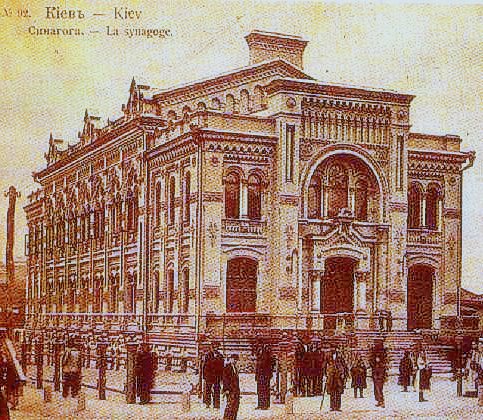
Shota Rustaveli Street decoration is a central (choral) synagogue building. And to open this prayer house was not easy even for the famous Lazarus Brodsky.
As Kyiv was not in the "limits of sediment", the Minister of Internal Affairs in the city was granted permits in the city, which did not allow Jews to build a cult buildings "neither in the central part of Kiev, nor even in remote parts of it." Therefore, a spectacular project of the synagogue, designed to order by Brodsky by G. by the plume, was rejected by the provincial authorities. However, residential or household premises could be used for ritual needs. Lazar Brodsky and Kyiv Rabbi Evsay Sukkerman filed a complaint in St. Petersburg, to the Senate, which was attached to the drawings of the lateral facade of the synagogue on the side Allows ... the Senate supported the request. And in 1898, on the day of the 50th anniversary of Lazar Brodsky, a solemn opening of the Choral Synagogue took place. The ceremony was attended by high provincial officials who made a lot of efforts to ensure that this holiday did not happen.
In addition to sugar production, the Brodsky brothers invested considerable funds in flour, brewery and distillery. They belonged to a controlling stake in the Kiev Tram Society. Lazar Brodsky was a member of the St. Petersburg Council of the International Commercial Bank, the founder and chairman of the Board of the Second Shipping Company on the Dnieper and its tributaries, the director of the Kyiv Water Supply Society, the director of the Mucomol steam mill, a member of the Council of Mutual Credit Society and so on
By the end of his life, Lazar Brodsky was recognized as one of the largest entrepreneurs of the Russian Empire. For the high quality of products represented by its enterprises at the World's Exhibition in Paris in 1900, he was awarded the French Order of Honorary Legion. The life of Lazar Brodsky was cut short in 1904. Ironically, the cause of the death of the "Sugar King" was a sugar disease. When he was buried in the Marble Sklep at the Lukyanovsky Jewish Cemetery, the mayor, the mayor, commander of the military district, participated in the mourning procession. The famous lawyer Lev Kupernyk called the late "best of Jews."
In his testament, Lazar Brodsky left the city 500 thousand rubles for the construction of a covered market, and from the market revenues, the city had to allocate 22.5 thousand for the maintenance of a bacteriological institute, a children's department of a Jewish hospital, a two -class school. Brodsky and other charitable institutions created by him.
In the family at the head of the clan was Lev Israilevich Brodsky. According to his family tradition, he headed many companies, enterprises and charitable organizations, but was not alien to life weaknesses.
Family representatives have scattered around the world - in Europe, America, Australia. Unfortunately, the graves buried here are not preserved in Kiev, only the results of their activities remained.