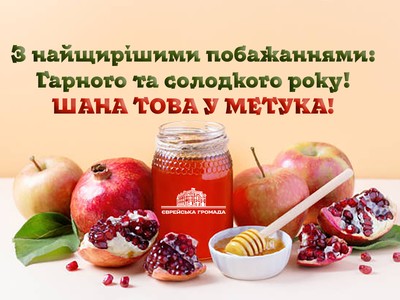
Shana goods uMetuka! 🍯🍎
Holidays
Dear friends, let this Rosh Hashanah be a new beginning for each of us, filled with light, kindness and hope.The Jewish New Year is not only a holiday, but also the Day of the Supreme Court. We stand before the Almighty with a request for life, health and peace. It is now up to us to decide what our next year will be — and that is why we wish you a good and sweet entry in the Book of Life.Our prayers today are for peace in Ukraine, for the protection of our soldiers and for the peace of the whole world. May this year bring us the fulfillment of the most important request — peace and security for our families and our land.May love and harmony always reign in your homes, may your hearts be filled with joy and gratitude, and each day of the new year brings only good news.From our entire Community — with the most sincere wishes:Have a nice and sweet year! Shana goods uMetuka!
Question of the day: Why is it customary to trumpet a shofar 100 times?
Holidays
According to Torah law, the minimum obligation on Rosh Hashanah is 9 sounds: three times tkiyah-truah-tkiyah.• Thiya — a long sound.• Troyes is an abrupt sound similar to crying.But the sages argued: what kind of crying did the Torah mean? There are short sounds (Troyes), medium (Schwarim), and a combination of both. To get out of this doubt, they decided to trumpet all the options. The result is 30 sounds. This is the mandatory minimum recorded in the makhzor (holiday prayer book).However, in practice in many communities for hundreds of years there is a custom to trumpet 100 times. Where does this figure come from?Our sages connected it with the biblical episode: the mother of the military commander Sisra, who died in battle with the Jews, was waiting for her son, and when he did not return, burst into tears. It is said that her weeping and sobs were a hundred times. In memory of this and in contrast to her tears, Rosh Hashanah is trumpeted a hundred times in a shofar.Only in Israel?No, this custom exists in all Jewish communities of the world — both in Israel and in the diaspora. The difference can only be in the order and distribution of the tubes during prayer.How to learn to trumpet?A shofar is not an easy tool. You need to learn how to properly fold your lips and breathe so that the sound is clear. They usually train in advance, starting a few weeks before the holiday. Traditionally, the teacher passes this skill on to the student, but today you can find video instructions and even special master classes.
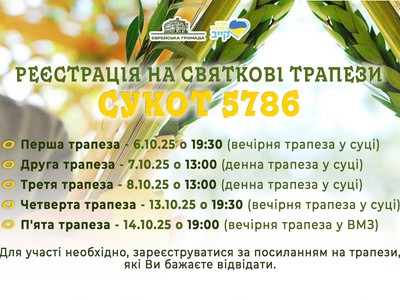
🌿🍋 Registration for Sukkot festive meals 5786 ✨🏡
Holidays
🍽️First Meal— 6.10.24 19:30 (evening meal in a 🌿 bitch)🍽️Second Meal— 7.10.25 13:00 (day meal in a 🌿 bitch)🍽️Third Meal— 8.10.25 13:00 (day meal in a 🌿 bitch)🍽️Fourth Meal— 13.10.25 19:30 (evening meal in a 🌿 bitch)🍽️Fifth Meal— 14.10.25 at 19:00 (evening meal at 🕍 VMZ)To participate, register at:https://forms.gle/osjFgRgUorgpeegr7 to those meals that you wish to visit.⚠️ Pre-registration isrequired! ✅HAG SUKOT SAMEAH!
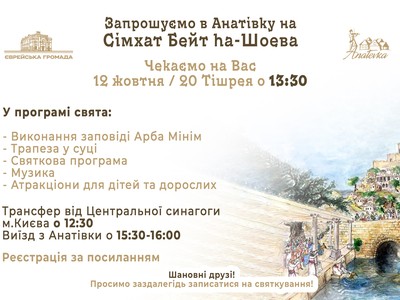
✨ We invite you to Anatovka on Simhat Beit ha-Shoeva ✨
Holidays
📅 12 October / 20 Tishrei1:30 p.m.📖 The holiday program includes:🌿 Fulfillment of the commandmentArba Minim🍽️ Meal atbitch🎉 Holiday programMusic🎠 Attractions for children and adults🚌Transferfrom the Central Synagogue of Kyiv — 12:30🚐 Departure from Anativka — 15:30–16:00Please register at:https://forms.gle/yqwFCNaNdZ9DfNmE6Dear friends!Please make an appointment for the celebration in advance!
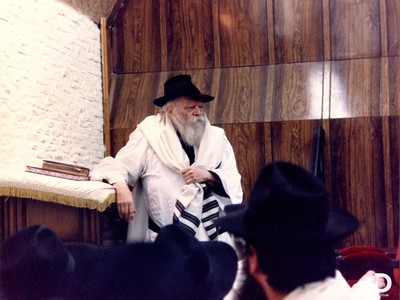
📖 The Lubavitcher Calendar:10 Special Chabad Traditions on Yom Kippur
Holidays
Distribution of Lekah on the eve of Yom Kippur 🍯In the Hasidic communities of Chabad, it is customary to ask and receive "lekah" (copper) on the eve of Yom Kippur. The meaning of this custom: if a person is destined to ask for help from others during the year, he allegedly executes his "sentence" in advance, and the rest of the year passes for him in sweets and blessings.Ner HaKhaim (Candle of Life) 🕯️In Chabad, it is customary for married men to light a special candle in the synagogue, called Ner HaKhaim, as a means to longevity.Tradition of three plates of soup on the final meal 🍲There was a custom to eat three plates of soup at the final meal. If there is not enough time, it is advisable to add at least three spoons of soup, symbolizing this tradition.Blessing of Hasidim and Yeshiva disciplesAfter the Minha prayer on the eve of Yom Kippur, the Rebbe blessed all the Hasidim, and then gave a separate special blessing to the yeshiva students — just before the Kol Nidrei prayer (the first prayer on Yom Kippur).Reading Tegilim all day 📖In Chabad, it is customary to read the Psalms (Tegilim) throughout the holy day (except for the time of prayer) so that the stream of Psalms sounds continuously in the synagogue.Jacket (White Robe) and Gartel (Prayer Belt) RebbeThe Rebbe prayed on Yom Kippur in a tunic made of Rebbe Marash's shirt, which is worn over the head rather than as a regular shirt, and with the garret of Rebbe Zemah-Tzedekah.Ascent to the Torah in Minhu on the "Maftir Yona"In Chabad, it is customary for the Rebbe to rise to read the Maftir Yona. This is the only day of the year when he ascends to the Torah not on Shaharit, but on Minhu.Prayer of the Maars after the feastIt is customary to pray to the Maars after fasting, dressed in a jacket and talit, but with a hat on their heads.Avdala and Kiddush Levana (Moon Blessing)The Rebbe performed Avdala and changed fabric shoes to leather ones in his office, and only after that went out to speak Kiddush Levan.Yom Kippur 5734 — The Yom Kippur WarOn this day, the Yom Kippur War began. A few months before her, the Rebbe warned of the need to be strengthened in Torah, prayer and parenting, explaining that this is where the power to “defeat the enemy” comes from. After the outbreak of the war, his words were perceived as a prophecy.Source:(https://t.me/+8KbDy9dQVqAxZWE8 )
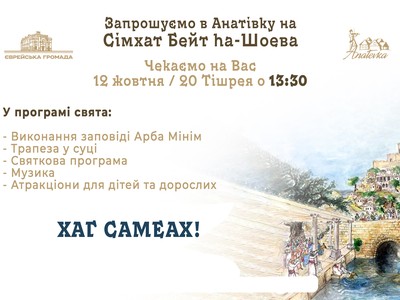
🎉 Friends, we remind you!
Holidays
Today in Anativka we celebrate Simhat Beit ha-Shoeva — a holiday of joy, light and spiritual exaltation!Join us to share the light of the holiday, the fulfillment of the commandment of Arba Minim and a good mood!AnativkaThe holiday starts at 13:30We are waiting for everyone!
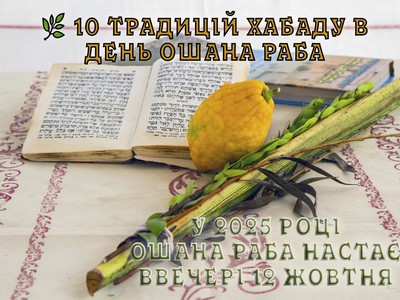
📖 Lubavitcher calendar: 🌿 10 traditions of Chabad on the day of Oshan Rab
Holidays
🌿10 traditions of Chabad on the day of Oshan Rab️1ლ 📖Reading the book "Dvirim"At night, before midnight, they read the entire book "Dvorim" (Deuteronomy).Rebbe Rashab and Rebbe read it alone, and Tehilim read it with the community.️2ლ 🙏Joint reading of TegilimAfter midnight, the whole of Tegilim (Psalms) is read.That night, “Yehi-razon” is said after each book, and the Rebbe stood throughout the reading.️3ლ 🌙Cheerfulness until dawnAfter reading, Tehilim does not go to bed — they stay at school all night.This night is considered the time when the sentences of the year are finally sealed by mercy.4️ლ 🍎Distribution of apples with honeyAccording to an ancient Chabadian custom, the Gabbai distribute sweet apples to everyone.At home, they are eaten with honey in their bitch — as a sign of the sweet year and mercy.5️ლ 🌿Preparation ofArava (Willow)The branchesof the arava bindthe leaves of the lulava.The Lubavitcher Rebbe personally preparedarava for all family members.6️ლ 🪶HibbutArava (branching)Before the strike, the Rebbe separated the branches, counted themand lightly struck the ground — as a symbol of softening severity.7️ლ 👶Blessing of childrenRebbe Rajac lightly touched the children with the branchesof the Arava —adults three times, and children — once more than they are years old, saying:"Guurot memutakot"(relaxed severity).8️ლ 📚Removal of all Torah scrollsDuring the prayer of Oshanoth on the day of Oshan the Rabbi, all the Torah scrolls are taken out of the ark,to awaken the greatest joy and holiness.9️ლ 🍯Sweet mealAt the festive meal, a halu with honey andkreplakh— dumplings with meat as a symbol of joy and gentle judgment.🔟 💰Zoom in TzedakOn the day when the "court is mitigated by good", it is customary to give more tzedakah than usual.Source:https://t.me/LubavitcherRebe770
✨🕎 The brightest holiday of the year — Hanukkah — is approaching!
Holidays
What we know about itCandles 🕯️, Hanukkah🕎, donuts🍩, sevion🌀...But today, let's talk aboutWunderofWhat is a miracle?We used to think it was something that violated the laws of nature.In Hebrew, miracles are calledto NIS— "flags", orniflaot— "a sign." This is a manifestation of the power of G-d.After the victory of the Maccabees over the Greek-Assyrians, a miracle happened:oil, which would be enough for only one day, burned in the Temple lampeight days— until a new clean oil is prepared.And next to it is another miracle:victory of a small handful of dedicated people over a powerful armyofThe Maccabees lit the Menorah despite the resistance of those who adopted Greek customs and built pagan temples in Jerusalem.Why do we celebrate a miracle with oil in the first place, and not a military victory?Because the miracle with the oil was obvious — everyone saw it.And the victory, although great, looked natural.Therefore, through an obvious miracle, people learned to recognizehidden wonders— and they understood: everything, even the most unusual, comes from G-d.— And which one would be?hanukkah wondershappened to you?
Preparing for Hanukkah:8 Hanukkah Candles as 8 Levels of Understanding Part 1
Holidays
Eight candles can be considered as eight stages of human development: from a small child to a world leader.1. Baby candle2. Military-patriotic (adolescent)3. Ritual4. Temple5. Identification ("We are not them")6. Integration ("We take the best from them")7. Anti-crisis ("Learning from mistakes")8. LeadershipThe eight candlestick themes are divided into two groups (four in each):Group 1:— the classical world of Jewry with themes accessible to most.Group 2:— "post-post-modern", where the Jewish view:becomes relevant to the peoples of the world;is enriched by the wisdom of the nations;protected from the dark forces;ready to take responsibility for the fate of the world.
Preparing for Hanukkah: Candle 1. Children's
Holidays
It is extremely important that we keep warm, joyful, beautiful stories from childhood. Growing up, we build on them — though not limited to childhood experiences.In Hanukkah, these are:Material joyHanukkah money —hanukkah Gelt(Yiddish) ordmey Hanukkah(Hebrew). Gifts that adults use to support the child's interest in the holiday.Even in Soviet times, many grandparents gave children Gelt - it was safe, because it did not have pronounced signs of Judaism."Taste" special effectsAdults struggle with diets, and Hanukkah brings exactly what is usually “impossible” — donuts, latkes, everything fried in oil. Children rememberthe pure joy of these tastes for life."Aesthetic" special effectsConcerts, performances, holidays — there are always a lot of them in Hanukkah, because there are no restrictions inherent in other Torah holidays. The doughnuts in the intermission are a classic.GameThe main symbol for children is the dreidel (savivon).Main imageCandles or oil lamps on the window when it is warm in the house, and outside it is cold, wind and snow. Contrast that is perfectly recorded in the child's memory.Children's Hanukkah is light, warmth, joy, tastes, the ringing of coins.Many “Soviet” Jews did not get it, but we can give it to our children now.
Preparing for Hanukkah: Candle 2. Military patriotic (teenage)
Holidays
Of all the Jewish holidays, only Hanukkah has a clear military victorious aspect. For centuries, Jews and their neighbors were not accustomed to perceiving Jews as warriors. Below is a very brief overview of Jewish heroism:Abraham goes to war against the world's rulers to save Lot-and wins.Shimon and Levi punish the city of Shechem for desecrating Dinah.During the exodus from Egypt, Joshua bin Nun becomes a great warlord.In ancient times, the prophetess of the Court, the hero Shimshon, King David — an outstanding commander and poet - are distinguished.Subsequently, Israel becomes a province of empires, loses its statehood, but Jews often fight as mercenaries and are known for their valor.Hanukkah awakens moraleThe Greeks did not usually impose their culture by force, but a fanatical emperor emerged who decided to break the Jewish way of life.Then the Hashmonahs rose up and led the people — and the Jews won, preserving their faith.In the 20th century, Jews fought in the First and Second World Wars, showing heroism. Many of them become the backbone of the Israeli army.And the image of a "weak Jew" changes to the image of a strong warrior-defender.To be continued…
Preparing for Hanukkah: Candle 3. Ritual Part 4
Holidays
The main decoration of Hanukkah is the lighting of candles.Ritual in Judaism is not a "formality", but an instrument of communication between the earthly world and the Higher.Candles and oil carry deep meanings. Among them is the symbolism of Moshiach (the anointed).Eight as a symbol of infinityIn mathematics, the infinity sign is an inverted eight.In Kabbalah, the seven lower Sefirot are connected with our world, and starting with the eighth, it is the Higher World, access to which requires spiritual experience.