
Preparing for the Hanukkah holiday: part 5. Candle 4. Temple candle
Holidays
The spiritual center of Hanukkah is the restoration of the Menorah in the Temple.The Greeks defiled the Temple, depriving it of its Jewish essence. The Jews lit the Menorah again — and, as it were, revived the Temple.The temple is our ownThe physical Temple is destroyed.But the spiritual Temple is in the Higher Reality and... inside a person.The menorah is with us.We have oil.The light is in us.

Preparing for Hanukkah: Candle 5. Identification ("We are not them")
Holidays
When spiritual conflict arises, we gain a clearer understanding of who we are and how we differ from others.📌Hanukkah gives a reason to think about the essence of the Jewish view of the world:❓ What we brought to humanity❓ What mission did the Most High lay in the Jewish people*Greek worldview and Jewish monotheismThe first Greece was pagan, with many gods.Jews contrast this with a single G-d and ethical monotheism.Later Greece is the cradle of science and logic.There is no room for miracles in their system.❗ And we believe that G-d rules the world without limiting Himself to the laws of nature.And the Hanukkah miracle with oil is a symbol of the fact that rationality and faith can coexist.

Preparing for Hanukkah: Candle 6. Integration ("We take the best from them")
Holidays
In the 20th century, Rabbi Kook created an approach that allows Jews to use the valuable tools of other cultures while preserving the Jewish essence.But the process started earlier:📎Jewish sages partially adopted the methods of Greek textual analysis;the idea of emanations of the Neoplatonists influenced the formation of the kabbalistic system of the Sefirot;Rambam borrowed logical models from Aristotle.❗This is how the Torah blessing is performed:"Japhet will dwell in the tents of Shem" - that is, the wisdom of the Greeks will serve the development of Jewish wisdom.


Preparing for Hanukkah: Candle 8. Leader's conclusion
Holidays
❗Great processes require great leaders.Hashmonai and Yehuda Maccabee are examples of people who took responsibility and led the people.A leader must be able to make non-standard decisions and lead people forward.❗ Hanukkah reminds us of this every year.📌 Wishes🕎May the light of Hanukkah inspire and sustain us all year long —that we may be worthy people and worthy Jews!
Jewish holidays
Holidays
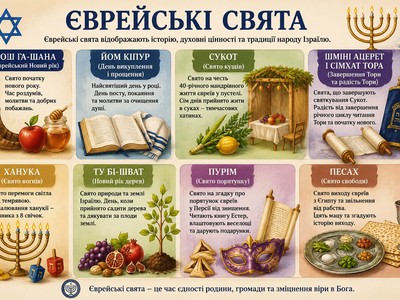
Jewish holidays reflect the history, spiritual values and centuries-old traditions of the people of Israel.🍎🍯 Rosh Hashanah — Jewish New YearA celebration of the beginning of the new year, spiritual awakening and reflection. These days they summarize the past year, pray and wish each other a good and sweet year.🤍 Yom Kippur — Day of AtonementThe holiest day of the Jewish year. It is a time of fasting, prayer, sincere repentance, and spiritual purification.🌿 Sukot — Kuren FestivalThe holiday recalls the forty-year wanderings of the Jewish people in the desert. For seven days, it is customary to spend time in a bitch — a temporary hearth, which symbolizes God's protection and trust in the Almighty.📜 Shmini Atzeret and Simhat ThorShmini Atzeret completes the festive period of Sukot. Simhat Torah is a celebration of the joy of the Torah, when the annual cycle of its reading ends and a new one begins immediately.🕎 Hanukkah — Festival of LightsA celebration of the victory of light over darkness, spiritual resilience and devotion to faith. For eight days, Hanukkah is lit by adding another light every evening.🌳 Tu BiShvat — New Year of TreesThe Feast of Nature and the Land of Israel. On this day, it is customary to plant trees, eat the fruits for which the Land of Israel is famous, and thank the Almighty for the generosity of nature.🎭 Purim — Holiday of SalvationA holiday in memory of the amazing salvation of the Jews of Persia from extermination. On Purim, they read Megilat Esther, arrange a festive meal, help the needy and give treats to friends.🍷 Passover — Celebration of FreedomFeast of the Exodus of the Jewish People from Egypt and Liberation from Slavery. During the festive Seder, they read the Haggadah, tell the story of the Exodus, and eat matzah.Jewish holidays are a time of family and social unity, preserving traditions and strengthening faith in the Almighty.
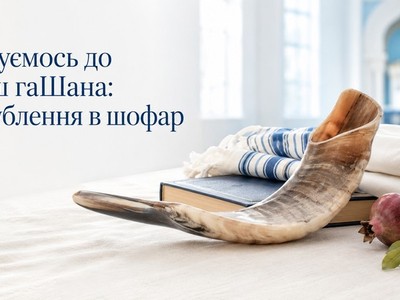
Rosh Hashanah Getting Ready: Shofar Tubing
Holidays
From the second day of the new moon elul (that is, from the 1st elul) until the day before Rosh Hashanah, the shofar is blown in the synagogues after the completion of the morning Shaharit prayer. These daily trumpets consist of four sounds: “Tchia”, “Chevarim”, “Troyes” and again “Tchia”.This trumpeting is not prescribed by the Torah, but established by an ancient Jewish custom. When Moshe ascended Mount Sinai on Rosh Chodesh in the month of Elul to receive the new Tablets of the Covenant, the Jews in their condition blew the shofar, so that all the people would know that Moshe had only temporarily ascended to Heaven (and not left the earth forever) and so that in his absence they would not fall into idolatry. In commemoration of this, the Jews blow the shofar from the beginning of Elul — to remember how Moshe ascended to the Most High and to confirm once again that Israel repented of the sin of creating a "golden calf" and was forgiven, because the Most High in His mercy gave new tablets after forty days. This reminder should awaken in every Jew the desire for tshuva — repentance and return to the Most High.They trumpet the shofar after completing the morning prayer, because Moshe at one time went up the mountain in the morning.The trumpeting is carried out throughout the month to warn the people about the approach of the Day of Judgment and to awaken the desire for teshuvah. After all, the nature of the sound of the shofar is such that it causes anxiety in the hearts of people, as it is said in the Scripture: "Can the people not be alarmed when the shofar sounds in the city?” (Amos 3:6) The sound of the shofar declares, “Wake up, you who are asleep, wake up from your sleep, wake up from your slumber, look at your deeds, and repent of your sins.” That's what Rambam wrote.On the eve of Rosh Hashanah, the shofar is not trumpeted to draw a line between the trumpet in elul, which is an ancient Jewish custom established by our sages, and the trumpet in Rosh Hashanah, commanded by the Torah.Starting from the second day of the new month of Elul until Oshan Raba, the last day of Sukkot (inclusive), in Ashkenazi communities, the morning and evening prayers include the 27th Psalm. This custom is based on the Midrash, which explains the first words of the Psalm: "The Lord is my light and my salvation." The Midrash interprets that the words "my light" refer to Rosh Hashanah, "my salvation" to Yom Kippur, and the further words "for He will shelter me in His bush" are reminiscent of the holiday of Sukkot. According to the custom established by Ari, this Psalm is recited after the morning and afternoon prayers.In some Jewish communities, it is customary to read the Psalms — ten or more — according to local custom after completing a prayer with a large number of people.Whoever writes a letter this month should indicate at the beginning or at the end the wishes to the addressee that he will receive the mercy and blessing of Heaven, be justified on the Day of Judgment, be inscribed in the Book of Life and be awarded the final approving signature.The meaning of this custom is to remind oneself and others about the approach of the Day of Judgment, the need to prepare for it, make teshuvah and ask for mercy from the Almighty.People who carefully follow the commandments of the Torah usually check kashrut tefillin and mezuzah in their homes, as well as other items related tothe fulfillment of the commandments. Anything that needs to be corrected is corrected immediately.According to the ancient custom, on each of the days of Elul in the synagogues, it is proclaimed: “Return, you apostate children” (Yirmeyahu 3:14).
From the first day of Rosh Khodesh of the month of Elul and to Oshan Rab (in 2026 — from August 13 to October 2)
Holidays
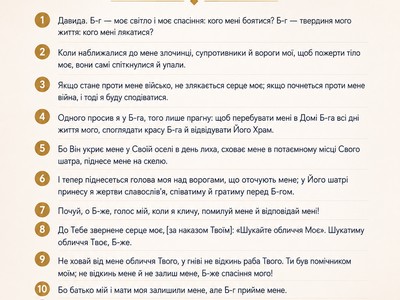
Psalm 27David: G-d is my light and my salvation: whom shall I fear? G-d is the stronghold of my life: whom should I be afraid of?As criminals, adversaries, and enemies approached me to devour my flesh, they stumbled and fell.If the army opposes me, my heart will not be afraid; if a war begins against me, then I will hope.There is one thing I have asked of G‑ d, and that is my desire: to be in G‑ d's House all the days of my life, to contemplate the beauty of G‑ d, and to visit His Temple.For He will shelter me in His dwelling place in the day of trouble; He will hide me in a secret place in His tent; He will lift me up on a rock.And now my head will be lifted up above the enemies that surround me; in His tent I will offer sacrifices of praise, singing and playing before God.Hear, O G-d, my voice when I call; have mercy on me and answer me!My heart is turned to you in obedience to your command, “Seek my face.” I will seek your face, O God.Do not hide Your face from me, do not cast Your servant away in anger. You have been my helper; do not cast me away or forsake me, for my salvation is God's.For my father and my mother have forsaken me, but G-d will accept me.God has come to your way, and lead me in the way of righteousness for the sake of those who follow me.Do not hand me over to my enemies, for false witnesses who breathe slander have risen against me.If I did not believe that I would see the goodness of God on the land of the living...Trust in G‑ d, be courageous, and let your heart be strong. Rely on G-d!

🌿 Sukkot, Shmini Atzeret and Simhat Torah 2026: calendar of holidays and days of festive rest
Holidays
🌿 Sukkot, Shmini Atzeret and Simhat Torah 2026: calendar of holidays and days of festive restIn autumn, a time of festive joy, prayers and meetings in the bitch awaits us. To plan things in advance, we recall the dates of holidays in 5787 for Ukraine and other diaspora countries — outside Israel.📌Days of festive rest with a ban on work under the laws of the holiday: September 26–27 and October 3–4. Holidays start the night before and end after nightfall.🌿SUKKOT — 26–27 SEPTEMBER/15–16 Tishrei🔹 Beginning — Friday evening, September 25.🔹 Saturday, September 26 is the first day of Sukkot, which this year coincides with Shabbat.🔹 Sunday, September 27 is the second day of Sukkot in the diaspora.🔹 The first two holidays end after the night of September 27.This is the time of festive prayers and meals in the bitch. On September 26, all the restrictions of the Sabbath also apply. 🍋 HOL GA-MOED — INTERMEDIATE DAYS of the HOLIDAY September 28 — October 2/ 17–21 TishreiIntermediate days begin after the onset of the night on Sunday, September 27, and last until the beginning of the next holiday on the evening of Friday, October 2.📌These are not ordinary weekdays: Work restrictions are relaxed but not lifted. In particular, under certain conditions, matters for the needs of the holiday and urgent work are allowed, the postponement of which will cause significant losses. Questions about specific work should be clarified with the rabbi. Read more in the explanationof the Jewish community of Dnipro.🌿Friday, October 2/ 21 Tishrei — Hoshan Rabah, the seventh day of Sukkot.He belongs to Hol HaMoed.🕍SHMINI ATSERET — 3 OCTOBER Saturday / 22 TishreiThe holiday begins on the evening of Friday, October 2. This year it coincides with the Sabbath, so all Sabbath restrictions apply.On this day, the Izkor memorial prayer is read. 📖 Simhat TORAH — OCTOBER 4 Sunday / 23 TishreiIn the diaspora, the Simhat Torah comes after the end of Shabbat on October 3 and lasts until the night of October 4.This is a celebration of the joy of the Torah: we complete the annual cycle of reading it and start a new one. On this day, there are holiday restrictions on work. 📌 IT IS IMPORTANT TO DISTINGUISHYom Tov and Shabbat have different rules: Yom Tov, which does not coincide with Shabbat, allows separate actions for preparing festive food under certain conditions. Therefore, the prohibition of work does not mean that all the rules of these days are the same.Check the 🕯️ exact time of lighting candles and the end of the holidays with the calendar of your community and city. May these days bring joy, warmth and unity to our homes! 🌿
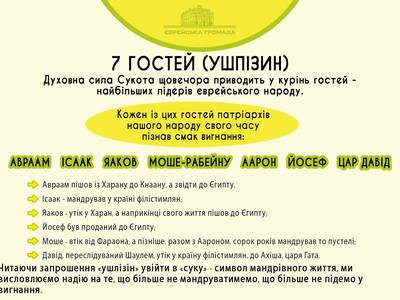
Sukhoth Preparation: Seven Guests (Ushpizin) for Sukhoth
Holidays
The seven guests (ushpizin) on Sukkot are the souls of the seven great righteous who, according to the Kabbalah, attend Jewish tents (sukkahs) on Sukkot: Abraham, Yitzchak, Yaakov, Yosef, Moshe, Aaron, and David. They are called “ushpizin” (from Aramaic for “guests”) and take turns leading the days of the feast, personifying spiritual presence and blessing in the sukkah.Who is UshpizinThese are the souls of the seven spiritual leaders of the Jewish people:Abraham — personifies chesed (kindness)Yitzhak — personifies guur (self-discipline)Yaakov — personifies tiferet (harmony and truth)Yosef — represents yesod (base and connection)Moshe — personifies the henchmen (victory and strength)Aaron — personifies the move (greatness and humility)David — personifies Malchut (kingdom)How is Ushpizin invited?Before entering the sukkah, it is customary to recite a special blessing, inviting these righteous guests to a tent. Ushpizin is also honored before each meal in the succa.Spiritual content of ushpizinThe invitation to ushpizin symbolizes the desire for spiritual growth and connection with heavenly sources. It is also a reminder of the wandering life of our forefathers, which allowed them to fulfill the will of the Almighty. By inviting them, Jews express the hope that they will no longer go into exile.
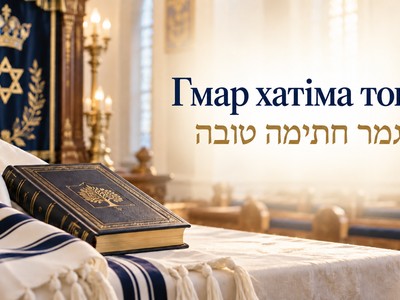
📖 On the eve of Yom Kippur: what they want and what traditions they follow
Holidays
Yom Kippur is a time of teshuvah, sincere prayer, inner purification and reconciliation. On the eve of this holy day, it is customary to ask forgiveness from those whom we could offend by word or deed, give tsedak and prepare for fasting.✨What do you wish for Yom Kippur?✍️"Gmar hatima tovo!"— Wishing you a good final signature in the Book of Life.🌿“Tsom kal!”— light fasting: Yom Kippur fasts for more than 25 hours and involves abstaining from food and drink.It is also appropriate to wish meaningful Yom Kippur, peace in the soul and sincere repentance. But the Happy Yom Kippur greeting is usually not used.🤝Ask for forgivenessBefore Yom Kippur, it is important to sincerely apologize to anyone we may have offended. If damage has been done, it is not enough just to say “I'm sorry” — you should, as far as possible, correct what you have done.The Jewish tradition teaches that Yom Kippur redeems a person's guilt before God, but guilt before another person only after sincere reconciliation with him.🤲Tzedak DatesOn the eve of Yom Kippur, it is customary to increase donations to charity. Tsadaka is an important part of spiritual preparation for the holy day.🍽️Prepare for fastingDuring the day, festive meals are arranged. The last one before the fast is calledseuda ha-mafseket— final meal.May our words be sincere, our apologies be accepted, and our hearts be open to the good.✍️Gmar hatima tova! Let the fast be light and meaningful!