Hanuka 2024/5785
Holidays
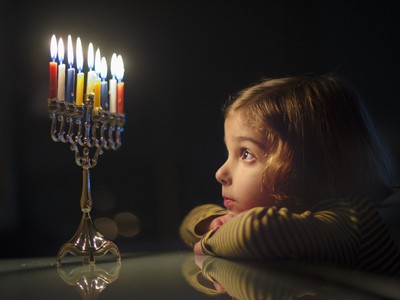
During the celebration of Hanuka, in the third year of a full -scale invasion of Russia into Ukraine, the Jewish community traditionally conducted a car race - the forces of light! A column of cars with mobile khangia drove the streets of Kiev, illuminating not only a city that is undergoing rocket and drone attacks, but also all of Ukraine!

What is that Bi-Sew?
Holidays
Each year has four days, which are its "beginnings". It is the 1st Nisana, the 1st Elula, the 1st Tyshrea and the 15th sewing-that bi-sew (that bi-sew on Hebrew literally-15th seamstress; the numerical meaning of the Jewish letters - fifteen).The 1st Nissan is the beginning of the year in terms of calculating the reign of the kings of Israel, as well as the order of the holidays in the year.1st Elula-the beginning of the year in terms of the age of pets.It is known that every tenth of this year Kosher for food for pets was transferred to the temple; This tithe was called Maaser Bhama. All animals born before the 1st Elul belonged to one year, and the Maaser had to be separated separately; All the animals born after the 1st Elul belonged to the other year, and their Maaser was already a tithe next year.Animals born before the 1st Elul could not be transferred to the temple to redeem animals born after that date-and vice versa.1st Tyshrea-the beginning of the year, which is the day of the court for the whole world; This day, a decision is made to whom life will extend for another year. In addition, the 1st Tyshrea is the beginning of the year in terms of the calculation of years ("sabbatical years", when the land is forbidden to cultivate, and the fruits growing on it are subject to special treatment) and Jovelus ("fifty year" when In particular, slaves were released, and land selected for debt was returned to their initial owners), as well as eagles (three years, during which it is forbidden to use young wood) and Maaserot concerning vegetables and cereals.Thou-sewing is the New Year of the trees, the beginning of the year from the point of view of the separation of Maaserot from the fruits of fruit trees.Maaserot (the parts of the crop transmitted to the temple, priests-Kogan, Levit, poor, etc.) were separated differently in different years. In the first, second, fourth and fifth years, counting from the last shmit, was separated by Maaser Shen (the "second tithe" - a tenth of the crop that had to be eaten in Jerusalem during the holidays); In the third and sixth years - Maaser oni (the "tenth of the poor", which had to be conveyed to the poor). All this is not counting the tubes (the parts of the harvest that was transmitted to the Kogan) and Maaser Richon (the "first tithe", which was transmitted to the Levita).Since (as well as in the case of Maaser Bham) fruits belonging to one year can not "bring" at the expense of the crop of the other year, it is necessary to determine which day is the beginning of the year to calculate the maaserot of fruit trees. Torah determined that they have their own "New Year"-that Bi-Sew.The fruits of fruit trees, which are tied to that bi-six, are considered fruits this year. The fruits that have been tied after that bi-sew will be considered fruits next year. The talmud is considered a fetus that has not yet reached a third of its normal size.Our sages have installed the 15th sewing as a "New Year of trees", because to this day most of the annual rainfall falls, and the fruits have time to tie in the trees; Therefore, the fruits that will be tied after that day will become a "separate blessing."The land to that bi-six is already enriched with rain and winter holidays, so it is the best time to plant trees.

“New Year” - on a weekday
Holidays
Although that bi-sew is called "New Year", it is only one specific question-the question of "age" of fruit trees. Therefore, on this day you can do any work, and it is not reflected in prayers.However, on this day it is customary to bring something from the holiday: they do not read the thang (the mourning part of the prayers), they do not pay the dead, and if it falls on Saturday - they do not read AB Harakamim (an excerpt containing the mention of the souls of the deceased).On this day, the fruits growing in Eretz-Israel are eaten, and they try to taste at least one new fruit that was not yet served on the table this year, and pronounced the blessings of Shehehayan ("Give us to live").At the same time, another "beginning of the year"-the 1st Elula-does not stand out from a number of days. Why? What is "worse" than that bi-seat?The fact is that that Bi-Semat is a day that glorifies the country of Israel, Eretz-Israel, moreover, chosen taking into account its natural features. It is here to this day that the fruiting ability of the Earth seems to be restored, the fruits are tied.Among the seven plants, which are especially famous for Eretz-Israel, five are the fruits of fruit trees and two cereals, as said in Tori (Darima, 8): “Your Lord Your God leads you… In the earth wheat and barley, grape vines, figs and pomegranate, olive oil and date juice. "Therefore, the day when Eretz-Israel begins, gaining strength in the winter, to give the life of a new rich harvest, it should be a joyful day for the Jewish people, and above all-for the Jews of Israel.Enjoying the fruits of Eretz-Israel, we pronounce blessings, the beginning and end of which are devoted to this earth. In it, we ask the one who created it and gave it excellent qualities and wealth, to give it to continue as generously as he gifted our ancestors Abraham, Yitzhak and Yakakov.It should be remembered that the Almighty judges all his creations in the hour of flowering. This means that in that bi-six he judges fruit trees and determines their future, and on this day we need to pray for them.In addition, the Thor itself compares the sons of Israel with trees (therefore, the custom is not cut boys until they turn three years old, just as we do not break the fruits from young fruit trees during the first three years), and, judging by the trees on that day The Most High is indirectly judged by Israel. And Israel is always advised on the day of the court, no matter how the sentence is issued, because he is judged by the Most High - so he is awarded an acquittal.
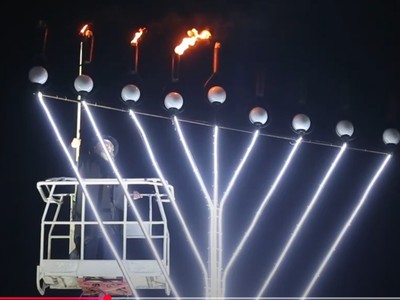
Ignition 4 Hanuka Candles in Babin-Yar2024/5785
Holidays
The sabbat just ended, and our community gathered in Babi Yar to light a fourth hunky candle. This act symbolizes the victory of light over darkness, hope over despair. Babin Yar, the place of tragic events, reminds us of the importance of memory and unity. By lighting the candles here, we honor the dead and affirm our devotion to life and freedom. The fourth candle of Hanuka emphasizes that even in the darkest times there is a place for miracles and revival. May its light bring peace, hope and victory to all Ukraine. Hanuka is just!
Hasidic medicine📖
Holidays
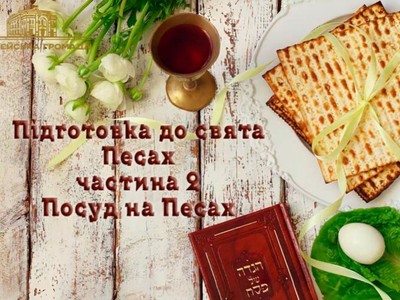
Preparing for Passover:Chatina 2.Tableware for PassoverOrdinary tableware that is used throughout the year absorbs chametz, so it cannot be used on Passover without special purification (halachic koshering). The best option is to purchase separate tableware for Passover. If this is not possible, you must perform the purification according to special rules. To avoid mistakes, you should contact a rabbi.The koshering of dishes should be completed a few days before Pesach, and not on the eve of the holiday.In our synagogue, you can kosher dishes for Pesach.For all questions, please contact the Civic Center at (044) 235.90.82/83



Jewish Instructions: We Prepare for the Holiday
Holidays
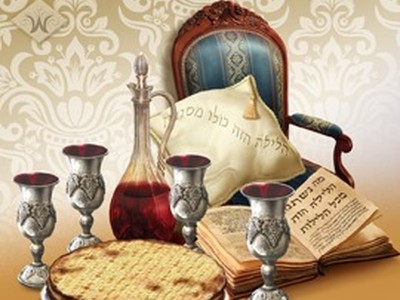
From many aspects of preparation for the holiday of the dogs, we will allocate one here - in the days of the holiday it is possible to light fire only from the already lit fire, so it is necessary to make sure that the day before, the house is lit "economic" (ie not Saturday) candles that can burn over a day. In this case, the economic candle of the next day (on the evening of April 13) should be lit from a candle lit on the eve of the first day (ie, before the onset of darkness on April 12). But her, as it will be Saturday evening, will need to be lit by already burning fire, that is, from a candle lit on the eve of Saturday (on Friday, April 11). Very convenient "daily" candles, that is, candles burning for almost 26 hours. You can buy them in the synagogue (Korzhenko Street (Osipova), 21).WARNING! Similarly, it is worth taking care of candles for the last two days of the feast of Passover (April 19 and 20). In addition, the last day of Pesakh reads a funeral prayer "Izkoir", and on this day those people in which one of the parents has already left this world should light the commemorative candles "Non -Noshomoly" (the same "daily"). To buy them better before the holiday, because in the days of Hol, Jewish shops are likely not to work.Mah NystanDuring the Easter Seder, the famous four questions are heard at the table, which begin with the words "Mah Nystana ѓa-Laila ѓa-Ze?" - "How is this night different from others?"We will not dwell in detail on these questions and even more so on the answers (all our time: there will be a seder - there will be answers), but we will try to find out how the days of the holidays are different from all other days of the year.Well, to be completely compressed then- It is forbidden to eat, in any way use or benefits from hamster or foods containing hamster in all days.- During the evening festive meal, the first two days of the Passover (Seder), you must eat a matu. During the rest of the days of the pass, you can eat a mats, but is not a commandment.- At night, the first two days of a pass need to be told about exit from Egypt.P.S. Traditionally, four questions are asked the youngest of those present on Ceder (or most often, all children present to make anyone offend). If this younger is already solid, he can simply proclaim these questions, but in the case of children in most cases, these questions sound in the form of a song.You can listen to the tune here -http://goo.gl/6gasr.Seder and with what it (on it) eatenThe "Ceder" is called the evening meals of the first two days of the pass, during which the commandments of eating a mats and talking about exit from Egypt are performed. The word "seder" in Hebrew means "order", and this meal is named so because the whole program of the event is strictly regulated and broken down into certain parts, with a total number 15.During Seder on the table must be present:- Mats;- wine or grape juice;- Growing, charred over an open fire chicken neck is a memory of the Easter sacrifice. (It is difficult to call it a menu detail because it is not eaten, but it should be required);- Baice - a whole cool egg - a sign of our mourning for the temple of Jerusalem;- Harosex - a salad -like clay of apples, nuts and wines - a memory of the work of Jews associated with the production of clay bricks;- carp - a piece of onions or potatoes;- Major - bitter salad or grated horseradish - bitter herbs - memory of the bitterness of slavery;- Wasser Saltz (salt water), which is dipped in the carp and egg before eating it.What is Kitness?"Kitniet" (in the pronunciation of European (Ashkenazian) Jews - Kitness) are called rice and legumes. According to the Ashkenazian Jews, the custom in the days of Passover, except Khomets, do not eat kitness. The root of the ban - we fear that since Kitness also make flour and oil, someone will confuse and eat in the days of the pass hamesis.What specifically belongs to Kitnes? Rice, peas, hummus (he is chickpeas, he is a Turkish pea), Hilbe (for us inactive, because it grows far in the south), sunflower seeds, black seeds, mustard, buckwheat, saffron, beans, soybeans, lentils, beans, poppy, lin, lin. Naturally, they do not eat all the derivatives of kitnes. Allowed ground nuts (pecans) and walnuts. Most communities are also allowed to consume cotton oil, although it is necessary to consult a slave for each case.By the way about oil - to use oil, squeezed from kitness (for example, to light), but it is impossible to eat. It is possible to store Kitness and trade it, unlike a hamster, although many prefer to hide Kitness away so as not to confuse ... If the kitness is needed by a child or a sick person, they are prepared in a separate dish."Khamiro"The last step in the search and destruction of a hammer is the "renunciation" of a hammer, that is, to get rid of the rights to possess the homez that has been forgotten, not detected during checking, or where it cannot be reached. To do this, read a special text, which in the first words is called "Kohl Hamiro" ("Everything will all").This text is read twice - in the evening (after searching for a hamster) and in the morning, after its destruction.In the evening (this year - Thursday, April 10) read the following text"All the kvass and all the sourdough that are in my possessions, which I have not seen and destroyed, which I do not know - let them become nothing and draw, like the dust of the earth."In the morning (this year - on Saturday, April 12), the following, "expanded" option:"All the kvas and all the leaven who are in my possession, those I saw both the ones I saw, and the ones I did not see what I destroyMay thy will, our God, and our God's parents, that just as I destroy the hamster in my house and in my possessions, as well as you have destroyed and removed from the face of the earth the spirit of uncleanness, and our evil spirit is removed from us, and let my heart honestly serve you. And all the forces of evil and the forces of uncleanness, let them dissolve like smoke, and you will remove the kingdom of evil from the earth, and all who squeeze your presence in this world will destroy and condemn the same way as you destroy Egypt and idols those days, at this time. Omein. Village! ”.Blessing when igniting candles in the days of the holidayThe candles are lit by a woman, while saying the following blessings:1. Borukh ATO A-Doi-Noi, E-Loy-Oy-Nu, Meleh, Oh-Oil, Asher Kideishon, Bemitsvoys of the Veczotson Lehadlik Neir Schel Youm-Tov! (Blessed you, my God, B ours, the king of the universe, who consecrated us with his commandments and command us to light a candle in honor of the holiday!)2. Borukh ATO A-Doi-Noi, E-Lay-Oy-Nu, Meleh A-Oil, Sheѓeheyon, Veciumon Veѓigion Lizman ѓAzman! (Blessed you, my God, the king of the universe, who gave us life and supported it in us, and gave us the opportunity to live to this time!)The score of the deadOmer is a measure of volume. The commandment to keep a countdown of 49 days (seven full weeks) between the Pesach and Shavuot given to us in the Torah, and since the beginning of the reference coincides with the day when the first fruits of the new crop were sacrificed in the temple (the size of the offering - just 1.1 l), these days were called "counting." According to Jewish laws in the evening (or, in the last case, in the morning), the Jew must pronounce the following words: "Today is the first (seventh, twenty -ninth, etc.) the day of the account of Omer." If more than seven days have passed, they add "twenty -fourth days or three weeks and three days of the Omer." Since every Jew is obliged to count Omer independently, then the question "What is the day of Omer?" It was answered: "Yesterday was such a day," that the one who asks the question himself calculated what day today.Every day, before the proclamation of today, they say blessings: Boruh A-doh-noi, e-lion-go-no, Meleh, Osher Kideshon, Bemitsvoys of Veczaczon Al-Sfiras. (You are blessed, God, B o ours, the king of the universe, who consecrated us with his commandments and command us to count Omer!). If you missed at least one day of a figure, then, continuing to count Omer, you should no longer say this blessing.Omer's accounts have a mourning tint (so -called half -crude days) in the sign of sorrow for 24 thousand students of the rabbi Akiva, who died during this period from the epidemic. In the days of the account, they do not play weddings, do not arrange entertainment and do not cut (the only break-on the 33rd day of the account, on the holiday Lag-Ba-Oymer).This year, Omer will be deducted for the first time on the evening of April 13.Summer time and in any weather ...As you know, the summer will not come with us, but far in the south, but the Jewish calendar is tied exclusively to Eretz-Israel. Accordingly, our prayers for rain and dew relate to exclusively historical homeland, because the dew and rain are here and so enough ...And as for us, as it belongs to the Jewish Easter, the Hydrometeo Center promises little rain. Let's hope they will be mistaken again.Bodikat-honome (Khomets search)On the night that precedes the first Easter night (ie from 13 to 14 Nissan, but this year, due to the fact that this night will be Saturday, everything is transferred to the night of the previous Thursday, from 12 to 13 Nissan, that is, on the night of 10 to 11 April), traditionally conduct a Khvass-Komok search ceremony. The whole family gathers together, is equipped with a bird feathers and a wooden spoon, goes in search of a hamster (many do it with a candle light, but the flashlight and light chandelier will also fit). This is usually done by the father, for the active (how else?) Help of children. They carefully inspect the whole house without avoiding hard -to -reach places (they spend a bird feathers there to pull out crumbs that can collapse there), and found a hamster (crumbs, etc.), sweeps a feathers in a spoon and from there to a bag.Before the ceremony, blessings are pronounced in search of a hamster, but because by this time the house has already been cleaned of all the homet -containing, so as not to pronounce the blessing in vain, the day before in pre -agreed places, bread crumbs wrapped in a piece of paper. The main thing here: do not forget where they were put, otherwise you have to seriously interrupt the whole house!After that, they say the text "Kol Hamiro ..." ("Everything is kvas ...") - a formula for refusal of all the kvass that belongs to the person. "Hamiro ..." is written in Aramaic, but when pronouncing this text, a person (as in the case of any legal document) should fully understand the meaning of written and pronounced, so it is better to read this text in Russian or Ukrainian.In the morning, the "found" of the hamster is destroyed.BIR Khomets (Khomets Destruction)The procedure of destruction of the hamster is traditionally carried out on the day that precedes the Pesakh (this year because the day preceding the Pesakh - Saturday, the hamster will be destroyed twice. For the first time - two days before Pesakh, on Friday, April 11).All found in the house and not sold hamster should be brought to the synagogue and to throw in a fire (usually it is bread crumbs, although it is not forbidden and something more significant). As always, our bonfires, your bread crumbs ...After that, they usually say the text "Kol Hamiro ..." ("Everything is kvas ...") - a formula for rejection of all the kvass that belongs to the person. "Hamiro ..." is written in Aramaic, but when pronouncing this text, a person (as in the case of any legal document) should fully understand the meaning of written and pronounced, so it is better to read this text in Russian or Ukrainian.However, this year the hamster is burned without pronunciation of these words (because we still have a hamster for a Saturday meal, and we do not yet refuse it this Friday, so the formula of refusal is not to be pronounced), but during burning the text "let your will be your will" (you can find in the prayer book).The time to be burned on Friday in Odessa is 11:51, but now it is not the eve of the Passover, but the eve of the forefront, it is possible to burn the hammets later, until the start of the sabbat (but still it is better to try to meet the sages allotted).For the second time, the hamster will be destroyed (but will not be burned!) On Saturday morning, April 12.Having finished the morning meal (the time you can eat a hamster in Odessa - 10:43), all the remaining hamster, including the salt, in which they were immersed in the shack, or wrapped in a film and hidden at home in the place where the solder is stored, or lowered. Having done this, they say the text "Kol Hamiro ..." ("Everything is kvas ...") - a formula for rejection of all the kvass, which belongs to man. As already mentioned, "Hamiro ..." is written in Aramaic, but when pronouncing this text, a person (as in the case of any legal document) should fully understand the meaning of written and pronounced, so it is better to read this text in Russian or Ukrainian.
Let Passover bring joy to every home
Holidays
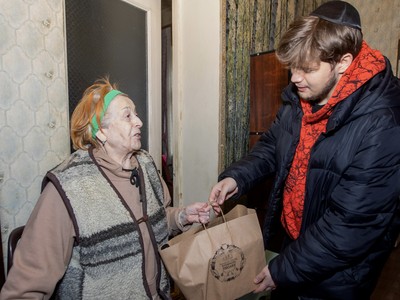
During this holiday season, we take special care of those who need our support now. Our congregation gladly handed over the Passover kits to the faithful who, due to illness or mobility difficulties, were unable to join us in person.We want everyone, regardless of the circumstances, to be able to feel the festive atmosphere and spend Passover in the circle of their people. This is important, because caring for each member of our community is the real essence of the holidays.May this Passover bring health, peace and blessings to every home! 🙏✨