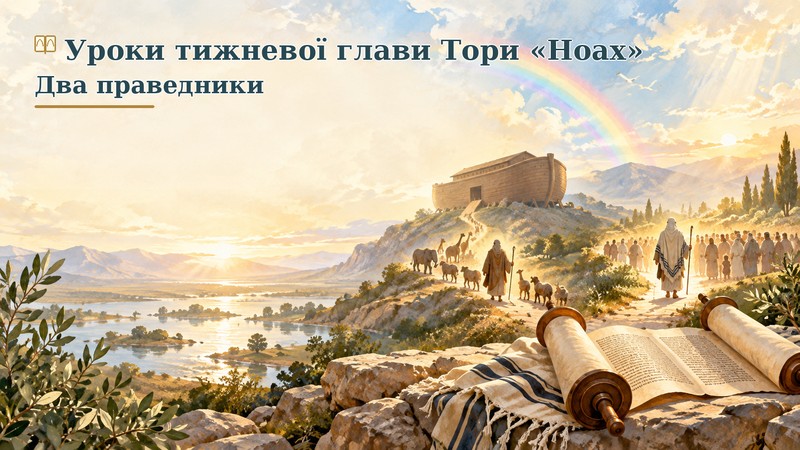
🌊 At the very beginning of the chapter of the Torah "Noah", which tells about the Flood, the words are heard:
“Noah was a righteous man, whole in his generations; Noah walked with G-d.”
Surprisingly, the Torah begins the story of the almost complete destruction of mankind with words about the holiness of Noah. Even more strange is the formula: “I was holistic in my generations.”
🤔 It seems that everything is not so simple with this righteous man. There are sages who believe that Noah “was righteous only in his generations, and if he had lived in the time of Abraham, he would not have been considered righteous.”
Others interpret the opposite: he was righteous “even in his sinful generations, and even more so would he be righteous if he lived among more worthy people.”
⚖️ From the point of view of the second group of interpreters, the picture has a clear contrast: Noah is a complete righteous man, his generation are complete sinners.
But from the point of view of the first group, which cautiously questions the level of Noah's righteousness, the story is much more complicated.
📜 Rabbi Berachiah said:
“Moshe is more beloved of the Torah than Noah. Noah, who was originally called a“righteous man, ”subsequently descended to the level of a commoner — a“man of the earth. ”And Moses, who was originally called an“Egyptian, ”at the end of his life rose to the level of the“man of G-d. ”
🕊 But why are we comparing Noah to Moshe? Why not choose a softer benchmark?
Or Sameach explains that there are only two types of righteous:
some retire, devoting themselves exclusively to the Torah;
others leave their own interests and aspirations for the needs of the community.
👥 People often tend to think of the former as more righteous than the latter. But Noah's story teaches the opposite.
Solitary with G-d and detached from the problems of his generation, Noah remained righteous “in his generations,” that is, he did not reach the level of true, complete righteousness.
Moreover, from the two quotes given in the midrash, we see a certain spiritual decline of Noah — to the level of the “man of the earth”.
🔥 Instead, Moshe, whose personal spiritual improvement seemed to have faded into the background, and his whole life was devoted to the needs of the people — and not always only high spiritual, and sometimes simple everyday needs — rises "from strength to strength."
🌧 The Age of Noah is the Age of Catastrophe:
“And the earth was corrupted before G-d, and the earth was filled with wickedness.”
No, Noah is not silent, as one would expect from a hermit. Sages say that he rebuked his generation and told them:
“Repent, and if you do not repent, the Almighty will bring a flood upon you.”
❓ So how do commentators reproach Noah? And why hasn't his sermon been heard by a generation?
The 🪵 Midrash of Tankhuma tells an amazing story:
“When the Almighty commanded Noah, 'Make yourself an ark out of cedar wood,' Noah went and planted the cedars, cut them down, sawed them, and made an ark out of them. Contemporaries asked him: “Why these cedars? Why this ark?”
Noah answered them, “The Almighty is going to bring a flood to the earth, and He has commanded me to make an ark so that I and my family can be saved.” And his contemporaries laughed at his words. "
🏡 Noah does not go to people — he only answers their surprised questions. He does not go out to the people, but works modestly near his house, cutting cedar logs.
Noah was not completely righteous not because he did not obey the order of the Almighty. On the contrary, we know for certain that he carefully fulfilled all the commandments of the Creator.
💔 But it seems that his heart did not really hurt for his neighbor, for humanity, for the whole world. Sinners caused him not so much pity as righteous anger.
Therefore, he warned them, but did not save them.
I blamed him, but I didn't persuade him.
Moshe behaves 🕯 differently when the Almighty said to him:
“Now leave Me, and My wrath will burn against the people, and I will destroy them…”
Moshe replied:
“If you do not forgive their sin, then erase me from Your Book.”
⚖️ And just as the two types of righteous are different, so is the result of their activities:
noah's generation is doomed to death,
generation Moshe — receives forgiveness.
🌱 This applies not only to the righteous of the "higher league", but also to ordinary people like you and me.
Notes:
Pentateuch, book of Breishit, 6:9.
Ibid., 9:20.
Pentateuch, Book of Shemot, 2:19.
Pentateuch, Book of Devarim, 33:1.
Talmud, Tractate Sanhedrin, 108.
Pentateuch, Book of Shemot, 32:32.
source: chabad.org