📌Topic of the day: Choosing a Jewish name
Community
Choosing a Jewish name is a very important step, because the name affects the fate of a person. What advice does tradition give on choosing a name? It is the custom of Ashkenazi Jews to name a child after a relative who is no longer alive, with the hope that the child will inherit all the good qualities of the one after whom it is named. Another reason to name a deceased relative after him is the exaltation of his soul. And among Sephardic Jews, it is customary to name children after living relatives. It is common to give the names of righteous people from the Tanakh (Torah, Prophets and Scriptures). Thus, boys are often named after their forefathers — Abraham, Isaac or Jacob, in honor of the prophets and kings of Israel — Sha 'ul, Shmuel, David, Shlomo, Moses or Aaron. Girls are named after their foremothers — Sarah, Rivka, Rachel or Leia, as well as in honor of other righteous women mentioned in the Tanakh, for example, Dvora, Yocheved or Khan. There is also a custom to name children in honor of the great rabbis and sages of the Torah, for example, Israel-Meir — in honor of Hafez Chaim. You can choose a name from the weekly chapter of the Torah, which was read in the week when the child was born, or in honor of the heroes of the holiday, if the birth fell on him: for example, Mordechai for a boy or Esther for a girl born in Purim. Usually, boys are given a name during circumcision on the eighth day, and girls on the first Saturday after birth, when the Torah scroll is taken out in the synagogue. For many of us who want to change our name to a Jewish name, an additional question arises — how to “combine” a non-Jewish name with a Jewish one? Some translate their name into Hebrew literally — for example, "Mila" corresponds to the Hebrew "Naomi".Others choose a Hebrew name in tune: Anatoly — Nathan, Yuri — Uri, Viktor — Avigdor, etc. In any case, choosing a name is a very responsible step. A person's name influences their destiny and character traits, so this question should be addressed to your local rabbi. Source:https://toldot.com
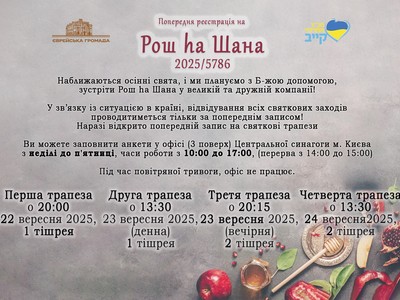
Rosh Hashanah Festive Dinners Appointment
Community
WARNING!Pre-registration for holiday meals is openRosh Hashanah inKyiv Central Synagogue🕍You can fill out the questionnaire for participation in meals at the link:👉 https://forms.gle/StT9VaVZZp3cyC2y9And also — in the synagogue office (3rd floor).Office hours:👉sunday – Thursday:from 10:00a.m. to 5:00p👉Friday10:00 AM - 4:00 PM☝️SaturdayWeekendTELEPHONE☎️ (044) 235-90-82 / 83

Our dates: 14 Elul
Community
OUR DATES*14 elul 5693year (September 5, 1933) — Rabbi Yosef-Yitzhak moves to Warsaw.After his expulsion from the Soviet Union, Rabbi Yosef-Itzhak (the sixth Lubavitcher Rebbe, Rabbi Rajac) settled in the capital of Latvia, Riga, where he lived until 1933, when he decided to move to Poland.*14 elul 5702(August 27, 1942) — Yorzeit (anniversary of the departure from this world) Rebbetzin Chai-Mushka Gorenstein.The youngest daughter of the fourth Lubavitcher Rebbe during the Second World War was taken to the Treblinka Nazi concentration camp. According to eyewitnesses, on this day, Rebbetzin Khaya-Mushka, along with other Jews sentenced to extermination, was burned in the ovens of Treblinka.source: chabad.odessa

Our dates: 15 Elul
Community
*15 elul5657 (September 12, 1897) — Rebbe Sholom-Dov-Ber founded the Tomhei Timimim yeshiva in Lyubavichy.During a luncheon hosted on the occasion of the wedding of his son Rabbi Yosef-Yitzhak, Rabbi Sholom-Dov-Ber (the fifth Lubavitcher Rebbe, Rabbi Rashab) announced the founding of a yeshiva that would combine Torah studies and Hasidism.Two years later, in 5659, on the night of the feast of Simhat Torah, Rabbi Rashab said: “The yeshiva, founded by the grace of the B ha higher, has not yet been named. And now I call her “ TomheiTmimim” (“Supporting the Clean”), and the students who study in it and behave in accordance with her spirit are called tmimim.”In the 100 years that have passed since the creation of the first Tomhei Timim, similar educational institutions have appeared in many countries of the world, and traditionally the academic year in these yeshivas begins with 15 elul. After the collapse of the USSR, the "Tomheitmiivska" turn finally reached the countries of the former Soviet Union.

Our dates: 17 elul
Community
*17 elul1656 (2105 BC) — Noah sends a pigeon to scout.After the unsuccessful reconnaissance flight of the crow, Noah released a dove from the ark. The pigeon, too, could not find a place to land and returned to the ark with nothing, and Noah had to postpone the next attempt for seven days.*17 elul5503 (September 5, 1743) — The wedding of the parents of Alter Rebbe.On this day in the city of Liozno, Rabbi Boruch and Rebbetzin Rivka became under the chuppah, and exactly two years and one day later a boy was born to them, who was called Schneur-Zalman.*17 elul5747 (September 11, 1987) — The Rebbe lays the “cornerstone” for the expansion of the “House of the Rebbe in Babylon (that is, in the Diaspora).”The Rebbe announced the need to build new buildings — Torah buildings, Ministry and charity (this is an allegorical statement, since the Pirkei Avot treatise says that the world stands on three things — Torah, service and charity). At the same time, it was decided to build a new expanded building of the Great Yeshiva.source: chabad.odessa

Our dates: 18 elul
Community
*18 elul 5369(September 17, 1609) — Yorzeit (anniversary of the departure from this world) Rabbi Yehuda-Liwa ben Bezalel (Maharal) from Prague.On this day, the jorit of the outstanding thinker and sage of Torah, Kabbalist and the perennial leader of the Prague Jewish Community, Rabbi Jehud-Liva, also known as Maharal, is celebrated. Rabbi Eguda was the descendant of King David, and among his descendants - the founder of the bribery Alter Rebe. Maararal was in a good relationship with the German Emperor Rudolf, who appreciated his knowledge and wisdom, and Rabbi Eguda has repeatedly used this friendship to protect the community from harassment. In addition, Rabbi is known for creating a golem (a figure of clay he enlivened using Kabala's knowledge) designed to protect Prague Jews from often pogroms at that time.Note: In the famous Strugatsky novel "Monday Begins on Saturday" there is a chapter "Vanity around the Sofa", where the sofa with the famous White thesis, which belonged, as written in the book, to the court alchemist of Emperor Rudolf Leo Ben Bezalel, is active. So the "court alchemist Lion" is our Rabbi Yehuda-Liwa ben Bezalel. And what else could it be called in a Soviet book in the 40th year of Soviet power?*18 elul 5458(August 25, 1698) — Birthday of Rabbi Yisrael Baal Shem-Tov (Besht).*18 elul 5458a son was born to the wise and righteous Rabbi Eliezer and Rebbetzin Sarah from the village of Okup.At the time of his son's birth, his father was a hundred years old and his mother was ninety. The boy was born unusual: at the age of three months, he was already walking and talking. When he was a year and a half old, his father died, having ordered his son to fear no one but the Almighty before his death. On the anniversary of his father's death, his mother died, and the townspeople took the orphan under their care.*18 Elul 5489(September 12, 1729) — the prophet Ahiya from Shiloh opens Baal Shem-Tov and becomes his teacher.Rabbi Israel himself said: "...On the day when I turned 26 years old, 18 Elul 5489, in the city of Okup, at midnight, my teacher and mentor Ahijah from Shiloh opened to me. The first lesson was devoted to the weekly chapter "Breishit".The prophet Ahijah studied with Besht for 10 years, revealing the secrets of the Torah to him.*18 Elul 5494(September 16, 1734) — Besht's Disclosure.Ten years after the beginning of his studies under the guidance of the prophet Ahijah and at the insistence of the teacher Rabbi, Israel opened up to the world as Baal Shem-Tov (in Hebrew it means "Lord of the Good Name", that is, a connoisseur of bondage).Prior to this, Rabbi Israel had refused to reveal himself for six years, for which he was subsequently deprived of 6 years of his life.*18 Elul 5505(September 15, 1745) — Birthday of Alter Rebbe.Although 10 months had passed since the wedding of Rabbi Borukh and the Rebbetzin of Rivka, they had no children and decided to go to Baal Shem-Tov (Beshtu).Every year, on his birthday, 18 Elul, Besht arranged a meal and uttered the words of the Torah. During the meal, Rabbi Baal Shem-Tov said to Rabbi Boruch: “Just until this time in a year you will be hugging your son.”On Wednesday, 18 Elul 5505, a son was born in Rabbi Borukh and the Rebbetzin of Rivka, who was named Schneur-Zalman, in honor of his paternal grandfather.*18 Elul 5508(September 11, 1748) — Opcherish (first haircut) Schneur-Zalman (future Alter Rebbe) Baal Shem-Tov.When Rabbi Boruch, the father of Alter Rebbe, arrived in Besht at the bottom of Rosh Hashanah in 5508, he told the teacher about his intention to bring his son to him when the third birthday of the baby will need to be first cut. Rabbi Besht gave his consent.*18 Elul 5508, Rebbetzin Rivka and her sister-in-law, Rebbetzin Dvo-Leya, together with the child came to Medzhybizh. Besht cut the child's hair and told the women to immediately go back home, without talking to each other about the place where they had been. All the way the baby asked what kind of Jew cut his hair, to which his mother answered him: "It's Grandpa."*18 Elul 5573(September 13, 1813) — Miteler Rebbe settles in Lyubavichy.After his departure from this world, Alter Rebbe, his son — Miteler Rebbe — spent several months in Kremenchug. The Ukrainian Hasidim asked the Rebbe to settle in Ukraine, but the Hasidim of Belarus also sent delegations to him with requests to settle among them. In the end, the "Belarusians" took the mountain and, after the feast of Shavuot, Miteler Rebbe went to Belarus.For 102 years, the Lubavitchers were the residence of four generations of Chabad leaders and the center of Hasidism for hundreds of thousands of Hasidim in Russia and other countries of the world.*18 Elul 5657(September 15, 1897) — the beginning of classes in the yeshiva "Tomhey-Tmimim" in Lyubavichy.As noted above, the Tomhei Tmimim yeshiva was founded on 15 elul, however, the actual start of classes fell on 18 elul. Here is what the sixth Lubavitcher Rabbi, Rabbi Yosef-Yitzhak wrote about this: "On the day of the Tov of the month of Elul (tov — "blessing" (Hebrew), the gimatria of this word corresponds to the number 17, that is, Tov of Elul — 17 Elul), my father, the fifth Lubavitcher Rabbi, chose the first 18 students and handed them over to the famous Hasid Rabbi Shmuel-Grunem Esterman from the city of Zembin, in order for him to teach Hasidism.And 18 elulah, during my meal "Sheva brahot" (wedding meal), my father said: "Today is 18 elulah, a significant day on which Alter Rebbe and our teacher, Baal Shem-Tov, were born. And on this holy day, I found a yeshiva <...> a yeshiva that will give students who have self-sacrifice in the nameof the Torah and Service in the way of Hasidism...".source: chabad.odessa

Question to the Rabbi:If meat and cheese have touched each other, can they be consumed?
Community
Questions:If meat and cheese have touched each other, can they be consumed?Answer:If both products were hot, it is forbidden to eat them. If only one of them was hot and the other was cold, it is enough to cut off a thin layer at the point of contact, the rest can be consumed.Questions:Themeat pan accidentally touched the cheese. What is the law in this case?Answer:If both the pan and the cheese were hot, both become forbidden. If one of them was hot and the other was cold, you need to cut off a thin layer of cheese that touched the pan. The rest of the cheese and the contents of the pan can be consumed. The pan itself is considered forbidden.To dig out the pan, you need to wait 24 hours, and then pour boiling water over its outer surface.Questions:If the meat pan touched the dairy one standing next to it, how should it be done in this case?Answer:If the outer surfaces of both pots were clean and dry, then the contents and the pots themselves remain allowed even when they were hot.From the series "Kashrut in a Non-Kashrut World"Author: Rabbi Eliezer WolfSource:https://toldot.com/articles/articles_5121.html

Slichot: halachic guidelines
Community
S'lichotread for at least four days. Therefore, if the first day of Rosh Hashanah falls on a Monday or Tuesday, they start reading them a week earlier.S'lichotdo not begin to read until the "minyan" is collected. If circumstances do not allow waiting, it is still allowed to start reading the sliphones, and the chazan pronounces the first "Kaddish" later, already in the middle of the sliphones.S'lichotread while standing; one who finds it difficult to stand must at least stand up to proclaim the “Thirteen Images of Divine Mercy” (Shemot 34:6–7). Anyone who reads slimy words without “minyan” has no right to recite these passages at all; in addition, he is not allowed to read those piyuts that are not written in Hebrew, but in Aramaic.The part of the slurs that corresponds to "Nefilat apayim" in "Tahanun" is also read standing without covering the face. During the reading of the confession ("Ashamna"), they beat themselves in the chest on every word.To read blindness and prayers in the days of the Last Judgment, you should choose Khazana, who has a reputation of a pious person who loves Torah and is known for his good deeds. It is desirable that he be not under 30, married and had children. The same requirements are put forward to the one who in Rosch ha-shot in Shoafar, as well as to the one who suggests the order of rush. However, the main criterion for the choice of Khazan is the desire of most of the priests. It is better that Khazan is not the most worthy of all if it helps to avoid controversy and discord in the community.The one who is in Seven-day mourning after the death of a close relative does not visit the synagogue to read the blind, except for the evening before Rosh Ha-Shan when he is allowed. The one who is in the annual mourning after the death of his father or mother may be Khazana in Rosh Ha-Shan and Yom-Kipur only if there is no more worthy of him in Minajan. Anyone who is in thirty days after the death of other close relatives may be Khazana in Rosh Ha-Shan and Yom Kipur only if he usually performed this function in previous years. But if the synagogue is different, just as worthy, it is better to choose it. Both who are in a thirty -day and one who is in a month of mourning can be read.Hazan and the one who tricky in Shofar should devote as much time to Rosh Ha-Shan as much time to study the prayers, piuts and the laws of tricky in Shofar. It is also desirable that these days they avoid everything that can cause ritual impurity. In addition, at this time, they should study works on ethics and Hasidism, which encourage a person to serve the Almighty and inspire reverence and fear of the creator, who judges the world he created in Rosh Ha-Shan. If there is only one person among the priests who can trick in Shofar, but it is not distinguished by a special knowledge of the Torah, it is necessary to make sure that the one who tells her the order of tricky is a connoisseur of Torah, especially the laws concerning tricking in Schofar. Such a person will be able to check whether Shofar is suitable for the commandment, as well as to solve possible problems during the rush.Although "Tahanun" is not read on the eve of Rosh Hashanah, it is still spoken on the 28th of Elul at the "Minhu". At the end of the slurs that are read the night before Rosh Hashanah, a section similar to Tahanun is read anyway, even if it has already spread.Source:chabad.org
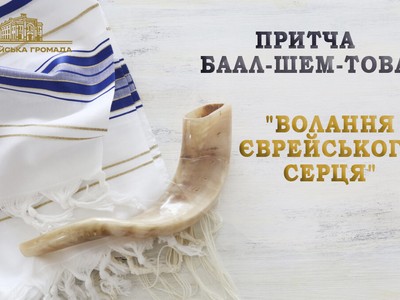
Parable of Baal Shem Tov "The Cry of the Jewish Heart"
Community
Baal Shem Tov once told such a parable about the sound of a shofar, which is trumpeted on the day of Rosh Hashanah.The Tsar's son spent many years in exile, far from his native home. When he finally returned — overgrown, dirty and torn — no one recognized him as the long-lost prince. But when he saw his father, a cry burst from his heart: “Father! Father, save!” The king recognized his son's voice and, deeply moved, hurried to meet him.Similarly, the soul of a Jew is in exile, far from his father's house. Descending from the Throne of Glory, she is absorbed into a material body, rude and dirty with sins. But on the day of Rosh Hashanah, the Jewish soul is inflamed with a passionate desire to return to the Almighty and then says from the depths of his heart: “Father! To our Heavenly Father, save us!”This is the meaning of the sound of the shofar — the cry of the Jewish soul coming from the depths of the heart.📌Essence of cryingAs the teachings of Hasidism explain, the main aspect of the cry is not its content, but its very essence, the very fact of conversion. When a person cries, there are two sides: the cries themselves and the meaning they want to convey through them. In our case, the main thing is not the meaning that the Jew puts into his cry, but the cry itself.In terms of meaning and content, there may be differences between people: everyone has their own words, thoughts, desires. But from the point of view of the essence of the cry — all are equal. Everyone turns to G-d and seeks to return to Him. Someone yells loudly, someone so that no one hears it, but everyone turns to the Creator.📌Blessing is not in vainThis cry, which is expressed in the sound of a shofar, is raised infinitely high and accepted by the Almighty. The proof is the blessing we say on the day of Rosh Hashanah: “Blessed are You… that with mercy You hear the sound of the shofar of Your people Israel.”After all, there is a law of blessing: bracha is spoken only when there is absolute confidence in the need to say it; when there is doubt, the blessing is not pronounced. Therefore, if the Halakhah attributes to uttering the blessing that the Almighty hears the sound of the shofar of the people of Israel, this indicates that this voice is really heard and accepted by the Creator.Rabbi Levi-Itzhak from Berdychiv gave such an example. The child asked the father for an apple, and he did not give it to him. Then the child quickly uttered the blessing to be said before eating the fruit: “Blessed is… that which creates the fruit of the tree.” And his father had to give him an apple so that the blessing would not be said in vain. In the same way, the Jewish people bless the Almighty, saying that He hears the sound of the shofar of the people of Israel with mercy — and the Almighty “must” do so so that the blessing is not in vain.And if this is the behavior of an earthly father, a man of flesh and blood, who did not want to give the child an apple, then all the more so does the Almighty, who wants to bestow a generous hand on the Jewish people. All you have to do is ask Him. Therefore, we can be sure: when we smoke in a shofar on the day of Rosh Hashanah, his voice reaches the Creator and is received by Him with mercy, and He gives each of us a “good and sweet year”!From the works of Lubavitsky Rebbe; short adapted summarySource:chabad.org

Rosh Hashanah Prayers & Meals
Community
Recording for festive mealsRosh Hashanah inKyiv Central Synagogue🕍You can fill out the questionnaire for participation in meals at the link:👉https://forms.gle/StT9VaVZZp3cyC2y9And also — in the synagogue office (3rd floor).Office hours:👉sunday – Thursday:from 10:00a.m. to 5:00p👉Friday10:00 AM - 4:00 PM☝️SaturdayWeekendTELEPHONE☎️ (044) 235-90-82 / 83
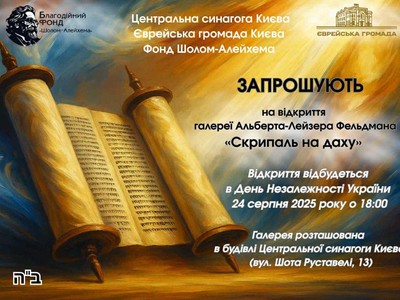
Visit to feel the atmosphere of creativity Art Gallery
Community
✨The art gallery Albert Leyzer Feldman "Fiddler on the Roof"🖼Days of work:sunday to Thursday⏰Hours of Operation:12:00 – 19:00🚪Address:24 Esplanadna Street🎟Free admissionArt that inspires and opens up new horizons — visit to feel the atmosphere of creativity!