
Rosh Chodesh - the beginning of the month
Community
Tomorrow is the first day of TishreiRosh Hashanah - the First Tishrei - is also a young man's day.It is said: "Trumpet this month in the shofar of the young man, on the day of our holiday."In connection with these words of the Torah, it is customary to quote the following words of the Tanakh: “… on the day of the young man He will return home” (Misha 7).These words contain a hint of the Throne on which the Almighty sits on this day, the Day of Judgment, because the word "throne" - kisi - is pronounced in the same way as the word "hide". The moon is only "hiding" in the young man. We know that the Almighty is merciful to all of us on the Day of Judgment and also “hides” our guilt.Many meaningful aspects of this day are in the concealment: “Trumpet this month into the shofar of the young man (the day of the concealment of the moon)…”“What holiday is the Moon hiding on?" The Talmud asks. "Rosh Hashanah." (Beitsa, 15)All other holidays fall on the second or third week of the month, when the moon is full or almost full in the sky, and only Rosh Hashanah is young.The Talmud likens the Jewish people to the moon, so that, according to the calendar, it seems to shine on holy holidays; however, in Rosh Hashanah, it tries to look as modest as possible and diminishes its greatness by trembling on the Day of Judgment. On this day, the Almighty turns a blind eye to his sins and gives him forgiveness. (Psikta Raba, 40)The significance of the Day of Judgment itself, which falls on the first Tishrei, is also hidden — Rosh Hashanah is not even mentioned in the Torah explicitly as the Day of Judgment. The Torah wanted a person's fear of sin to persist throughout the year, and he had no reason to postpone repentance to Rosh Hashanah - the day when he would appear before the Court.Another reason for the concealment is that the date of the Day of Judgment must be securely hidden from Satan, who accuses the Jewish people, and they must not know the judgment before it begins. Therefore, the month of Tishrei is the only one whose coming is not blessed in the synagogues on the last Saturday of the previous month.

Preparing for Rosh Hashanah: Breaking the Vows
Community
Termination of the vows on the eve of Rosh HashanahOn the eve of Rosh Hashanah, it is customary to break the vows during the year to appear before the judgment of the Almighty cleansed of grave sin: unfulfilled vows (including those simply forgotten and those that remained unfulfilled). This ceremony takes place after the completion of the morning prayer.Since our vows can only be broken by a Torah scholar, it is necessary to go to him and tell him what vows we have taken, and explain that if we knew that we would not be able to fulfill them (or there is another reason for which we repent) in accepting them, we would not take them upon ourselves. Then the Torah scholar tells us three times, “You let go.” The essence of this assumption is that these promises are recognized as data erroneously.A request to break a vow must be made in front of three (or more) people. For although a rabbi who is a scholar of the Torah, in principle, has the right to break the vows alone, three ordinary Jews also have this right. And nowadays, we believe that no one person has the right to break promises alone.In practice, on the eve of Rosh Hashanah, each person chooses three others for himself and tells them that he repents of all the promises he made during the year. They say to him, “You're free to go.”There is a formula for this ceremony, which is given in the prayer books. This formula sets out in detail all the problems associated with vows and how to break them.sourcehttps://toldot.com/
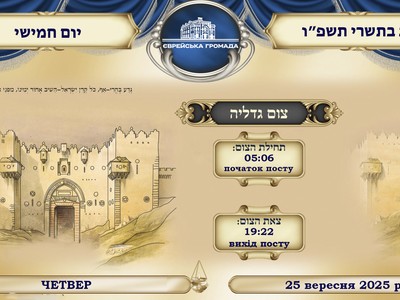
Ghidalya's Fast
Community
The fast of Hedalya is a Jewish fast that comes the day after the two days of Rosh Hashanah,Gedaliah (Gedaliah, Gedalyau) was the name of the governor of Judea, the actual ruler of the country in the last days of its existence, shortly before the Babylonian exile. As a result of the conspiracy, the governor Gedalya was killed. With his death, the last spark of Jewish statehood in Eretz Israel was extinguished, many Jews were killed, and the rest were expelled from the country by the Babylonians or fled from it themselves. In memory of these tragic events, our sages established the post of Hedalya. Fasting on this day begins early in the morning with sunrise, and the fast of Gedaliah ends in the evening with the release of the stars.

Ten days of repentance. Part 1.
Community
The first ten days of the month of Tishrei, the Terrible Days, have another name – Ten Days of Repentance.👉The first name indicates that beginning with Rosh Hashanah, when the Heavenly Court sentences every living creature on earth, and ending with Yom Kippur, when this sentence is affirmed, the whole world is gripped by fear of the Almighty.👉The second name indicates that these ten days are the most suitable time of the year for repentance. The Prophet says, “Seek G-d while He may be found, call upon Him while He is near; and to the Almighty our God, for He forgives many things” (Isaiah 55:6,7).Our sages explain that it is about the Ten Days of Repentance: in these days the Almighty, as it were, comes down to us, making Himself especially close and accessible.☝Therefore, each of us these days is obliged to once again analyze our behavior, realize our actions and make a note.

10 Days of Repentance, Part 2
Community
Anyone who wants to fulfill the commandments as carefully as possible, already within Ten days of repentance buys an etrog, lulav and adas for arbaa minim (see below, 128:1), so that another merit is credited to him before Yom Kippur - preparation for the fulfillment of this important commandment.On all days between Rosh Hashanah and Yom Kippur, the Shaharit and Minh at the end of Tahanun read the full text of "Avina, Malkaina" before the open aron kodesh, with the exception of "Minhi" on Friday and prayers on Saturday (Shabbat) teshuva) and on the eve of Yom Kippur (since "Avina, Malkaina" is not read on days when "Tahanun" is not said).The Sabbath between Rosh Hashanah and Yom Kippur has two names.*The first – Shabbat Shuva – she received the first words "Aftari", which is read on this day: Shuva, Israel! (“Return, O Israel!”) (Hoshea 14:2).* The second is Shabbat teshuvah, because this Saturday is one of the Ten Days of Repentance. The second name implies that although on the Sabbath we do not read prayers in which we mention our sins, but this Sabbath it is necessary to carry out teshuvu, only a special, "Sabbath teshuvu", that is, to strive to rise to a higher spiritual level not from the abyss of sin, but already in the sphere of holiness.It is customary to light a special candle before the Sabbath, which burns all day long, so that we can shine the "light of teshuvah".The most respected person in the community is summoned to read the aftara on Shabbat teshuvah. Minhu reads Tsidkath even if the next day is the eve of Yom Kippur. Eyelashes, etc. are not read at the end of this Saturday, unless Yom Kippur coincides with the following Saturday.It is not customary to consecrate the moon until the end of Yom Kippur - except that the weather raises fears that it will not be possible to do this on the night after Yom Kippur.

Ten days of repentance. Part 2.
Community
10 Days of Repentance.☝It is recommended these days to strictly observe those details of the laws of the Torah in which Jewish law sometimes allows for relaxation. For example, someone who eats bread baked by a non-Jewish baker throughout the year must only eat bread baked by a Jew during the Ten Days of Repentance.The logic here is simple: because these days we are asking the Almighty to do more for us than we deserve - so we should do more for the Almighty than the letter of the law requires.👉The slichot of Gdalya's Post is not cited in cidur (like the slichot of other posts), but in a collection of slichots read on the eve of Rosh Hashanah. Since in the Post of Gdalya the slichot is read not before the Shaharit prayer, but in the middle of it - in the Tahanun, they skip a part similar to the slichot before Rosh Hashanah, and read only those parts that are similar to the corresponding parts of the slichot for other posts.👉Namely: do not read "Ashrey", the entire chapter after the first "Kadisha" (quotes from the Tanakh about the greatness and mercy of the Almighty), "Slakh Lana", drink "Az Terem", "El Erech Apaim", confession of sins ("Ashamna"), the 6th chapter of the book of Tegilim together with the introduction to it ("Vayomer David..."), and at the end of "Tahanuna" they read the full text of "Avina, Malkaina" with some changes specifically for the Ten Days of Repentance, after which the khazan pronoun pronounces "Hatsi Kadish" (and not "Kadish Shalem", as in the slasht before Rosh Hashan).

Preparing for Yom Kippur
Community
📖Yom Kippur — Day of Atonementis the most important holiday in the Jewish calendar.▪️ PeriodTen Days of Repentancebegins with Rosh Hashanah and reaches its peak on Yom Kippur.▪️ It is the day of atonement for sins that man has committed against G-d.▪️ The trial begins on Rosh Hashanah and the final verdict is delivered on Yom Kippur.🚫Yom Kippur ProhibitionsOn this day, we refrain from:️1? Food and drink.️2? Bathing.️3. Use of cosmetic oils.️4? Wearing leather shoes.5️? Marital intimacy.📜 The Torah says (Vaikra 16:31):“That you may humble your souls…”🌿Spiritual content🔹 Yom Kippur is a day when a person moves away from everyday life and devotes all the strength of the soul to purification and repentance.🔹 The goal is to atone for the sins of the past year and rise to a new, higher spiritual level. 📖Sefer HaHinuh (Commandment 313)explains:“God's goodness is that He has set aside one day in the year when people can atone for their sins through repentance.Therefore, we are commanded to fast: food, drink and other pleasures pull towards the material and prevent the soul from seeking the truth.This day is given to strengthen the soul so that it becomes worthy to receive the forgiveness of the Almighty. ”
📌Preparing for Yom Kippur
Community
One of the most important Jewish holidays is approaching - Yom Kippur (Judgment Day) - the day of repentance and fasting, when, according to religious tradition, the entire previous year is summed up and the sentence for the new year is pronounced.Yom Kippur Laws⚖️☝️All the laws of Yom Kippur come into force at the beginning of sunset on 1 October/9 Tishrei.☝️Yom Kippur is a day of strict fasting; on this day it is forbidden to wash and use cosmetics, as well as to wear leather shoes, as it is a symbol of luxury.☝️If an experienced doctor believes that it is dangerous for the patient to fast, he must obey and break the fast, following the instructions of the rabbi.☝️It is customary to wear white clothes on this day, which symbolizes purity from sins. Jews are like sinless angels who do not need to eat, drink, or take care of their bodies.☝️It is customary to spend Yom Kippur in a synagogue, because prayers take almost all day. On this day, the memorial prayer Izkor is read.
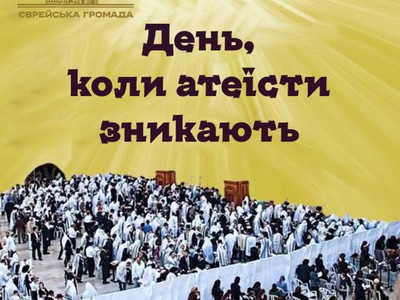
Yom Kippur is the day of Atonement and Forgiveness.
Community
Do you deserve another year of your life?Yom Kippur is the day of Atonement and Forgiveness. It is on the 10th Tishrei that the Almighty weighs our actions and pronounces the final verdict.On this day, we strive to get as close as possible to the Almighty, we repent, pray. Yom Kippur is both a heavy fast (more than a day) and a solemn holiday.This is a day of true and complete unity between the Creator and the Jewish people.Even though we break promises, we take on something new and important. Every year, more and more Jews seek to study the Torah, traditions, commentaries of the wise, and much more.

Our dates: 21 elul
Community
21 elul 5524 (September 18, 1764) – Yorzeit (anniversary of the departure from this world) Rabbi Jonathan Eibeschitz from Prague.Rabbi Jonathan ben Nathan Nata Eibeschitz (sometimes spelled Eibenschütz, Eibenschütz and Eibeschütz) was born in 1690 in Krakow, the son of the descendants of the famous Rabbi Nathan Neta Shapiro (among his descendants Rabbi Pinchas of Korets) and studied in the yeshivas of Poland, Vienna and Moravia. After that, Rabbi Jonathan led the yeshiva in Prague, was the chairman of the Prague court and the rabbi of the French city of Metz, as well as the rabbi of the "Three Communities" — the cities of Altona, Hamburg and Wandsbeck.Rabbi Jonathan gained fame as a cabalist and a brilliant orator-preacher, as well as one of the most prominent Talmudic scholars of his time, who did a lot for the development of pilpool, one of the methods of analyzing Talmudic texts.Rabbi Jonathan passed away in 1764. He is buried in the famous cemetery of the Jewish quarter of Prague.21 elul 5699 (September 5, 1939) — Rabbi Yosef-Yitzhak moves from Otwock to Warsaw.On September 1, 1939, the Second World War began with the invasion of Poland by German troops. After its beginning, the sixth Lubavitcher Rabbi Yosef-Yitzhak (Rabbi Rajac) decides to leave Poland and return to Riga.21 elul (September 5) at 3 o'clock in the afternoon, Rabbi Rajac left Otwock and headed for Warsaw. Leaving the city where he had arrived four years earlier, Rabbi Yosef-Yitzhak cried.On the way to Warsaw, the Germans covered them with their fire. All the passengers left the cars, hiding at the edge of the road, but the Rebbe told his family that there was nothing to be afraid of, “since the Father is now working for us.”When they arrived in Warsaw, it turned out that because of the war it was impossible to leave for Latvia. The Rebbe stayed in Warsaw until December 2 (December 14), when he miraculously managed to escape to Riga.21 Elul 5700 (September 24, 1940) – The inauguration of Rabbi Yosef-Yitzhak center of the Chabad movement in the United States.On such an occasion, as befits the Hasidim, a paint brand was arranged. The headquarters of the movement was the Seven Seventy building — building number 770 on Brooklyn's Eastern Parkway.Source:chabad.odessa

Our dates: 22 Elul
Community
*22 elul5177 (September 3, 1417) – Yorzeit (the anniversary of the departure from this world) Rabbi Jacob Molino (abbreviated Maaril), nicknamed the "father of Ashkenazi customs."Rabbi Yaakov, born in 1365, was the best disciple of Rabbi Meir of Vienna and is considered the greatest legislative (halakhic) authority of all European (Ashkenazi) Jewry of the time.By this time, the rabbis had two "scientific schools" — Ashkenazi and Sephardic (German and Spanish) — that used different methods to make legislative decisions. Both methods were based on traditions derived from a chain of generations, and Rabbi Maaril became famous as a zealous defender and guardian of Ashkenazi traditions, including even the most insignificant customs, such as the melodies of festive prayers.Source:chabad.odessa

Our dates: 23 elul
Community
*23 elul1656 (2105 BC) — A pigeon brings an olive branch in its beak.On the 301st day of the Universal Flood, Noah sends a pigeon for a second reconnaissance. This time the pigeon flew all day and only returned in the evening with an olive twig in its beak. From this, Noah realized that the water had receded, some vegetation was already rising above the water, so that soon it would be possible to complete the voyage.*23 elul5697 (August 30, 1937) — Yorzeit (anniversary of the departure from this world) to the slave Meir-Shlomo Janowski.Rabbi Meir-Shlomo Yanovsky is the father of Rebbetzin Khana and the grandfather of our Rebbe, a famous sage, a connoisseur of Torah and Hasidism. His grandfather, the sage and righteous Rabbi Abraham-David Lavut, the author of the book "Shaar HaKolel", was the rabbi of the city of Mykolaiv and after his departure from this world, Rabbi Meir-Shlomo received an offer to take this position.Source:chabad.odessa