📜 HISTORY OF TANIA (1760–1796)
Community
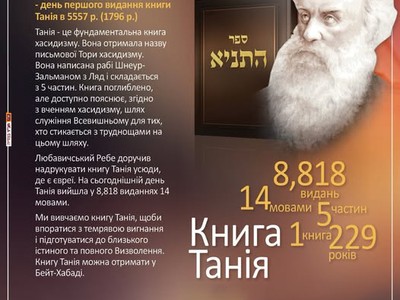
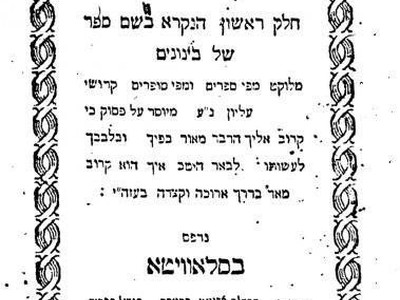
The history of the appearance of the "Tania" is a thirty-year process of the formation and formation of the teachings of the Alter Rebbe, the dissemination of manuscripts, the spiritual guidance of students and the constant need to collect the path of Hasidic work into a single, clear work.📜1760–1770: The beginning of the formation of the doctrineDuring these years, the young Alter Rebbe, a student of Magid from Mezherich, began to develop a system of Hasidic thought based on a reasonable knowledge of the Divine.Students write down his lessons in a notebook — "kuntresim", but the materials are still fragmentary.📜1772–1780: Growth in the number of studentsThe glory of the Alter Rebbe spreads.The Hasidim, who come to him in Lyady, begin to ask similar questions:about the soul, about the inner struggle, about joy, about service, about the character of the tzaddik and benoni.Alter Rebbe realizes that personal answers are no longer enough.📜1780–1790: First manuscripts appearStudents begin to rewrite his teachings by hand.There are different versions of the origin of the discrepancies in the texts:• possible mistakes of scribes;• late or inaccurate insertions;• distribution of texts that have not been properly approved.This creates a serious problem: the teaching can be distorted.Alter Rebbe says to the students:“We need a book that will set out a common path — so that everyone can properly serve the Almighty.”The construction of the future "Tania" begins.📜1791–1794: End of editingAlter Rebbe brings the text to its final form:collects spiritual letters and instructions;turns them into a coherent work;divides into sections;carefully edits the wording.He decides to start the book with the word “Tania” in order to combine Hasidic psychology with the long tradition of the Tana 'is.📜1795: Receiving Ascamot (recommendations)Before printing, Alter Rebbe sends the manuscript to two great righteous:• Rabbi Zushi from Anopol• Rabbi Judy-Leiba HaKohenRabbi Zusha wrote that this book “will shed light on the soul of Israel.”Rabbi Judah-Leib noted that “Tania” reveals the path of service “accurately and clearly for everyone.”These recommendations strengthened the book's credibility and protected it from forgery.📘1796 — the first printing of "Tania"The first edition is published in the city of Slavuta.Alter Rebbe included in it:📚Five parts of "Tania"️1ლLikutei Amarim — "Book of Middle"The doctrine of inner struggle, the structure of the soul and the path of constant spiritual service.️2ლSha 'ar ha-Yihud ve-ha-EmunaExplain the true unity of the Almighty and the mystery of creation.️3ლIgeret ha-TshuvaA profound teaching of return, spiritual purity, and renewal.4️ლYgeret HaKodeshAlter Rebbe's letters on Hasidic ethics, spiritual economics, blessing, and holiness.5️ლKuntres AharonIn-depth explanations for difficult places in Kabbalistic and Hasidic sources.📖The main idea of "Tania"Main principals:• every Jew carries a Divine Soul;• fighting is not a weakness, but a mission;• to be a tzaddik is given by a few, but the path of the "average" is available to everyone;• Joy is part of G-d's ministry• spirituality is a work of mind, heart and constancy."Tania" teaches that internal difficulties are not a disadvantage, but part of the purpose.🌟The meaning of "Tania" todayTania is studied daily around the world as part of the Hitas cycle.It became the basis of Hasidic psychology and the central work of Chabad.Alter Rebbe created a book that gives every Jew"a guide to the inner soul".📖Lubavitcher calendarhttps://t.me/+8KbDy9dQVqAxZWE8
New Year of Hasidism in our Community
Community
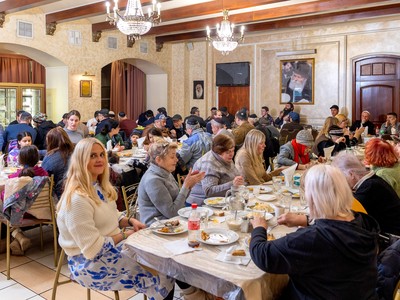
Farbrengen Yud-Tet Kislev in the Central Synagogue of Kyiv is a warm, meaningful meeting of our community dedicated to the New Year of Hasidism and the important events behind this day.On this day, we remember the liberation of the Alter Rebbe and the birth of the Hasidic teachings of Chabad as we know them today.We came together to talk about meanings, ask questions, share opinions, and support each other.A common table, niguns, an atmosphere of unity — all this created a space in which everyone felt part of a great tradition and a living community.Yud-Tes Kislev reminds: there is a path that we pass together. And this day is a good opportunity to take a step forward.
📌 SICH FOR THE WEEKLY CHAPTER "VAYESHEV"
Community
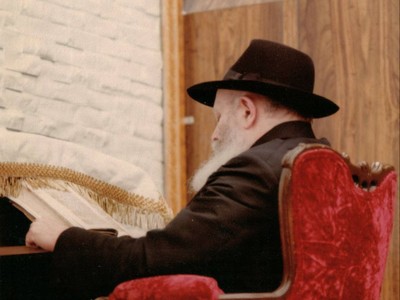
The chapter "Vayeshev" begins with the words: "And Jacob settled..." — hinting that after many years of trials, Jacob finally wanted a little peace. But that's when new difficulties come — the story with Yosef.💡The Rebbe explains:When a Jew seeks spiritual peace, thinking that he has already done enough, it is then that Heaven sends new tasks. Not as a punishment, but as a sign: you have new strength, new opportunities, you can rise higher.🔹Yosefis a symbol of the Jew who remains faithful to G-d even in the darkest place: in Egypt, inprison, among people far from holiness.He knows how to bring light where it has never been.🔹Brothers Yosefis the path of holiness, learning, spiritual detachment from the world.The Rebbe teaches us that both ways are necessary, but the main thing is to combine them:to be in the world, to work, to communicate, to build — and at the same time to remain fully committed to the Torah and the mission of the Jew.🔥The main idea:Each “trial of Joseph” is not a fall, but an invitation to rise higher.If we encounter difficulties, misunderstandings or darkness, it means that it is there that we need to light the light.🕯SHABBAT ШАЛОМ🕯📖Lubavitcher calendarhttps://t.me/+8KbDy9dQVqAxZWE8

Our dates: 24 Kislev
Community
24 Kislev 5052 (December 15, 1291) — Yorzeit (anniversary of the departure from this world) of Abraham ben Shmuel Abulafia.Rabbi Abraham Abulafia is considered one of the greatest kabbalists of the Middle Ages. He was born in Zaragoza (Spain). At the age of 20, he went to Eretz Israel, where he tried to find the mythical river Sambathion, behind which live the lost ten tribes of Israel. At the age of 40, Abulafia, convinced that he possessed a prophetic gift, went to Rome to reveal to Pope Nicholas III the full extent of the suffering of the Jewish people and to convince the head of the church to alleviate the fate of the Jews. Nicholas sentenced Abulafia to burning, but the sentence was not carried out due to the death of the pope. Abulafia prophesied with great confidence the coming of Moshiach in 1290 and many believed it, intending to move to the Holy Land.source: chabad.odessa

Our dates: 25 Kislev
Community
25 Kislev 41 (3720 BC) — Cain's murder of Jevel.On this day, the first and, unfortunately, not the last murder in history occurred. On this day, the eldest of the sons of Adam and Eve, Cain, killed his younger brother, Abel.25 Kislev 2449 (1312 BC) — the construction of the Portable Temple (Mishkan) was completed.The production of temple utensils, panels and structural elements was fully completed by 25 Kislev, but Mishkan was not yet ready "for commissioning". The elements of the portable Temple were ready, but Mishkan had not yet been assembled. Only 3 months later, 25 adar took place "training", when during the week the structure was assembled and disassembled daily. The service in the Portable Temple began on Nisan 1.Our sages say that the 25th day of the month of Kislev received “compensation” 12 centuries later, when the Maccabees, who expelled the invaders from Jerusalem, began the ceremony of consecrating the Temple on this day.25 Kislev 3241 (520 BC) — Consecration of Geyhal the Second Temple.After the Jews returned from Babylonian captivity, they undertook to rebuild the destroyed Temple. On this day, Geyhal of the Second Temple was consecrated — the building in which the Holy of Holies was located.25 Kislev 3597 (165 BC) — The beginning of the consecration of the Temple after the victory over the troops of Antiochus IV.Immediately after the victory over the Greco-Syrians and their expulsion from Jerusalem, the Maccabi brothers began to cleanse the Temple area. And so, on 25 Kislev, all the "repair and restoration" work was completed, and the Jews began the ceremony of consecrating the Temple. Read about what happened here.According to one opinion, this day was the first day of the Hanukkah miracle.25 Kislev 5665 (December 3, 1904) — Yorzeit (the anniversary of the departure from this world) Rabbi Chaim-Hizkiyya Medina.Rabbi Chaim-Hizkiyaѓu was born in Jerusalem and already in his youth became known as an outstanding Torah scholar. For many years he was a rabbi in various cities in Turkey, and then he returned to Jerusalem. After that, Rabbi Chaim became the head of the rabbinical court in Hebron and the head of the local yeshiva. For many years, Rabbi Medini was one of the most prominent jurists of the Sephardic community at that time (his pen belongs to the 20-volume halachic encyclopedia "Sdei Hemed") and was respected not only among Jews, but also among Arabs, who considered him a saint. After his departure from this world, they even tried to steal his body for reburial in the mosque, but fortunately, this attempt ended in failure.source: chabad.odessa

Our dates: 26 Kislev
Community
26 Kislev 4959 (27 November 1198) — Yorzeit (anniversary of the departure from this world) Rabbi Abraham ben David of Posquier.Rabbi Abraham ben David, known by the acronym Raavad I (Raavad II lived in the same area at the same time) was born in the city of Narbonne in the southern French province of Provence. Already in his youth, he led a yeshiva in the nearby city of Nîmes, which during his leadership became the leading Jewish educational institution in Provence. Later, he opened an academy in Poschje, where he paid for the education of needy students out of his own pocket.Raavad gained fame for his critical writings (Ghasagot) directed against the writings of Rambam. In addition, Raabad is known as a connoisseur of the Cabal — his pen includes comments on the cabalistic work "Sefer Yetzirah" ("Book of Creation").
Hanukkah LUBAVITSKYI REBE
Community
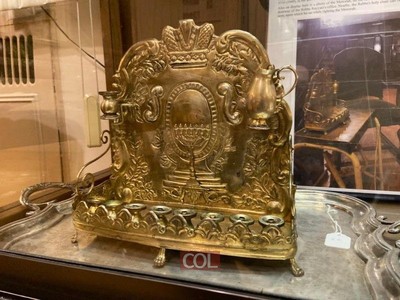
🕎Hanukkiah Rebbe RajacaRebbe Rajaca's Hanukkiah has survived to this day.It is of the “backless” type — that is, it is a flat Hanukkah with a decorative plate behind the candles.✨ On the "back" you can see the relief of an old round menorah, made by hand.It was such Hanukkah that was common among many tzaddiks of Eastern Europe.📸Legendary SnapshotThere is a rare and very famous photo of Rebbe Rajac sitting at the entrance to his office next to his Hanukkah.In the photo, you can see that Hanukkah is on a low table, it has lighted candles, and the back plate with the menorah stands out clearly.This snapshot was historical evidence of the kind of Hanukkah our Rebbe enjoyed.🕎Hanukkiah RebbeThe Rebbe usually lit a simple aluminum Hanukkah plank with a “back” behind it.Despite its simplicity, Hanukkah is adorned with:⭐️ Magen David,🦁 two lions,Tablets 📜 of the Covenant.🎁 According to some sources, the Rebbe received this Hanukkah from his father-in-law — Rebbe Rajaca — and therefore used it.Others claim that the Rebbe purchased it himself early in his stay in the US.Both versions converge on the same thing:👉 The Rebbe was very attached to this Hanukkah and had been igniting it for many years.📍Where did the Rebbe ignite Hanukkah?In the house — at the door between the living room and the small kitchen room.Since 1990 (5750) — in his office in 770, on a chair placed in the doorway opposite the mezuzah.Rarely did the Rebbe enjoy another backless Hanukkah — usually when he was igniting Hanukkah in the library.🕎Golden Hanukkah Rebbe — a unique caseAmong all Hanukkah Rebbe there is one special and extremely rare — Golden Hanukkah, which the Rebbe used only once.✨Brief historyIn 5738, the Rebbe received a gift of luxury Hanukkah made of pure gold from the Rebbe of Aaron Klein.Based on Hanukkah, the phrase is engraved:“I lit the light for the Messiah.”This Hanukkah is distinguished by:semicircular branches,significant weight and massiveness,rich hand engraving,exclusive artistic performance,rarity of use — the Rebbe lit it only once in his office.💫 It was because of its solemnity and connection with the idea of the Messiah that this Hanukkah received special attention among the Hasidim.🕎Hanukkiah from Nizhyn — wedding giftThe Rebbe had another special Hanukkah - the Hanukkah of Rebbe Isroel Novha from Nizhyn,which he received as a wedding gift from the grandfather of Rebbetzin Chai Mushka — Rabbi Abraham Schneerson.This Hanukkah has historical, family and spiritual value — it connects the Rebbe with previous generations of the Schneerson family.🕎Golden Hanukkah in 770In the great hall 770 there is a great Hanukkah, modeled after the Temple Menorah and covered with pure gold.It was made by the artist and Hasid Reb Hirschl Packer in 5743.🔥 The first ignition occurred on the sixth night of Hanukkah 5743.Initially, the place of shamash was located at an angle, and the Rebbe ordered not to put a candle there, so as not to create the impression of the Temple Menorah (seven candles). Subsequently, the shamash was raised higher.It is customary to light this Hanukkah with wax candles, rather than oil candles, so as not to burden the synagogue staff.For many years, Hanukkah was lit by the famous chasan Reb Moshe Talishevsky.Source:📖Lubavitcher calendar
We invite you to ignite Hanukkah in Babyn Yar
Community
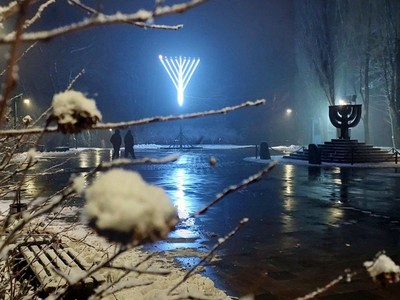
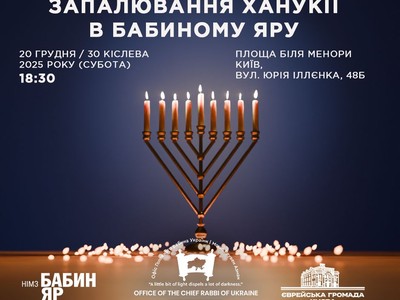
We invite you to ignite Hanukkah in Babyn YarDecember 20/ 30 Kislev (Saturday) at 18:30Location: Menorah Square, Babyn Yar National Historical and Memorial Reserve, 48b Yurii Illienko Str.Hanukkah is a festival of light that overcomes darkness. The Hanukkah candle is a symbol of hope, resilience and faith in the victory of good even in the most difficult times.Its inflammation in Babyn Yar, a place of tragedy, remembrance and prayer, has a particularly profound meaning. This is our common sign that darkness will never overcome light, and memory and life overcome oblivion.Organizers: Jewish Community, Office of the Chief Rabbi of Ukraine and Babyn Yar National Historical and Memorial Reserve.

We invite you to the exhibition of painting "Palms"
Community
We invite you to an exhibition of painting"Palms"artistAlbert-Leiser FeldmanN o t a r y🖐Hamsa — Miriam's HandA guardian and symbol of protection, female wisdom and spiritual presence.In this exhibition, the palm speaks the language of color, signs, and silence.It holds memory, blessing, and hope.📅28 December 2025 — 5 January 2026Art 📍 Space"Fiddler on the Roof"Shota Rustaveli, 13). A painting in which every line is like a touch.Each work is like a sign that stays with you.Come and see.And feel it.