
Question to the Rabbi: Is it necessary to restrain emotions?
Community
Each person comes into the world with his or her own character traits and peculiarities of emotional nature. Someone reacts calmly, and someone flashes instantly. But strong emotionality in itself is neither a flaw nor a verdict. It is part of human purpose, a tool that can be used for good. Working on qualities does not mean becoming someone else — only more accurately using the forces that are laid down by the Almighty.The greatest difficulty for an emotional person is to be able to notice the moment of choice. It seems as if the flash occurs instantly, without pause, without any possibility of stopping. But there is always freedom of choice — it's just that this gap can be very short, almost elusive. And the task is not to become indifferent or invulnerable, but to gradually increase this pause — at least for a fraction of a second.The first step is to accept your nature. This is not a weakness, but a material for growth. Everyone gets their trials: someone is given patience, someone is given the ability to argue, and someone has a strong heart that reacts violently to any injustice. But it is in these features that great power is hidden. Emotionality can be a source of compassion, energy, the ability to protect others — if you learn how to manage it.The second step is to prepare in advance for situations in which emotions usually prevail. A previously thought out short "stop signal" — a phrase, breathing, internal gesture — helps to connect the mind in a tense moment. This does not cancel the feelings, but gives the same little pause in which the choice is born.The third step is to work with self-esteem. Often, outbreaks arise not from anger per se, but from a sense of threat, pain, shame, or fear of being unclear. Awareness of these internal sources makes the response less automatic.And most importantly, the path of self-improvement should not turn into self-accusation. The Almighty does not expect a person to change his character in one day. He wants us to make a sincere effort, to move forward, even if the steps are small. Stopping for a split second, a restrained phrase, a softer tone is already a victory.Emotionality can be corrected, but not eradicated. And the ability to notice the moment of choice comes gradually — through patience with oneself, awareness and belief that growth is always possible.Source:https://toldot.com/

75 Years of Art: Borys Kogan Exhibition
Community
We invite you to the opening of a new exhibition dedicated to the 75th anniversary of Boris Kogan, an artist of subtle shadows and deep meanings.In the Skripal on the Roof gallery, the works of the master of different years will come to life — like the quiet voices of time that speak to the heart of everyone who is able to listen.The opening of the exhibition will take placeDecember 4 at 18:00N o t a r yAddress: 13 Shota Rustaveli Str., Kyiv.Come to touch the art that preserves human tenderness in even the darkest colors.
📖 Lubavitcher calendar - the day when the court ruled: "The Rebbe does not testify"
Community
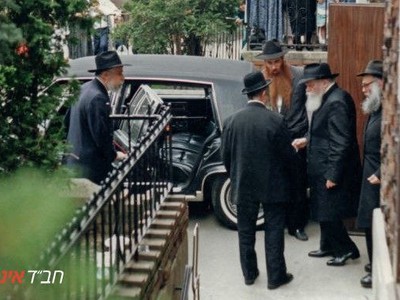
📖 Lubavitcher calendar🗓 13 Kislev 5746 — the day when the court ruled: "The Rebbe does not testify"During the book trial, the opponents tried to get the Rebbe to testify in person in court — a move that would give them the opportunity to ask audacious and demeaning questions about his leadership and status.The day of the announcement of the decision, Kislev 13, in 770 was proclaimed a day of fasting and reading Tehilim. In the morning, the hall was filled with Hasidim and yeshivas — the tension was in the air.The Rebbe's lawyers said in court that he is the spiritual leader of the Chabad movement, not the owner of tangible property, and therefore his personal testimony does not relate to the merits of the case.A special role was played by Dr. Weiss, the Rebbe's doctor, who testified that after a severe heart attack suffered by the Rebbe in 1977, severe emotional upheaval could be dangerous to his health.It is said that in those days the Rebbe said:“You need to think about how yeshiva students will perceive such things…”And so — at noon, the decision of the federal court was heard:"Rebbe does not testify" — The Rebbe is not obliged to testify.The news reached 770 instantly, where great joy broke out. In the evening, slave Avram Shemtov held a long farbrengen with yeshiva students — everyone felt that this was the first step towards the victory of Didan Nottsakh.A year later, a line appeared:"Let all the inhabitants of the world know what happened on the 13th of Kislev",which became a symbol of the greatness of those days.On the same day, the lawyers talked to the Rebbe for about two hours in the library building. The Rebbe stressed that there can be no concept of inheritance regarding Rebbe Rajac, "because he is with us."He also told lawyers to act not as Hasidim, but as lawyers, adding:“But for Chabad to win — according to your own conviction.”Source:https://t.me/+8KbDy9dQVqAxZWE8

Topic of the Day: Women and Art in Judaism
Community
The question of the talents given to a person arises especially vividly when it comes to gifts related to art: dance, singing, stage. Sometimes it seems that the opportunities that modern culture opens up are contrary to Jewish law. And then the natural question arises: if the Almighty has endowed a woman with exceptional talent — why? What is the purpose of the gift, which, at first glance, is difficult to fit into the Halakhah?In Judaism, talent is not an accident. Each gift is part of a person's task in this world, an instrument of communication with the Creator. But the Torah teaches that an instrument always serves a purpose, not the other way around. Even the brightest abilities do not free a person from spiritual landmarks, but, on the contrary, help to reveal the depth that manifests itself precisely within these boundaries. Restriction does not destroy talent — it directs it, gives it a new meaning.History knows many women whose abilities shone in various fields — literature, art, education, social activities. Their influence was manifested not only publicly, but also quietly — within the community, in work with children, in the transfer of values, in the creation of peace in the home. Judaism does not block a woman's path to creativity — it only offers a space where creativity serves not external glory, but spiritual depth.Dance, voice, stage expression— all this can be used to inspire other women, create educational and cultural projects, develop girls, strengthen their identity and confidence. Female groups, training programs, therapeutic practices through movement or music are no less significant than a large stage, and the impact is often much deeper.It is also important to understand that public success does not always equal domestic well-being. Life in art requires great sacrifices, and not all of them correspond to what the Torah considers true happiness. Sometimes giving up part of the opportunities is not a loss, but a path to integrityWhen the Almighty gives talent, He also gives the way of revealing it. Even if this path does not coincide with the usual ideas about career. Each gift has its own Jewish application — perhaps less visible to the world, but much more significant in terms of eternity.The Torah does not take away talents. It makes them meaningful. And when a person directs his gift to where he becomes part of his spiritual mission, the talent does not diminish — he begins to shine for real.Source:toldot.com

Question to the Rabbi: When do they say "Lechaim"?🥂
Community
In the Torah (chapter Lech Lech 14:18–20)it is said that Malki-Tzedek, who served as a priest, met Abraham after the war with bread and wine. Then he blessed Abraham and the Almighty:“And Malki-Tzedek, king of Shalem, brought out bread and wine. And he was a priest of G-d the Most High. And he blessed Abram, and said," Blessed be Abram of the Most High God, the Lord of heaven and earth; and blessed be the Most High God, who has delivered your enemies into your hand. "However,Gmara (Nedarim 32b)says that for this seemingly noble act of Malki-Tzedek, heavy punishment was meted out — his descendants were not allowed to serve as koenas. Why? Because he first blessed Abraham, and then only the Almighty. It is not permissible to bless a slave before his Master. Malki-Tzedek, as a priest, should understand this.One of the eminent sages, the author of the book "Sde Hemed" (Asphat dim, Brachot 1:45), makes an interesting remark that is directly related to our question.He writes: some halachic authorities believe that it is necessary to first pronounce the blessing on the alcohol that they are going to drink, then drink a little — so that there is not a big pause between the blessing and the use — and only then say to each other: "Lechaim".This must be done in order to avoid the mistake of Malki-Tzedek: if you first say "lechaim", and then — a blessing on the wine, it turns out that first they bless the "slave", and only then — the Lord. This is also presentedin Kaf HaChaim (Orach Chaim 175:55) and Mikrei Kodesh (Yamim Noraim 7; Slave Zvi-Pesach Frank, 1873–1960).In addition, if a person first tastes a drink and feels pleasure, he will be able to bless others with greater inner concentration.Recall: Yitzhak, before blessing Esau, asked him to prepare a special dish.Source:toldot.com

Honoring the victims of the Holodomor in the heart of Jerusalem
Community
The Chief Rabbi of Ukraine and Kyiv honored the memoryof the victims of the Holodomor of 1932–1933 at the opening ceremony of themonument in the heart of Jerusalem.Together with VicePrime Minister for European and Euro-Atlantic Integration of Ukraine Taras Kachka, Deputy Head of the Office of the President of Ukraine Iryna Mudra and Ambassador of Ukraine to Israel Yevhen Korniychuk, they paid tribute to millions of innocent Ukrainians starved to death by the criminal Soviet authorities.The ceremony was attended by political and public figures, as well as Knesset deputies.During the speech, the rabbi thanked the people of Israel for their solidarity and ability to hear the pain of others.In Jerusalem — in the unchanging capital of our people — he prayed for the souls of the innocently killed and for a just Peace, which Ukraine needs so much today.
We invite you to celebrate the New Year of Hasidism!
Community
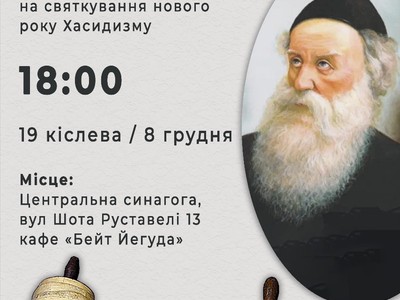
Kislev's 19th is a special day when we remember the liberation of the Alter Rebbe and the birth of the Hasidic light, which still warms our people.We invite you to join the joint celebration in the warm atmosphere of our community.Timing:18.00Date:19 kislev / 8 DecemberLocation: Kyiv Central SynagogueShota Rustaveli, 13). beit Yehuda CafePre-registration isrequired by phone:+38 (097) 727 19 06 — Mojshe

Light memoryof the Hero who chose the lives of others
Community
The community with deep pain and at the same time pride reports:Matitiago (Anton) Samborsky, the son of our rabbi, who died defending Ukraine,posthumously awarded the Order of the HeroN o t a r yThe representative of the 46th Brigade, in which Matitiago served, spoke about his feat: he remained alone in the position, face to face with the enemy, in order to save his brothers and preserve extremely important military equipment. This is an act of a person who puts the lives of others above his own.It is a great honor and light pride for our community to know that a real Hero has grown among us, whose courage has become the pride not only of the Jewish people, but of the whole of Ukraine.The Hero is remembered forever. His light does not fade away. awarding video:https://www.facebook.com/share/v/17XFStFWUb/?mibextid=wwXIfr

Our dates: 18 Kislev
Community
18 Kislev 4998 (December 7, 1237) — Yorzeit (anniversary of the departure from this world) Rabbi Avraham Maimuni.Born in 1185, Rabbi Avraham Maimuni Ha-Nagid, also known as “Avraham ben Ha-Rambam”, was the son of the great sage Rambam (Rabbi Moshe ben Maimon) and at the age of 19, following his father, he headed the Jewish community of the city of Fostat (the old part of Cairo). His pen owns many comments and responses (answers to questions about Jewish law) in which he defends and develops the views of his father.18 Kislev 5572 (December 4, 1811) — Yorzeit (anniversary of the departure from this world) Rabbi Boruch ben Yechiel from Medzhybizh.Rabbi Boruch was born in 1753. His father was Rabbi Yechiel Ashkenazi, and hismother was Rabbi Adel, the daughter of the founder of Hasidism, Rabbi Yisrael Baal Shem-Tov.Rabbi Borukh was a rabbi in Tulchyn, and then returned to his native Medzhybizh, where he led the Hasidic movement, which had many supporters and followers. At the "court" of Rabbi Boruch lived the famous wit, the "Jewish Hoxha Nasreddin", Herschel Ostropoler.18 Kislev 5637 (December 4, 1876) — Yorzeit (the anniversary of the departure from this world) to Rabbi Yosef-Yitzhak from Ovruch.Rabbi Yosef-Yitzchak (Rabbi Rajac) was born in Lubavitches and was the fifth son of the third Lubavitcher Rabbi Tsemakh-Tzedek. His wife was Rebbetzin Khan — the daughter of Rabbi Jacob-Israel from Cherkasy and Rebbetzin Dvori-Leya (daughter of Miteler Rebbe) and after the wedding, at the insistence of their father-in-law, they settled with him. At the age of 36, during the life of his father, Rabbi Yosef-Yitzhak settled in the town of Ovruch, where he became the leader of the Hasidic movement.The daughter of Rabbi Yosef-Yitzchak was Rebbetzin Stern-Sara, who later became the wife of the fifth Lubavitcher Rabbi Sholom-Dov-Ber. Her son Rabbi Yosef-Yitzhak (the sixth Lubavitcher Rabbi, also known by the acronym “Rabbi Rajac”) received his name in honor of his grandfather.source

Our dates: 19 Kislev
Community
*19 Kislev5533 (December 15, 1772) — Yorzeit (anniversary of the departure from this world) Rabbi Dov-Ber from Mezherich (Mezheritsky Magid).When young Dov-Ber was five years old, a fire broke out in his parents' house. The kid tried to console the crying mother, saying that she should not be so sad over the lost property, to which the mother replied that she was sad not because of the lost property, but because of the fact that the documents confirming that their family descends from the famous Talmud sage Rabbi Yohanan gya-Sandlar (Yohanan the Shoemaker) - a direct descendant of King David - had disappeared. And then little Dov-Ber said: "Do not cry, mother, I will try to make our family famous again."The boy kept his word. Rabbi Dov-Ber, a scholar of Torah and Kabbalah, was known as "Magid" (preacher, orator), since he had long held the position of Magid in Korets, Rivne and Mezherich. He was the successor of the founder of Hasidism, Rabbi Israel Baal Shem-Tov, and led the movement after his departure from this world in 1760. During his leadership of the movement (from 1761 to 1772), the "wide river" of Hasidism turned into a "river delta with many sleeves".Among his students were Rabbi Schmelke from Nicholsburg and his brother Rabbi Pinchas from Frankfurt, Rabbi Levi-Itzhak from Berdychiv, Rabbi Menachem-Nachum from Chernobyl, Rabbi Schneur-Zalman from Lyad (Alter Rebbe), Rabbi Noam-Elimelech from Lizhensk and his brother Rabbi Meshullam-Zusya from Anipol, Rabbi Zeev-Wolff from Zhytomyr, Rabbi Shlomo from Karlin, Rabbi Menachem-Mendl from Vitebsk and many others. Magid's disciples created more than 150 directions of Hasidism — Gursky, Kotsky, Lubavitsky, Chernobyl, Vyzhnytsky, Slonim...Rabbi Dov-Ber left this world in the Ukrainian town of Anipol, where he was buried. His only son Rabbi Avraham HaMalakh (Angel) became the grandfather of Rabbi Yisrael Friedman from Ruzhin (Ruzhinsky Rebbe).*19 Kislev5559 (November 27, 1798) — Alter Rebbe's release from prison. "New Year of Hasidism".Arrested for false denunciation of Rabbi Schneur-Zalman was taken to St. Petersburg. He was placed in the Peter and Paul Fortress, in the casemates of which he stayed for 53 days (for the first three weeks he was in a cell for "rebels against the authorities", since the main accusation was the collection of money for the Turkish sultan, but later he was transferred to a cell with milder conditions of detention).All this time, the Privy Council studied the materials of the case of the "sect of Zalman Borukhovich", and the interrogation of the Alter Rebbe took place not in the fortress, but in the office of the Privy Council, on the other side of the Neva (the Rebbe was transported there every time by boat).Ministers and once even the emperor himself took part in the interrogations. He liked the answers of the rabbi and 19 Kislev decided to release him. The Hasidim were acquitted of all charges and their opponents were prohibited from interfering with their activities. This day is called the "New Year of Hasidism".*19 Kislev5559 (November 27, 1798) — Birthday of Rebbetzin Menuha-Rohl.On the day of Alter Rebbe's release, his grandson was born — the daughter of his son Rabbi Dov-Ber (Miteler Rebbe) and Rebbetzin Shane. The girl was named Menukha-Rohl ("Menukha" means "peace", and Rohl is the name of the daughter who died in her youth, Alter Rebbe)Rebetzin Menucha-Rochl really wanted to live in Eretz Yisrael and in 1845 she moved there with her husband. Rabbi Yaakov Slonim was the head of the Hasidim living in Hebron, and after he left this world, his widow, who became famous for her modesty, piety and knowledge, became the “mother” of the Hebron Hasidic community.Source:chabad.odessa

Our dates:20 Kislev
Community
📌20 Kislev 3414 (347 BC) — Speech of the prophet Ezra at the assembly in Jerusalem.The Prophet Ezra was the head of the Sanhedrin and the leader of the Jewish people at the time of their return from the Babylonian exile and the construction of the Second Temple. On this day, Ezra addressed the general assembly in Jerusalem with a call to adhere to the laws of the Torah and not to weaken efforts to study it. In addition, Ezra obliged all Jews who took wives of representatives of other peoples to divorce them (here it should be understood that we are talking about women who have not renounced the worship of pagan idols)📌20 Kislev 5557 (December 20, 1796) — The book "Tania" was first published."Tania" is one of the most popular books in the world, and by the number of places of printing, it is generally difficult for it to find a competitor, because "Tania" was printed on the water, in the air and in various places of the Earth — even in Iraq during the reign of Saddam Hussein and in Ramallah, the capital of the Palestinian Authority."Tania", also known as "Likutey amarim" (it is also called "Torah of Hasidism"), is the main work of the Alter Rebbe. Rabbi Schneur-Zalman wrote it for 20 years, and only after making sure that all the mistakes were corrected, allowed it to be distributed. However, as a result of thousands of rewritings, inaccuracies crept into the book and Alter Rebbe sent special envoys to Rabbi Yehuda-Leib Klein and Rabbi Zuse from Anipol in order to discuss with them the possibility of printing Tania.In September 1796, Alter Rebbe gave the text to the Slavic printing house of Rabbi Meir Shapiro, agreeing that he would finish the work by December (the beginning of the Kislev) and the study of the "Tania" could begin on 19 Kislev, on the day of the departure from this world of the Mezheritsky magician.However, there was still no 19 Kislev's "Tania", which upset Alter Rebbe very much. Only 26 Kislev, on the second day of Hanukkah, a special messenger brought from Slavuta 200 first copies of "Tania", published 20 Kislev.Soviet religious Jewish refuseniks had their own jargon designed to confuse the KGB. In this slang, the study of "Tania" was called a "walk with Tanya". Now the daily "walks with Tanechka" are carried out by tens of thousands of Jews, and according to tradition, the new annual cycle of "walks" begins on the 19th of Kislev, as Alter Rebbe wanted.📌20 Kislev 5559 (November 28, 1797) — Completion of the liberation of Alter Rebbe.When Alter was asked where to send him after his release, he said that he wanted to go to the house of Hasid Mordechai Lepler. But in the same building, on the first floor, lived a stubborn opponent of Hasidism (mishnaged), one of the denunciators, according to whom the rabbi was imprisoned. And Alter's rabbi was mistakenly taken to his home.Seeing Alter the rabbi, the mishnaged was frightened, but still offered to sit down. He ordered the samovar to be placed, washed the plate himself, and struck up a conversation with the rabbi, saying, “You think you have already won, but let it be known that when you come to me now, you will not get out of here until you sign that you cancel the new order of prayer introduced by you, and other innovations that our parents did not follow. What did you miss in what they say "naaritsokh", and not "keser"?..."Meanwhile, the Hasidim, who had been waiting for the arrival of the rabbi all day, began to worry — maybe the rumors about the dismissal, as Mossnagdim said, are false? And they went to Lepler's neighbor.Having reached the goal, the Hasidim heard from the door: "You didn't like Naaritsoh, only "keser"?!" and realized that the Rebbe had been brought here by mistake. Seeing the Hasidim, the misnaged got scared. Mordechai Lepler wanted to hit the misnaged, but the Alter Rebbe told him not to do anything. “What are you doing here, Rebbe? said Rabbi Mordechai. "Get out of these people's tents!" But the Alter Rebbe said that one should give honor to those who received him, drank a glass of boiling water and left with Rabbi Mordechai. "You literally gave me life! he said to his Hasid. "And believe me, all the days that I was in prison, I was not as hard as during those three hours that I was in the house of this misnaged."derelo:chabad.odessa

Our dates: 21 Kislev
Community
📌21 Kislev 2313 (1448 BC) — Yorzeit (the anniversary of the departure of Shimon ben Jacob from this world.Shimon was the second son of our forefather Jacob and forefather Leah, and the second in the general list of Jacob's sons. In the years of his stay in Egypt, after the death of Jacob's first-born Reuven, Shimon led the Jewish people.It was Shimon and his younger brother Levi who stood up for the disgraced honor of their sister Dina and took revenge on the residents of the city of Shechem (the young avengers were 14 and 13 years old at the time!). After the first visit of the sons of Jacob to Egypt, Shimon remained in that country as a hostage, while the other brothers went to Canaan for the remaining brother (Benjamin). Commentators explain this by the fact that at one time it was Shimon who proposed to kill Yosef, and besides, remembering the possibilities of the brothers, Yosef tried to separate Shimon and Levi... It was for the same reason that the representatives of Shim kolenon and Levi were scattered throughout Eretz Yisrael. The tribe of Levi did not receive its share at all and was engaged in the service of the Most High, and the tribe of Shimon, although it had a share among the lands of the tribe of Yehuda (in the southwest of the country, their possessions included, in particular, Beer Sheva), but among its representatives there were many Melameds (teachers) and poor people - both of them traveled around Eretz Israel in search of earnings and sustenanceShimon passed away at the age of 120 and was buried with his younger brother Levi in the city of Masada.In the book "Yalkut Shimon" it is said that no judge or king of Israel came out of the tribe of Shimon because of the sin of the head of the tribe Zimri bin Salu in the desert (his example pushed the people to enter into forbidden relations with the Moabite women, which caused pestilence among the Jews).📌21 Kislev 5705 (December 6, 1944) — Salvation of Satmar Rebbe.The head of the Satmar Hasids, Rabbi Yoel Teitelbaum (1887-1979), was rescued among 1,368 other Jews from the Bergen-Belsen Nazi concentration camp. The rescue operation was led by the head of the Zionist organization of Hungary, Rudolph Kastner (on 29 ava he managed to save another 1,686 Jews). Already after the war, a scandal broke out in Israel, the so-called "Kastner case". Hungarian Jewish survivors of the Holocaust accused him of having saved three thousand people in exchange for the lives of hundreds of thousands of others (Kastner persuaded the Jews of Budapest not to resist their deportation to the "death camps", but instead allowed him to take out several thousand prominent figures of the Jewish community and the Zionist movement). The judges could not reach a unanimous verdict, and Kastner was killed by one of the Hungarian Jews.But, anyway, Rabbi Yoel was saved, and Satmar Hasidim celebrate 21 Kislev as a kind of Thanksgiving Day.source: chabad.odessa