
Our dates: 22 seamstresses
Community
22 shevat 5619 (January 27, 1859) — Yorzeit (anniversary of the departure from this world) Rabbi Menachem-Mendel ben Leibusch Morgenstern of Kotzk.Rabbi Menachem-Mendl was born in Poland, in the town of Bielgoraj, near Lublin. Born into the family of a fierce opponent of Hasidism, Rabbi Leibush Morgenstern, he became fascinated by the new movement and became a disciple first of Rabbi Yaakov-Yitzhak Ha-Levi Horowitz ("Ha-Jose mi Lublin", "Seer from Lublin"), then of Jacob-Yitzhak ben Asher from Pshishka, and later of Rabbi Simkha-Bunem from Pshishka.Rabbi Menachem-Mendl was a rabbi in Tomaszów Lubelski and then moved to Kock, later becoming known as Kocker Rabbi. Even in Tomashiv, a small group of supporters rallied around him, and in Kotsk he already had thousands of students, the most famous of which were his brother-in-law Rabbi Yitzhak-Meir Rotenberg Alter ("Hidusha HaRim", the founder of Gur Hasidism) and Rabbi Hanokh-Enokh from Alexandrov.The last 20 years of his life, the rabbi from Kotsk spent in complete solitude, in voluntary isolation from relatives and students. He did not leave behind any books or manuscripts (his statements are recorded in the book "Amod Ha-Emet"), but the memory of him remained in his students, because the rabbi from Kotsk is considered the forerunner of Gur Hasidism — one of the most powerful Hasidic movements.22 Shevat 5748 (February 10, 1988) — Yorzeit (anniversary of the departure from this world) Rebbetzin Chai-Mushka Schneerson, wife of the Rebbe.Rebbetzin Chaya-Mushka was the second daughter of the previous Lubavitcher Rabbi Yosef-Yitzchak (Rabbi Rajac). She was distinguished by high scholarship in the Torah area and a sharp mind. People around her appreciated her for her subtle sense of humor and warm attitude towards everyone.Rebbetzin Khaya-Mushka passed away after a short illness and the funeral, which took place a few hours after her death, was attended by more than 15,000 people. She was buried next to the grave of Rebbetzin Sterna-Sara's grandmother, opposite the grave of Rebbe Rajac's father.source: chabad.odessa
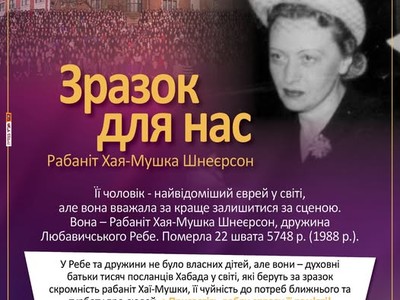
Yorzeit Rebbetzin Chai-Mushka Schneerson, the Rebbe's wife.
Community
22 Shevat 5748 (February 10, 1988) — Yorzeit (anniversary of the departure from this world) Rebbetzin Chai-Mushka Schneerson, wife of the Rebbe.Rebbetzin Chaya-Mushka was the second daughter of the previous Lubavitcher Rabbi Yosef-Yitzchak (Rabbi Rajac). She was distinguished by high scholarship in the Torah area and a sharp mind. People around her appreciated her for her subtle sense of humor and warm attitude towards everyone.Rebbetzin Khaya-Mushka passed away after a short illness and the funeral, which took place a few hours after her death, was attended by more than 15,000 people. She was buried next to the grave of Rebbetzin Sterna-Sara's grandmother, opposite the grave of Rebbe Rajac's father.source: chabad.odessa

Our dates: 23 sevats
Community
23 Shevat 2572 (1188 BC) — War against the Knee of Benjamin.On this day, the combined armies of the 11 tribes of Israel engaged the people of Benjamin's tribe. The reason for the fratricidal war was the position taken by the Binyaminites in the case of the "Giva Concubine".Then, after their refusal to extradite the guilty, a ban was imposed on marriages between representatives of the Benjamin tribe and other tribes of Israel, and bloody battles began between the Benjamites, after which 600 (!) men survived in the Benjamin tribe. The final reconciliation took place on the 15th of Av, in honor of which the holiday was founded.Source:chabad.odessa

Our dates: 24 seamstresses
Community
*24 seamstresses3410 (351 BC) — Prophecy of Zechariah.“In the twenty-fourth day of the eleventh month, which is the month of Shebat, in the second year of the reign of Darius [Darius II], the word of the Lord came unto Zechariah the son of Berechiah, the son of Ido the prophet, saying, … I have returned to Jerusalem with mercy; my house shall be built in it” (Zechariah 1:7-16). This prophecy refers to the rebuilding of the destroyed Temple, which happened two years later in 3412.*24 seamstresses5648 (February 6, 1888) — Yorzeit (anniversary of the departure from this world) Rebbetzin Menuhi-Rochl Slonim.Rebbetzin Menucha-Rochl was the daughter of Miteler Rebbe and Rebbetzin Sheina and was born on 19 Kislev, the day her grandfather Alter Rebbe was released from prison ( "New Year of Hasidism"). The girl was namedMenukha-Rohl ("Menukha" means "peace", and Rohl is the name of the daughter who died in her youth, Alter Rebbe)Rebetzin Menukha-Rohl wanted very much to live in Eretz Yisrael and in 1845 moved there with her husband, Rabbi Yaakov-Kuli Slonim, who was the head of the Hasidim living in Hebron. After he left this world, his widow, who became famous for her modesty, piety and knowledge, became the “mother” of the Hebron Hasidic community.source: chabad.odessa

Our dates: 25 Shevat
Community
25 shevat 5643 (February 2, 1883) — Yorzeit (anniversary of the departure from this world) Rabbi Israel ben Zeev-Wolf Lipkin Salanter.Rabbi Yisrael Lipkin, known as Rabbi Yisrael Salanter (from Salant), was born in the Lithuanian town of Jegora, in the family of the famous Talmudist Rabbi Zeev-Wolf ben Arie-Leib Lipkin. From the age of 12, the boy studied in the town of Salanti.Rabbi Salanter created a new teaching, which was called mussar ("ethics"). In Vilna and Kovno (Vilnius and Kaunas) there were special prayer rooms (musar shtibl), where Rabbi Salanter delivered sermons to artisans and merchants, calling them to repentance and drawing gloomy pictures of inevitable retribution for any wrongdoing. In contrast to Hasidism, which taught that serving God should be done with a joyful feeling, he saw in fun and joy a sinful frivolity, but at the same time, being a strict ascetic, widely interpreted the principle of pikuah nefesh ("salvation of the soul; here - breaking the commandment, if it is necessary to save life). Thus, on Yom Kippur 5608 (1848), when a cholera epidemic was raging in Vilna, he, having pronounced a blessing, demonstratively took up the meal right there in the synagogue and called on those present to follow his example, because although the strictest fast is prescribed on this day, the preservation of life and health is more important than any ritual.Rabbi Salanter lived in Paris, Frankfurt am Main, Klaipeda, lectured on Judaism to students at the University of Königsberg. Among his disciples were the famous Rabbis Moshe-Yitzchak Darshan (Kelm Magid), Simkha-Zisl Broyda and Yitzchak Blaser.Rabbi Salanter is buried in Koenigsberg (now Kaliningrad).source: chabad.odessa

Our dates: 26 seamstresses
Community
26 Shevat 5427 (February 19, 1667) — Yorzeit (anniversary of the departure from this world) Rabbi David ben Shmuel HaLevi (Taz).Rabbi David ha-Levi was born in Volodymyr-Volynsky and held rabbinical posts in various cities, and then settled in Ostroh, where he was a rabbi, opened a yeshiva and wrote his commentary on the main collection of laws "Shulkhan Arukh" — "Turei za 'av" ("Golden Pillars"). This book earned him the fame of one of the greatest Halakhists (legislators) of his time, and its name, as is often the case, became his middlename, so that now Rabbi Shmuel is known to us as Rabbi Taz (an acronym for the title of his book).Rabbi Taz is buried in Lviv.source: chabad.odessa
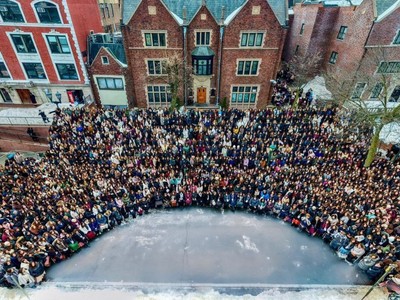
Page of 🌍 History: World Congress of Rebbe Messengers
Community
The World Congress of Envoys of the Rebbe (כינוס השלוחות העולמי) is an annual international meeting of women who carry out the mission of the Lubavitcher Rebbe in different countries of the world. Every year, hundreds of participants gather in New York, in the world center of Chabad — in the legendary 770 Eastern Parkway building.Thecongress takes place on the eve or near 22 Shevat — the day of the departure from this world of Rebetsen Hai-Mushka, the wife of the Rebbe. This date gives the meeting a special spiritual depth and atmosphere of inner unity, because it is the image of Rebetzen that is an example of dedication, modesty and devotion to the community.The main goal ofthe congress is to strengthen theconnection with the Rebbe, support each other, share experiences and gain new strength to work in Jewish communities around the world.📜StoryThe first congress took place in 5751 (1991) and immediately took a special place in the life of the movement. The Rebbe personally participated in the meeting, addressed the envoys with a special conversation, emphasizing the unique role of the Jewish woman in spreading the Torah, Hasidism, and Jewish warmth, and distributed every dollar in the tzadakah.Subsequently, part of this conversation was published in a special collection of 22 shevats dedicated to the spiritual mission of women of our generation.In 5753 (1993), the Rebbe went out onto the balcony to bless the gathered. These events have become historic and will forever remain in the memoryof many families.🏫Atmosphere & ProgramFor a few days, the area of Crown Heights is filled with the voices of guests from all over the world. There are heads of Chabad houses, teachers, organizers of educational and social projects — women who build Jewish life in their cities every day.The program ofthe congress combines lectures, practical seminars, working meetings and sincere painters. Real issues of public activity are discussed, experience is exchanged, solutions to complex challenges are sought and mutual inspiration for new ideas is provided.The traditional symbol ofthe congress is a joint photo in front of the 770 building — a clear indication of how widely the Rebbe mission has spread around the world.🎉CulminationThe congress ends with a large festive banquet that brings all the participants together.The most touching moment of the evening is the roll call of cities and countries. When places of service are named in turn, women are brought up from their places, and it becomes clear that the network of messengers covers literally the whole world — from large capitals to the most remote corners. This creates a powerful sense of unity and shared responsibility for the fate of the Jewish people.✨Spiritual meaningThecongress is not only an exchange of experience, but above all a time of spiritual strengthening. Here, the participants again feel the meaning of their mission and receive inner strength to continue their ministry.Particular attention is paid to the theme of Geula and the preparation of the world for the coming of the Messiah — in accordance with the words of the Rebbe that it is our generation that completes this historical mission. The day-to-day activities of each messenger are seen as an important part of the overall Liberation process.👩👧Communication during the yearIn addition to the main congress, regional meetings and special programs for the daughters of envoys are held throughout the year. Thanks to this, there is a constant connection, mutual support and a sense of a large family.Thus, the World Congress of Rebbe Messengers becomes not just an annual event, but the living heart of the world movement of women who bring the light of the Torah, Hasidism and Jewish warmth to thousands of families around the world.Source:📖 Lubavitcher calendar
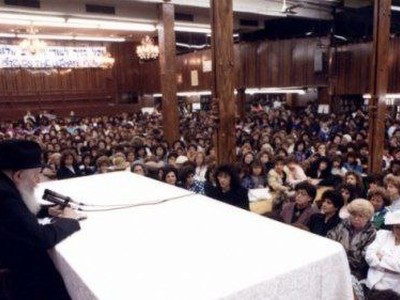
Topic of the day: 🌸 Woman in Judaism and Hasidism
Community
The word isha (woman) in Jewish tradition sometimes means a married woman, but more often it means the entire female gender.From the point of view of Hasidism, the spiritual mission of a woman is associated with the sefira Malchut — the ability to accept the Divine Light and reveal it in the reality of the material world.It is through a woman that the Divine becomes tangible in everyday life: in the home, family, upbringing, an atmosphere of warmth and faith.In the future Liberation, the prophet's words will come true: "a woman will surround a man" — the height and depth of the power of the receiving principle will be revealed.✨ Loyalty to the Almighty: Lessons from the TorahDuring the sin of the golden calf, the women refused to give their jewelry to the idol.Hasidism explains: since the woman's soul is rooted in Malchut — the source of the divine vitality of the world — they internally felt more clearly that the Almighty continues to rule the world, and therefore did not succumb to deception.Similarly, in the event with the scouts, the women did not share the despair of the people. On the contrary, the daughters of Clofhad asked for their share in the Holy Land, showing faith and connectionto the future of Israel.🧠 About the nature of feelings and mindThe expression of the sages "women have an easy thought" in Hasidic sources is explained not as a disadvantage, but as a different mental structure.A woman has more developed feelings, intuition, emotional sensitivity.This makes it more alive, subtle and deeply sensitive — able to respond faster with the heart.Therefore, it is the woman who often creates the atmosphere of the house and forms the inner world of the family.📖 Study of the Torah for womenAccording to the Halakhah, women are not obligated to the commandment of constant study of the Torah in the same way as men, but are obligedto know all the laws relating to their lives: kosher, sabbath, family purity, prohibitions and daily practices.At the same time, the Lubavitcher Rebbe especially emphasized that nowadays women need a broad and deep study of the Torah.He encouraged the lessons of the Tanakh, the Alah, the Haggadah, the Ein Yaakov, the daily study of the Sefer ha-Mitzvot, and even the basics of the Talmud.The Rebbe explained that the woman's connection to the Torah is essential, so they also recite morning blessings to study the Torah.Knowledge strengthens faith, dignity and spiritual autonomy.🔥 Study of HasidismThe teaching of Hasidism reveals love and awe before the Almighty, explains the inner meaning of G-d's service.Since these commandments are bindingon every Jew and every Jewess, women are also obligedto study Hasidism.The previous Rebbe distributed Yiddish conversations precisely so that they were available to women and girls, and encouraged them to share what they heard with their friends.According to the Rebbe, there is even a special dignity in this — the female soul perceives Hasidic ideas with a special depth of heart.🕯 Commandments and Role in the HomeThe woman is obligated in all the forbidden commandments and in all the prescriptions that do not depend on time.Since ancient times, three foundations of the Jewish home have been associated with a woman:halal, family cleanliness, lighting of Saturday candles.These commandments form the spiritual foundation of the family and fill the home with the light of holiness.Therefore, a Jewish home is traditionally built around its presence, warmth, and inner strength.🌿 Modesty and social roleTradition emphasizes the value of modesty and dignity.The main mission of a married woman is to build a home, raise children, and create a spiritual atmosphere.At the same time, in our generation, the Rebbe actively encouraged the participation of women in education and social activities, especially in parenting, where their natural sensitivity and maternal heart bring a special blessing.SummaryJudaism and Hasidism do not see a woman as a secondary figure, but as a source of inner strength, faith and the revelation of G-dhood in the world.Through it, holiness becomes a part of everyday life.Its contribution is quiet, but decisive, hidden, but decisive for the fate of the entire people.📸 In the photo: The Rebbe pronounces a special Siha only for womenSource:📖 Lubavitcher calendar

Ayom Yom: 23 Shevat
Community
Today23 Shevat 5786N o t a r y📌5729 (1962)— The Rebbe approved the creation of the districtNahalat Ar Chabadin KiryatMalakhi, named in the abbreviationHana— in honor of his mother, Rebbetzin Hana.Iom YomOne day, as Alter Rebbe was leaving his room, he heard the Rebbe say to several women:“My (= my husband) says.”Saying to the Rebbe:Because of one commandment [consecration of a woman, Kidushin], I am yours;but because of many commandments — I belong to the Almighty!And it stretched out on the floor, completely immersed in the state ofdouble angle— a deep spiritual attachment to G-d.When he came to his senses, he said (explaining that it was through the words that the Rebbetzin awoke to the big two-angle in the Almighty):"Tseena u-reena" — to get out of oneself and see G-dhood, this happens through the "daughters of Zion":Malchut(daughter aspect) awakensZeir Anpin(= higher holy qualities).In the future, what is said in Scripture will come to pass:"A valiant woman is the crown of her husband"N o t a r ySource:📖Lubavitcher calendar

Question to the Rabbi: Why did G-d appear before people and show His power, and now He does not?
Community
Dear K.,G-d does not perform "extra" miracles and does not needlessly violate the order of Creation established by Him. Those miracles that were performed once - during the exodus of the Jewish people from Egypt, in front of everyone - were enough to testify to His power and absolute authority over the world He created. And the story about it in the Book, given to all the people and carefully preserved and passed down from generation to generation, immortalized the knowledge about the miracles that had been performed. Later, this story became available to other peoples. The world is informed about the power of the Almighty.Everything else depends on the choice of each person. If she is looking for a real answer, she will understand and make sure that the message is true. If she wants to evade and justify herself by ignorance, this is also her choice. After all, the Almighty expectsCHOOSING THE RIGHT PERSON, her spiritual effort and work — this is the task and merit of man. If the Creator revealed knowledge of Himself openly and constantly, a person would be deprived of the possibility of choice.However, in truth, for those who live in the world of the Torah, who are involved in our Tradition, for people in whose lives the connection with the Almighty, the search and joy of His closeness are not abstract ideas, but everyday reality, for them what is said in the Torah about miracles is obvious as if they saw these miracles with their own eyes. And they don't need a repetition at all.However, in fact, it is not so difficult for any person, if only he wants to "look", to see the "hand" of Providence in everything that happens in his life, in his environment and in the world, to begin to catch "strange" patterns and connections — small and large, in other words, miracles that occur constantly. And this gradually reveals to the sensitive understanding what has not yet been revealed to the whole world with obviousness — the presence and power of the One Who is behind everything that is happening.The time will come when the Creator of the world will again and with even greater force reveal His power in the eyes of all, proclaim His rule in full voice. Then the time allotted for "work" will end — the time of concealment — and the joy of clarity and summing up will come.Read more about your question in Ramban's commentary on the Torah, at the end of Bo's chapter (in Shemoth's book). source: https://toldot.com/

Page of history: Qumran caves
Community
Page of History: The Qumran Caves over the Dead Sea are one of the most important archaeological sites attesting to the ancient history of the Jewish people on this land.It was here that the Dead Sea Scrolls were found — manuscripts more than 2,000 years old, including the oldest copies of biblical texts.These texts are a unique testimony to the continuous spiritual, cultural and historical connectionof the Jewish people with the Land of Israel.source: IsraelinUkraine

Ayom Yom: 24 Shevat
Community
📅 Today 24 Shevat 5786Iom Yom"And the people saw — and trembled" — when the Jews saw the manifestation of G-dhood, then they "trembled": they awakened the movement of life, the inner revival.If you knew, ”said Rebbe“ Tzemach Tzedek, ”the power of the poems of Tegilim and their effect in the higher worlds, you would speak them constantly.Know that the psalms of Tegilim destroy all obstacles, rise higher and higher without any obstacle, stand before the Lord of the Worlds and perform their action — with kindness and mercy.Source:📖 Lubavitcher calendar