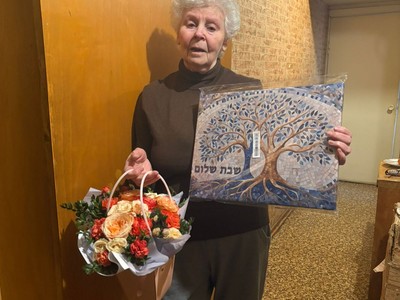
MAZAL TOV, MARGARITA HAIMINA 🔯💐
Community
80 years is not just a date.It is a journey of life filled with experience, dignity, and inner light.As part of the Community Care program, we welcome birthday people on a monthly basis.And to those who are currently limited in movement, we come personally — so that no one is left without attention.As a sign of attention and care, the representative of the Community visitedHavrylenko Margarita Khaimivna,congratulating her on her respectful 80th anniversary.With warm wishes of health, strength and peaceand with the feeling that the Community is always there.Caring is presence.And it doesn't depend on the dates.

"New Year" — on a weekday
Community
Although Tu bi-Shvat is called the "New Year", we are talking about only one specific issue — the issue of the "age" of fruit trees. Therefore, any work can be done on this day, and it is not reflected in prayers.However, on this day it is customary to bring something from the holiday: they do not read Tahanun (the mourning part of the prayers), do not mourn the deceased, and if it falls on Saturday, they do not read Av Garahamim (an excerpt containing mentions of the souls of the deceased).On this day, they eat the fruits growing in Eretz Yisrael, and try to taste at least one new fruit that has not yet been served this year, and pronounce the blessing of Schehean on it ("Who gave us to live").At the same time, another "beginning of the year" — 1st Elul — does not stand out from a number of weekdays at all. Why? Why is he "worse" than Tu BiShvat?The fact is that Tu bi-Shvat is a day that glorifies the Land of Israel, Eretz Israel, moreover — chosen taking into account its natural features. It is here that the fruitful capacity of the earth seems to be restored, the fruits are tied.Among the seven plants for which Eretz Israel is especially famous, five are the fruits of fruit trees and two cereals, as it is said in the Torah (Dvarim, 8): “The Lord your God leads you… into the land of wheat and barley, vines, figs and pomegranates, the land of olive oil and date juice.”Therefore, the day when Eretz Yisrael begins, having gained strength over the winter, to give life to a new rich harvest, should be a joyful day for the Jewish people, and above all for the Jews of Israel.Enjoying the fruits of Eretz Israel, we pronounce a blessing, the beginning and end of which are dedicated to this land. In it, we ask the One who created it and endowed it with great qualities and wealth to continue to bestow it as generously as He endowed our forefathers Abraham, Isaac, and Jacob.It should be remembered that the Almighty judges all His creatures in the hour of their flowering. This means that in Tu bi-Shvat He judges fruit trees and determines their future, and on this day we need to pray for them.In addition, the Torah itself compares the sons of Israel to trees (hence the custom of not cutting the boys until they are three years old, just as we do not pluck fruit from young fruit trees for the first three years), and judging by this day of trees, the Almighty indirectly judges Israel as well. And Israel always rejoices on the day of Judgment, no matter what sentence is passed on it, because the Almighty himself judges him — that is why he is awarded an acquittal.

Question of the day: What is Tu BiShvat?
Community
Each year has four days that are its “beginnings.” These are the 1st Nisan, the 1st Elul, the 1st Tishrei and the 15th Shevat — Tu BiShvat (Tu BiShvat in Hebrew is literally the 15th Shevat; the numerical value of the Hebrew letters tet and vav is "tu" — fifteen).1st Nisan is the beginning of the year in terms of counting the years of the reign of the kings of Israel, as well as the order of the holidays in the year.The 1st of Elul is the beginning of the year in terms of the age of pets.As you know, every tenth of the kosher pets born in this year were transferred to the Temple; this tithe was called maaser bgema. All animals born before 1 Elul belonged to one year, and the maaser was to be separated from them separately; all animals born after 1 Elul belonged to another year, and their maaser was already the tenth of the following year.Animals born before 1 Elul could not be transferred to the Temple to redeem animals born after that date — and vice versa.The 1st of Tishrei is the beginning of the year, which is the Day of Judgment for the whole world; on this day, a decision is made as to who will have life extended for another year. In addition, the 1st of Tishrei marks the beginning of the year in terms of counting the years of shmita ("sabbatical years", when the land is forbidden to cultivate and the fruits that grow on it are subject to special treatment) and yovel ("the fiftieth year", when, in particular, slaves were set free and lands taken for debts returned to their original owners), as well as eagles (a three-year period during which it is forbidden to use the fruits of a young tree) and maaserot relating to vegetables and grains.Tu B'Shvat is the “New Year of the Trees”, the beginning of the year in terms of separating the maaserot from the fruit of the fruit trees.Maaserot (parts of the harvest given to the Temple, kohan priests, Levites, the poor, etc.) were separated differently in different years. In the first, second, fourth and fifth years, counting from the last shmita, the maaser sheni ("second tithe" is the tenth part of the harvest that had to be eaten in Jerusalem during the holidays) was separated; in the third and sixth years - maaser oni ("the poor man's tithe", which had to be given to the poor). All this - not counting the trumah (part of the harvest that was given to the kohans) and the maaser rishon (the "first tithe" that was given to the Levites).Since (as in the case of maaser behemah) fruits belonging to one year cannot be "applied" at the expense of the harvest of another year, it is necessary to determine which day is the beginning of the year for counting the maaseroths of fruit trees. The Torah has determined that they have their own "New Year" — Tu B'Shvat.The fruit of fruit trees tied to Tu bi-Shvat are considered to be the fruit of this year. Fruits that started after Tu bi-Shvat will be considered next year's fruits. The Talmud believes that the fetus has not yet reached a third of its normal size.Our sages established the 15th of Shevat as the “New Year of the Trees”, since by this day most of the annual rainfall rate usually falls, and the trees have time to tie the fruits; therefore, the fruits that will be tied after this day will become a kind of “separate blessing”.The land to Tu BiShvat is already enriched with rains and winter holidays, so this is the best time to plant trees.

Prayer for a beautiful etrog
Community
Tu Bishvat is the New Year of the Trees, so it is good to say these verses and requests during the morning prayer (but you can do it later) on this day (February 2). It is known that among Ashkenazi sages there is a tradition: in Tu bi-Shvat to pray for the etrog, listing all its properties, so that all Jews get good and beautiful etrogs for the holiday of Sukkot.May it be the will of the Most High, our G-d and the G-d of our fathers, to bless all etrog trees so that they bear their fruits on time and give good, beautiful, most suitable etrogs, free from any defect; let there be no spot on them, let them be perfect, without the slightest blemish, let not even a thorn prick them. And may they be available to us and to all Jews, our brothers, wherever we are, so that we can fulfill the commandment of lulav on the holiday of Sukkot. Let it be for our good, for a good life and for peace, as You commanded us in Your Torah through Moshe, Your servant:“And take for yourselves on the first day the fruit of the beautiful tree (etrog), the palm branch and the branches of the thick-leaved tree” (Vayikra 23:40).And may Your will be done, Lord, our God and the God of our fathers, to help us and help us fulfill this commandment — about the lulav, the adas, the willow branch and the etrog — as it should be, at the appropriate time, on the holiday of Sukkot, which will come for us on good days and for peace, in joy and peace. And send us a beautiful, most suitable and perfect etrog, exactly as required by the Law.And may it be the will of the Most High, our G-d and the G-d of our fathers, to bless all kinds of trees, that they may bear their fruit in abundance, juicy and good; and to bless all the vines, that they may give much juicy and good grapes, that the wine made of it may be sufficient for all Your people, Israel, to keep the commandments of Kiddush and Abedalah on the sabbaths and feasts.And let it be done with us, and with all the people of Israel, our brethren:“Go, eat your bread in joy and drink your wine with a cheerful heart, for G-d is already well pleased with your works” (Kohelet 9:7).“I have come to my garden, my sister, my bride; I have gathered my myrrh with my balm; I have tasted my combs with honey; I have drunk my wine with milk. Eat, my friends, drink and be drunk, my beloved” (Shir HaShirim 5:1).Let the words of my mouth and the thoughts of my heart please You.The Almighty is my support and my salvation.תפילה לאתרוג נאהיהי רצן מלפניך ד' אלקינו מלכי אבותיך שתברך כל אילנות אתורוג bring out their fruits in their time, and bring forth good אתורוג beautiful and elegant and clean from all things, and they will be whole, and there will be no flaw in them, not even the thorn of a thorn, and they will be present to us and to all our brothers of Israel wherever they are, to keep the commandment of Ntilah with the הלולב in the holiday of the הסוקות that will come upon us for a good life and for peace when you pray to us in your turn ע''י משה אבדך 'ולקחתם לקעם ביום ישקון פרי עץ הדר כפות תמרים ואנפע עץ אבות' ויהי רצון מלפניך ד' אלקינו ואלקי אבותינו שתעזרנו ותסייענו לקיים מצווה זו של נטילת לולב והדס וערבה ואתרוג כתיקונה בזמנה בחג הסוכות שיבוא עלינו לימים טובים ולשלום בשמחה ובטוב לב, ותזמין לנו אתרוג יפה ומהודר ושלם וכשר כהלכתו.ויהי רצון מלפני ד'אלקינו ואלקי אבותינו שתברך כל מיני האילנות ויוציאו פרותיהם בריבוי שמנים וטובים,ותברך כל הגפנים שיוציאו ענבים הרבה שמנים וטובים כדי שיהיה היין היוצא מהם מצוי לרוב לכל עמך ישראל לקיים בו מצוות קידוש ומצוות הבדלה בשבתות ובימים טובים, ויתקיים בנו ובכל ישראל אחינו מקרא שכתוב «לך אכול בשמחה לחמך ושתה בלב טוב יינך כי כבר רצה אלקים את מעשיך». «באתי לגני אחותי כלה אריתי מורי עם בשמי אכלתי יערי עם דבשי שתיתי ייני עם חלבי,אכלו רעים שתו ושכרו דודים» (שה''ש ה', א').יהיו לצון אמרי פי והגיון לבי לפניך ד' צורי וגואsource: https://toldot.com
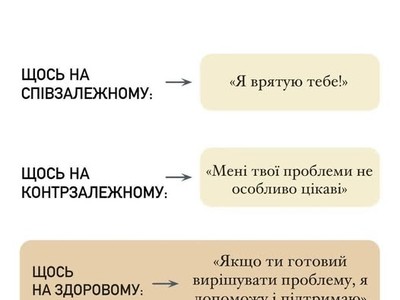
Psychologist page: Maturity in relationships.
Community
In every contact between people there is an invisible space ✨ — what happens between two psyches, two stories, two ways to survive in this world.When we respond with codependency🤍, it's usually about pain that stretches back to childhood.About an experience in which no one saved us — and now we are desperate to save someone else, as if this is what will heal our own wound🩹.There is a lot of fear: to lose, to become unnecessary, to be left alone🌫️.When we respond with counter-dependence, it🛡️'s also not about indifference.It's about an experience in which intimacy was once dangerous⚠️.Where the feelings of the other were covered so much that the only way to survive was to move away, close, not let in🚪.And only when we gradually move to a healthy contact🌱, something new appears — a real ability to be around without losing yourself.Be open but not absorbed🌊.Be attentive, but not responsible for someone else's life🎒.Be a support, but not a rescuer🤝.It's maturity🌿.It forms slowly.Born in an inner place where we already know:“I have my limits🧭.Another person has his own way👣.And we can only truly meet when everyone stands on their own feet. ”It is there that relationships begin that do not exhaust, but nourish✨.They do not destroy, but grow🌳.They are not drawn to extremes, but give resistance and reciprocity⚖️.This is the point where two adult parts are able to really see each other👁️🤍.source: InstitutPsihoterapiiResurs

Psychologist page: How to support yourself in a state of nervous tension?!
Community
When everything is annoying: how to support yourself in a state of nervous tension?!Sometimes we wake up already tense. The heart beats faster, thoughts jump in front of each other, and the world seems too loud and too demanding. This is normal. Nervousness is not a sign of weakness, but a body signal: “I need care.”Here are some simple but deeply effective ways to support yourself when emotions take over:1. Name your feelingsTry to say out loud or write down: "I'm angry now", "I'm scared", "I'm tense". Surprisingly, the simple act of awareness reduces the power of emotions.2. Breathe slowlyStop. Inhale on 4 counts. Exhale for 6. Repeat several times. Breathing is your “inner anchor” in the storm.3. Ask yourself: what can I do right now?Not tomorrow. Not in an hour. And now. It can be: take a sip of water, open the window, go out for 5 minutes in the air. Small actions bring back a sense of control.4. Imagine you're your best friendWhat would you say to someone who feels like you? Warm words? Hugs? Now say it to yourself. You deserve compassion no less than others.5. Limitation of information consumptionNews, messages, social networks — all this can worsen the internal state. Allow yourself an "informational rest".6. Remember: it will passNo emotion is eternal. As clouds float through the sky, so will your condition change. Give yourself time.Taking care of yourself is not a luxury, but a necessity. Sometimes it looks like tea with honey, sometimes — as a "no" to unnecessary things. Listen to yourself. Support yourself. And remember — you are not alone.If you want — share in the comments: what works for you when the world is noisy too loud?!source: InstitutPsihoterapiiResurs

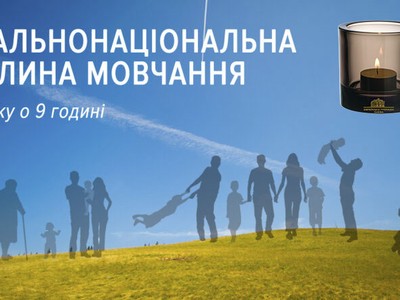
A moment of silence.
Community
Every day at 9:00Cease movement.Shut your mouth.Remember.Honor thememoryof the dead:soldiers, children, peaceful people.Those who are no longer around.But who is with us forever is in the heart.It's not just a minute of silence.It is our dutyIt's humanity.Alive — thanks to those who were lost...........

Ayom Yom: 12 Shevat
Community
Today 12 Shevat 5786,the eve of Saturday Beshalakh.📌 13 Shvata 5702, the Rebbetzin of Stern-Sara, the wife of Rebbe Rashaba and the mother of Rebbe Rajaca, departed from this world.Ayom YomExact translation:Mind and inspiration are two different worlds:the world is cold and balanced and the world is hot and excited.The work of man is to unite them into one whole.Then excitement turns into aspiration,and the mind is the guide in the life of work and action.Source:📖 Lubavitcher calendar
Siha Rebbe to the Weekly Chapter of Beshalakh
Community
🟦SONG OF THE SEA AND THE PATH OF LIBERATIONSiha Rebe for the Weekly ChapterBeshalach🟦Exit is not the end, but the beginningThe head of Beshalakh tells about the moment that at first glance seems to be the pinnacle: the people of Israel leave Egypt, are freed from slavery and see miracles. But the Rebbe emphasizes: this is where the real work begins.Egypt is not only a geographical place, but a state"Metsarim"— restrictions. Leaving Egypt means starting the path of liberation, not completing it.🟦Why a path through the desert?The Torah says that the Almighty did not lead the people by the shortest path. The Rebbe explains: the freedom gained without internal training can be lost. The desert is a process of nurturing, purifying, and strengthening faith.A true geula is built gradually as a person changes from the inside out.🟦The dissection of the sea — the disclosure of the hidden"Kriat Yam Suf"— not just a physical miracle. According to the Rebbe, it is a symbol of revealing what is usually hidden. The sea personifies the concealment of the Divine, the land — openness.When the sea parted, it became obvious: even in the deepest "waters" of the world, the Almighty is present.🟦Shirat ha-Yam - Song of the SeaA song by the sea is not just a thank you for salvation. The Rebbe notes that she is the prototype of the song of the future Liberation.Then they sang because of the miracle that had already happened. In the future, the song will be born from a constant feeling of God's presence in the world.🟦The war with Amalek is an internal battleAmalek, who appears immediately after the miracles, symbolizes cold, doubt and indifference. The Rebbe teaches: the higher the spiritual upliftment, the stronger the resistance.Victory over Amalek is achieved not only by strength, but also by strengthening faith, connection with the Rebbe, and constancy in service.🟦A lesson for our generationThe Rebbe connects Beshalakh with our time — the generation standing on the threshold of Geula. We are already “out of Egypt”, but we are still walking in the desert.Our task is to turn the path into a song: to reveal G-dhood in everyday life and prepare the world for complete and final Liberation.🟦Message of the weekEven if the journey seems long, it is accurate. Each challenge reveals the depth of the soul.And it is from this path that the real song of Geula is born.📖 Lubavitcher calendar
Page of History: Adolfo Kaminski
Community
He was 18 years old.His weapon was an acid bottle.And he saved 14,000 lives.Paris, 1943.Adolfo Kaminski was a dye apprentice and worked in a textile workshop when France was under occupation. He studied chemistry through tissue: how acids interact with inks, which solvents remove pigments, how color changes at the deepest level.He did not yet know that this knowledge would one day become the boundary between life and death for thousands of people.When the systematic identification and deportation of Jews began, bureaucracy became the main tool.ID card. Ration cards. Passes.And there was one decisive word on the documents.One word could rob the future.Resistance found Kaminsky and asked:is it possible to remove this stamp without damaging the paper?It seemed impossible.But Kaminsky mentioned lactic acid — it could dissolve the right ink without destroying the paper fibers.It worked out. Then the jewelry work began: new names, dates, details.Any mistake could have tragic consequences for many.He was hidden in a small attic room.Orders were coming in endlessly.Dozens, hundreds of documents.He worked under a dim light bulb.The vapors of chemicals were corrosiveto the eyes.Hands were constantly in ink.And he counted.30 documents per hour.30 chances to live.He realized that every hour of sleep was a wasted time for those who waited.He almost stopped sleeping.Once it became known that the shelter with hundreds of children was in danger of being inspected.Kaminsky worked for two days without stopping.Until the forces left him.He fell asleep for an hour.He didn't stop when he woke up.He continued.The children survived.At the time of the liberation of Paris, he had helped to save about 14,000 people.He never took the money.For him, life had no price.After the war, he lived quietly, became a photographer and almost never shared his story with anyone.Only at the end of life did the world learn:Heroism is not always loud.Courage is not always armed.Sometimes there is enough knowledge, conviction and refusal to give up.Adolfo Kaminski died in 2023 at the age of 97.His legacy —these are people who live,because one teenager decided,that their life is more important than sleep.

Our dates: 15 Shevat
Community
📌15 Shevat 5612 (February 5, 1852) — Yorzeit (anniversary of the departure from this world) Rabbi Nehemiah of Dubrovna.Rabbi Nehemiah was also born on 15 Shevat 5548 (1788) and was the son-in-law of Rabbi Chaim-Avraham, son of Alter Rebbe. He was a student of the Alter Rebbe, one of the greatest Hasidim of the Miteler Rebbe, and a study partner for the third Lubavitcher Rebbe, Rabbi Menachem-Mendel (Rabbi Tsemakh Tzedek). Rabbi Nehemiah was an outstanding sage (gaon), the author of the book "The Devrei Nehemiah", but he did not want to use the Torah "as a hoe" (that is, to get a living from it) and earned a living by making thales.📌15 Shevat 5620 (January 24, 1788) — The beginning of the writing of the Torah scroll, dedicated to the birth of the fifth Lubavitcher Rabbi, Rabbi Sholom-Dov-Ber.On 10 Kislev that year, Rebbetzin Rivka saw in a dream her mother, Rebbetzin Shane and her grandfather, Miteler Rebbe (the second Lubavitcher Rebbe, Rabbi Dov-Ber), who ordered to write the Torah scroll so that a good son could be born, and the grandfather asked to call the child by his name. Rebbetzin Rivka told her husband, Rabbi Shmuel (the future fourth Lubavitcher Rabbi, Rabbi Maharash), about her dream, and they decided to write a Torah scroll.The beginning of the work had to be postponed: Rebbe Maharash wanted the soifer (Torah scribe) to use the highest level of kosherness for the scroll, but it was not easy to get it. When this was done, the father of Rabbi Maharasha, the third Lubavitcher Rabbi Tsemakh Zedek (Rabbi Menachem-Mendel) ordered that the scroll be written without undue attention, only in the presence of his sons. The writing of the scroll was completed on the 14th hash of the following year, in the room of Rabbi Tsemakh TzedekThe born boy was named Sholom-Dov-Ber and, over time, he headed Chabad, becoming the fifth Lubavitcher Rebbe (Rabbi Rashab).Shevat 📌15, 5700 (January 25, 1940) — Rabbi Levi-Itzhak, the Rebbe's father, was released from prison and sent to exile in the village of Chile.For a month, Rabbi Levi-Itzhak traveled in a "Stolypin" car from the Yekaterinoslav prison to Almaty, and neither the exhausting road nor the overcrowded cars with inhumane conditions prevented Rabbi Levi-Itzhak as much as the lack of water for morning hand washing (11 days of water was not enough even for drinking, but Rabbi Levi-Itzhok, who did not yield to any detail of the Jewish law, even being in such a difficult situation, used this water only for washing his hands).📌15 Shevat train reached the terminal station and after 10 months inprison, Rabbi Levi-Itzhak felt like a man for the first time. However, immediately after arriving at the site, they were sent to remote areas of Kazakhstan, where they had to drag on for years of exile. Rabbi Levi-Itzhak was sent to the most remote place — the village of Chili.source: chabad.odessa