
MEMORIAL PRAYER "IZKOR"
Community
Izkor is a memorial prayer that is recited four times a year: on the last day of Passover, in Shvues (outside Eretz Yisrael – on the second day of the holiday), on Yom Kippur and in Shmini Atzeret.Izkoir is a special prayer in which the one who prays asks the Almighty to give the soul of the deceased peace, light and a place among the souls of the righteous, and also proclaims his intention to make a donation in memory of the soul of the deceased.Izkor's words containing the promise of charity should be taken quite seriously: the promise must be fulfilled after the holiday (because on the holiday, according to Jewish Law, you cannot pay money). If the person is not going to donate, it is better to keep the promise; in this case, you should not say the phrase about donation.According to the custom of most communities, those who have both parents alive leave the synagogue hall while reading Izkor. Izkoir mentions the Jewish nameof the deceased and the Jewish name of his mother, if, of course, it is known. If it is unknown or if the deceased did not have a Jewish name, he is remembered by the name that was usually called during his lifetime.You can order a prayer in the Central Synagogue of Kyiv by calling 063.770.04.43 Zalman

LESSON ON THE NIGHT OF THE 7TH DAY OF PESACH
Community
On Nisan 21, seven days after the Exodus, the Jews found themselves trapped, hemmed in on one side by the pursuing Egyptians and the waters of the Black Sea ("Yam Suf" in Hebrew) on the other. All night the pillar of fire was between the Jews and the Egyptians, and when it dawned, the Most High commanded Moshe: "Lead the people forward!". The first to enter the water was Nachshon ben Aminodav from the tribe of Yehuda. The water receded and the Jews crossed the sea as if on dry land. When the Egyptians rushed after them, the sea waters returned to their usual position, drowning the Egyptians, and the Jews, who were miraculously saved, sang the "Song of the Sea" on the shore. In memory of the miracle of the splitting of the sea, it is customary for men to stay awake and study the Torah on the night from the 6th to the 7th day of Pesach.

MOSHIAH 'S MEAL
Community
Jewish tradition says that on the eighth day of Passover, the glow of the Moshiach light is most strongly revealed in our world. In honor of this day, "seudat Moshiach" ("Moshiach's meal") is arranged, during which, as during the seder, 4 glasses of wine are drunk.📌"Seudat Moshiach" will be held in the Central Synagogue of Kyiv on April 9/Nisan 22 after Minha

Ayom Yom: 19 Nisan
Community
Today is Nisan 19, 5786, the 4th day of the OmerIom-yom🌙“How is this night different?”My grandfather and teacher (Maarash) explained the familiar words of Agada through the prism of the future Liberation:"What is the difference between this night..." — by "night" is meant exile (Galut). How does the current, last exile differ from all previous ones?💧“All nights we don't dive even once…”The word “immerse” (matbilin) indicates the cleansing and “polishing” of the soul. In the previous expulsions, the purification was not completed, because new wanderings came for them.“…and this night — twice”: after the last expulsion, there will be a complete purification — both of the body and the revelation of the very essence of the soul.🍞“All nights we eat leaven or matzah…”Previously, even after liberation, our service to the Almighty was double: we had both the Divine soul (matza — modesty and annulment of the "I") and the animal soul (chamets — ego and pride).“… this night is matzah only”: after the last exile, the spirit of impurity will finally leave the world, and we will have no room for selfishness.🌿“We eat greens all night long…”The word "green" hints at the pallor of the face from jealousy (kina). In previous exiles, there was a different kind of jealousy — even the “jealousy of the wise” (envy of the knowledge of another).“… this night — only bitter herbs (maror)”: after the final Galut, only the highest “jealousy” will remain — when each righteous person “burns himself” with the greatness of another, seeking even greater light and closeness to the Creator.🍷“All night long we eat and sit and lie down…”“Food” is the enjoyment of spiritual revelations. Someone achieved only external pleasure ("sitting"), and someone — deep, essential ("reclining").“… this night we all lie down”: after the last exile, every Jew will receive the highest, essential pleasure from proximity to the Almighty.📖 Lubavitcher calendar
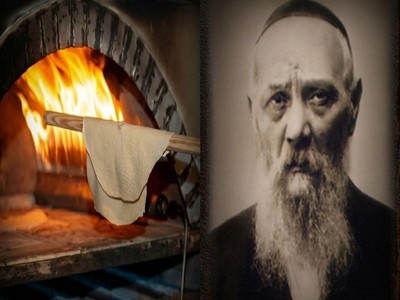
Page of history: 🕯 When even the authorities retreat: how the matzah was infested in the Soviet Union under the supervision of a rabbi
Community
📖 On the eve of Passover, the value of every detail in fulfilling the commandments is particularly acute. But there were times when kashrut required not just diligence, but real self-sacrifice. The story of Rabbi Levi-Itzhak Schneerson, the father of the Lubavitcher Rebbe, is a vivid testimony of how one person, having unshakable faith, was able to change the reality around him.🔥 Rabbi Levi-Yitzhak Schneerson's preparations for Pesach began long before the holiday itself - in fact, for a whole year. It was an extremely complex chain of actions, in which there were no "small things": the search for suitable wheat, strict control of the harvest, proper storage of grain, constant supervision of the grinding process, preparation of mills and replacement of equipment, control of flour transportation and, finally, the organization of the baking itself. All this happened in the conditions of the Soviet reality, where any religious activity could end in arrest.💧 The level of his caution and severity is impressive. Once, during the transportation of flour, the train passed under a bridge, from which water droplets got into one of the cars. Upon learning of this, the rabbi immediately decreed that the whole wagon was unsuitable for baking matzah. The cargo owners tried to object — after all, they were talking about large losses. But the rabbi was adamant: either they obeyed his decision, or he would forbid the use of the entire party. In the end, they had to concede.⚔️ On another occasion, only one drop of water fell on the flour bag. For some, it would seem like a trifle, but not for him. The rabbi personally came to the bakery, cut the bags, destroyed the sieves and banned the use of the entire batch. No one dared to contradict him.⚖️ The same principle was manifested when the owners of the mill wanted to use the old sieve because of the inability to purchase a new one. Despite the high costs, the rabbi categorically refused to give permission without completely replacing the equipment. In the end, the owners obeyed — otherwise their products would simply stop buying.😤 But for the rabbi, it was not only the observance of the law that was important, but also the inner strength of a person. One day, a Jew came to him, who had been standing in line all day to bake matzah and was afraid that his family would be left without food at Passover. In response, the rabbi suddenly said: "Well, what if you are left without matzo?» Hearing this, the man was indignant and spoke sharply. Then the rabbi smiled and said, “Now you'll get your turn. That was the answer I was expecting.” He valued living faith, inner pain, and true determination.🏛 And yet the most spectacular twist came later. Rabbi Levi-Itzhak Schneerson reached the highest echelons of Soviet power and achieved the incredible: the state not only allowed to bake matzah, but also obliged to fulfill all the requirements of kashrut that it would establish. He drew up clear instructions, put his overseers in mills and bakeries — and the authorities obeyed.🌍 That year, Dnipropetrovsk became the only city in the entire Soviet Union where matzah was baked openly and in compliance with all strict requirements. From there, matzo was sent to different parts of the country, and the Jews knew: you can rely on this matzo.⛓️ However, Rabbi Levi-Itzhak Schneerson himself almost did not have time to take advantage of the fruits of his labor. Shortly before Passover, he was arrested. One of the accusations was that he openly stated that matzah, which does not comply with the laws of the Torah, is chametz and forbidden. He went into exile, but he did not depart from his principles.🕊 Subsequently, the Lubavitcher Rebbe, speaking about this, emphasized an important lesson: not everyone has to confront a large system. But everyone must be able to resist himself — his fear, doubts, inner resistance. When a person stands firm, with the knowledge that the Almighty is next to him, even the most powerful forces in the world can retreat.✨ Passover is not only liberation from external slavery, but also the freedom to be faithful to the truth.Let this Passover be truly kosher, joyful and filled with inner strength to go to the end — just as our righteous ones did.Source:📖 Lubavitcher calendar
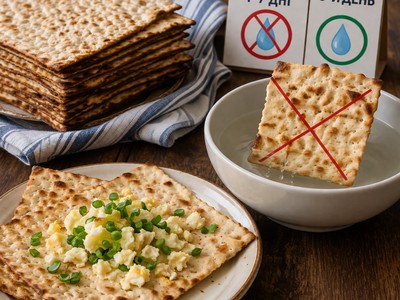
"Shruya" and the 8th day (dry and wet matzah)
Community
In the first 7 days of Passover in Chabad, the matzah should not come into contact with water (no knedles). There are fears that the crumb of flour inside the matzah may not have baked and will become chametz.But on the 8th day (outside Israel), the Hasidim deliberately eat “wet” matzah to show that it was only voluntary austerity.Source:📖 Lubavitcher Calendar
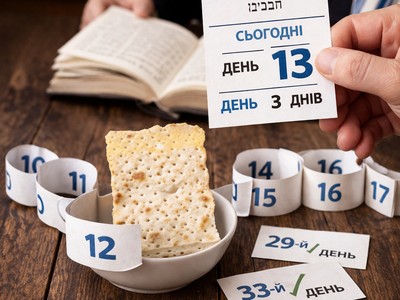
Question to the Rabbi: What should I do if I missed the day of Omer's countdown?
Community
It happens: I twisted, forgot, fell asleep — and now the chain of days was interrupted. What if one day of Omer's account is missed? Rav Benzion Silber explains the halachic side of the issue, based on the classic disputes of the sages:There is an opinion of the author of "Alahot Gdolot" that all 49 days of the account are one big commandment. I missed the link — I broke the whole chain. But the authors of "Tosafot" do not agree with this: every day is a separate power.We follow the opinion of "Tosafot" and continue to count further! However, in order not to say the blessing (bracha) in vain (taking into account the opinion of Alakhot Gdolot), Shulkhan Arukh decrees: you need to count, but without pronouncing bracha.If you still want to “credit” the blessing, ask someone who counts on time to keep you in mind when pronouncing his brahma (or listen carefully to the cantor in the synagogue).Rabbi Benzion Silber's main advice is: “Keep counting with joy and work on your spiritual growth.” Mistake is not a reason to give up what you started, but an opportunity to show perseverance.Source:toldot.com

Our dates: 21-23 Nisan
Community
📌21 Nisan 2447 (1314 BC) — Moshe leaves Midian.Seven days after the conversation with the Almighty, who appearedto him in a burning bush, Moshe agrees to the task offered to him — to free the Jews from slavery. With the consent of his father-in-law, Jethro, he sets his wife and children on a donkey and travels to Egypt to tell Pharaoh, “Let my people go.”📌21 Nisan 2448 (1313 BC) — Division of the Red Sea.Seven days after the Exodus, the Jews were trapped, trapped on one side by the Egyptians who pursued them and by the waters of the Red Sea (“Yam Suf” in Hebrew) on the other.All night long the pillar of fire was between the Jews and the Egyptians, and when it dawned, the Most High commanded Moses, “Lead the people forward!”The first to enter the water was Nahshon ben Aminodab from the tribes of Judah. The water receded, and the Jews crossed the sea as if on dry land. When the Egyptians rushed after them, the sea waters returned to their normal state, drowning the Egyptians, and the Jews, who miraculously escaped, sang the Song of the Sea on the shore.Nisan 📌22, 5608 (April 25, 1848) — Yorzeit (the anniversary of the departure from this world) Rabbi Yitzhak Kalish from Vorka.Rabbi Yitzchak was brought to Hasidism by his father, Rabbi Shimon Kalish. His teachers were Rabbi David from Lelov, Rabbi Yaakov Yitzchak ha-Levi Horowitz (the Seer from Lublin), Rabbi Simha-Bunem from Pszysha and his son Avraham-Moshe. After their death, he chose Rabbi Menachem-Mendel of Kotsk (Kotsker Rebbe) as his new mentor and befriended his students Rabbi Yitzhak-Meir of Hur and Rabbi Hanoch-Enoch of Aleksandrov. After Avraham-Moshe's death, Yitzhak settled in Przyska and became a recognized leader of the local Hasidim, but after some time he moved to the small town of Warka (near Warsaw). Here many followers gathered around him, and 114 (!) Hasidic rebbe emerged from among his students. Rabbi Yitzchak made many efforts to abolish the forced conscription of young Jews into military service (cantonists) and the ban on wearing traditional Jewish clothing, but these efforts were unsuccessful.Nisan 📌23, 5340 (May 8, 1580) — Yorzeit (anniversary of the departure from this world) Rabbi Moshe of Trani (Ha-Mabit).Rabbi Moshe was the son of the famous sage Rabbi Yosef from the Greek town of Trani. At the age of 16, he moved to Eretz Yisrael and settled in Safed. He began his studies in the famous yeshiva of Rabbi Yaakov Beirav and became one of the four disciples who received laughter (a certificate of consecration to the rabbis) from Rabbi Yaakov. The other three are the author of "Shulchan Aruch" Rabbi Yosef Karo, the famous cabalist Rabbi Moshe Cordovero and Rabbi Yosef Sagis.Soon Rabbi Moshe (known as Ha-Mabit by the title of one of his books) began teaching himself. Famous scholars came out of the walls of his yeshiva, and the greatest sages of Safed recognized the authority of Rabbi Moshe, consulting with him on Jewish law.source: chabad.odessa

Our dates: 26 Nisan
Community
26 Nisan 2115 (1245 BC) — Yorzeit (the anniversary of the departure from this world) Rabbi Yehoshua bin Nun.Rabbi Joshua bin Nun (Joshua in biblical translations) was the successor of Moses and the leader of the Jewish people during the settlement and conquest of Eretz Israel.Yehoshua was born in Egypt, and at first his name was Oshea (later, already in the desert at the direction of the Almighty, it was changed, and the letter “yud” (I) (in the Hebrew version) was added to it). Tradition says that it was the same letter “yud” that was subtracted on behalf of Avraham's wife Sarah (formerly called Sarai).Rabbi Yehoshua accompanied Moses when he ascended Mount Sinai, and guarded the Tabernacle (the Ark of the Covenant) in Moses' absence, and led the Jews in the battle with the Amalekites at Rephidim (Ex. 17:9–13). As one of the 12 spies sent to explore the land of Canaan, Yehoshua ben Nun together with Caleb ben Yefuneh contradicted the ten others who were frightened by the enemy's forces and insisted on entering the land promised by the Most High. As a reward for their steadfastness and faith in victory, only Yehoshua and Kalev—two of the entire generation—were granted the opportunity to enter the Promised Land. Moshe Rabbeinu was appointed by Yeshua as his successor, entrusting him with the responsibility of conquering Eretz Yisrael and dividing it among the tribes of Israel.Yeshua's wife was a woman named Rahab, the owner of the courtyard in Jericho, who at one time saved the scouts who came to this city.chabad.odessa

A moment of silence.
Community
Every day at 9:00Cease movement.Shut your mouth.Remember.Honor thememoryof the dead:soldiers, children, peaceful people.Those who are no longer around.But who is with us forever is in the heart.It's not just a minute of silence.It is our dutyIt's humanity.Alive — thanks to those who were lost...........

Psychologist's page: Accepting change is not about weakness.
Community
Embracing change is not about weakness.It's about the path.When something in life changes — a job, a relationship, a place of residence, or even our own views — we rarely say right away, “Great, I'm ready.”More often than not, shock comes first.Then the objection: “No, it can't be.”Next — anger, frustration, despair. Sometimes even a feeling of complete emptiness.And that’s okay.Change is a process. The psyche takes time to “digest” the new reality. We are not robots to adapt instantly. We are people with emotions, fears and experiences.But after the lowest point, there is gradually room for solution.“Okay, what can I do?”Then — the first small experiments.And over time — adaptation. Acceptance: A new balance.It is important to remember: if it is difficult now, it does not mean that it will always be so.Each phase has its own meaning. And each one is temporary.Give yourself the right to walk this path at your own pace.No shame. No comparison. No self-blame.Because embracing change is not a leap.It's a road. And you're already going through it.source: InstitutPsihoterapiiResurs