
Our dates: 24 Adars
Community
📌24 Adar 5577 (March 17, 1817) — Alexander I forbids blood libel.On this day, a royal decree announced that the accusation of Jews using the blood of Christian children to prepare matzah — an accusation that for centuries led to the death of Jews — was a lie, but a hundred years later, anti-Semites tried to revive bloody slander by initiating the so-called “Beilis case”.📌24 Adar I 5700 (March 4, 1940) — The sixth Lubavitcher Rabbi, Rabbi Yosef-Yitzhak (Rabbi Rajac) leaves Riga.On this day, Rabbi Rajacand his family left Riga through Stockholm for Gothenburg to sail to the United States.source: chabad.odessa

Our dates: 25 Adars
Community
*25 adar3364 (397 BC) — Death of the Babylonian ruler Nebuchadnezzar.On this day, Nebuchadnezzar died (in Hebrew — Nebuchadnezzar, the Babylonians called him Nabukuduriuszur), the ruler of the Babylonian Empire, who 26 years earlier had captured Jerusalem and destroyed the First Temple.*25 adar5525 (March 18, 1765) — Yorzeit (anniversary of the departure from this world) Rabbi Avraham-Gershon Kutover, brother-in-law of Rabbi Baal Shem-Tov.While still living in the town of Okup, Rabbi Yisrael Baal Shem-Tov became a member of the secret union of Kabbalist-Nistarim (that is, "hidden righteous"). At that time he was 14 years old, but by the age of 18 he was already playing a prominent role among the Nystarim, although outwardly he did not stand out among other Jews. Having reached his 18th birthday, Rabbi Yisrael went to Brody, where he earned money by teaching young children. Then he married the merchant's daughter, Rabbi Abraham, but the merchant's son, the rabbi of the town of Brody, met the brother-in-law very coldly at first, who looked completely ignorant and did not want to learn at all (Rabbi Gershon tried to teach him Jewish sciences, but the brother-in-law turned out to be completely "incapable" of learning). The relationship between the two relatives did not work out, and Rabbi Gershon even offered his sister to leave Brody, so as not to embarrass him with an ignorant and lazy relative.The young couple left, but when Rabbi Baal Shem-Tov opened up and began to spread Hasidism, Rabbi Gershon became one of his most faithful and devoted students.Subsequently, Rabbi Gershon, along with a group of Hasidim, moved to Eretz Israel, settling in Hebron and Jerusalem.*25 adar5661 (March 16, 1901) — Birthday of the Rebbe's wife, Rebbetzin Hai-Mushka.She was born in the Belarusian town of Babinovichi not far from the then Chabad "capital" — Lubavitcher and was the second daughter of the previous, sixth, Rabbi — Rabbi Yosef-Yitzhak (Rabbi Rayats) and the granddaughter of the fifth Rabbi — Rabbi Sholom-Dov-Bera (Rabbi Rashab). At the request of her grandfather, Rabbi Rashab, the girl was named Khaya-Mushka in honor of the great-great-grandmother, the wife of the third Rebbe — Rabbi Menachem-Mendel (known as Rabbi Tsemakh Tzedek).Rebbetzin Khaya-Mushka was the Rebbe's faithful assistant. She was distinguished by high scholarship in the Torah and a sharp mind, but most of all people appreciated her subtle sense of humor and warm attitude towards everyone around her.

Question to the Rabbi: What is Bar - Mitzvah?
Community
Bar mitzvah— one of the most important moments in the life of a Jewish boy. This is the name of the day when he turns 13 years old and becomes obliged to obey the commandments of the Torah. The expression itselfbar mitzvaharamaic means “son of the commandment.” From this age, the boy is already considered an adult in terms of Jewish law and is personally responsible for the implementation of613 commandments of the TorahN o t a r yBy this time, the child is also acquainted with traditions and learns to adhere to them, but formally the responsibility lies with the parents. The sages decided that the father should gradually teach the son the commandments — prayer, blessings, study of the Torah. The Bar Mitzvah symbolizes the transition from preparation to full spiritual responsibility.On the day of the bar mitzvah, it is customary to arrange a festive meal. This is not just a family holiday, but a special joy — because the guy gets the opportunity to fulfill the commandments and serve the Almighty. Jewish tradition emphasizes that the joy of fulfilling the commandments must be very great. KabbalistArizalwrote that a person should rejoice in the performance of the mitzvah even more than if he had found a great treasure.Many sages compared a bar mitzvah meal to a wedding banquet. In the halakhic literature, it is noted that this is one of the most significant festive meals. On this day, we thank the Almighty for the fact that the boy grew up and reached the age of spiritual maturity, and his parents were honored to raise him and lead him to the fulfillment of the Torah.Part of the celebration is usually a small speech or a Torah lesson.drasha. The young man himself or one of the adults explains a verse from the Tanakh or an opinion from the sages' comments. It is emphasized that growing up in Judaism is associated not only with age, but also with the study of the Torah.Kabbalistic sources say that on the day of the bar mitzvah, a person receives a special spiritual force — a higher soul, which helps him fulfill the commandments. Therefore, this day is considered the beginning of a new stage of life.A bar mitzvah is not just a holiday or a family celebration. This is the moment when the young man becomes a full participant in the Jewish tradition and takes responsibility for his spiritual life. That is why this day is celebrated with joy, gratitude and a sense of the beginning of a great new path.

Ayom Yom:22 Adara
Community
Today 22 Adara1ლMy father (Rebbe Rashab) writes in one of his maamaras:What is said about the Third Meal: “there is no…”, etc., means that there is no obligation to eat bread, but you should try some food. And he said to Rabbi Yossi:“May my fate be among those who consume three meals.”The teachings of Alter Rebe at the beginning of his stay in Liozno:May a person always be especially attentive to prayerMinha. The Advantage of Mincha Prayer over PrayersShaharit andMaarivis that it occurs in the middle of the day — at a time when people are busy and burdened with their own affairs, but still interrupt them for the sake of the Minha prayer.2ლThe Blessing of the Cohens (Birkat Koganim) is the lowering of the higher mind (continued Moheen). Raising your hands is raising your heart. (raising Midot). And they bless Israel, who are called “sons of kings” (from the wordMalchutKingdomThus, this process manifests a completePartzufconsisting of tenSefirotN o t a r y📖 Lubavitcher calendar.

Story page: Thought-provoking stories
Community
📜Behind the scenes of Lyubavych: stories that make you thinkWe share a selection of rare episodes from the lives of the Lubavitcher Rebbe and their Hasidim. These short sketches contain humor, deep psychology, and the harsh reality of the past years.🍷Prohibition and the EpidemicDuring the First World War, a ban on the production of strong drinks ("mashka") was introduced in Lyubavichy, as the recruits staged riots. The local rabbi even imposed a strictherem(prohibition).Soon, an epidemic of diphtheria broke out in the town, mowing down the children.Rebbe Rashab, who was then abroad, learned of this and wrote a sharp letter: immediately lift the ban on alcohol, declare fasting and read prayers for recovery.Eyewitnesses mentioned: just nowheremwas withdrawn, the doctor confirmed that there were no new cases ofthe disease, and the patients began to recover.🍱"Lunch interferes"One of the yeshiva students (“tomim”) prayed long and diligently, but his study of the Talmud was weaker.A mentor asked him:“You are so deeply immersed in prayer — why don't you study with the same fervor? After all, the Torah is the wisdom of the Almighty!"The young man answered simply:“Lunch interferes…”(that is, it interrupts the spiritual mood).When the Rebbe was told about this answer, he laughed loudly and confirmed in Yiddish:"I-I, der varemes with mafsik"(Yes, yes, lunch does get in the way.)🧠Intelligence without working on yourselfOne Pinya from Pryluky studied in Lyubavychi. He was considered a brilliant connoisseur of the philosophy of Hasidism ("maskil"). But over time, he withdrew from the faith and became a secular person.Many years later, in Soviet times, he was met at the Hasidic feast in Poltava. Despite the lack of a beard, he was received very warmly.To an old friend's question:"Pina, what was the first reason for your going down this path?" he replied:“I hadintellectual understanding(Haskala), but there was nointernal work(Avoda).»Knowledge without working on one's own character turned out to be fragile.👶“Don't cry, you'll be a Rebbe”It is said that during the circumcision of the future Rebbe Rajac, his grandfather, Rebbe Maarash, said to the baby who was crying:“Don't cry, you'll be the Rebbe.”Interestingly, the Hasidim present at that time were even angry at these words. Why? Because at that time everyone was absolutely sure that his father, Rashab, would be the next Rebbe, and he would be the Mashiach.👤The “me” problemOne man refused the offered glass on the table, proudly showing that he had a whole bottle of his own drink in his pocket.The Rebbe remarked with a smile:“Why do you boast about what you have? It is pride and materiality. Esav also said:“I have a lot”(ish li rav) is properly prepared and signed by appropriate authority.Keep it simple — be an ordinary Jew!”📖Lubavitcher calendarN o t a r y

Blessing After Eating
Community
The blessing we recite after eating reveals another aspect of this commandment. After all, one would think that since we have already thanked the Almighty by saying a blessing before eating, there is no need to thank Him again. Therefore, the Torah commands us: even after we have eaten and are full, we must again pay attention to the good that the Almighty has sent to us and to all the people of Israel, thank Him and bless Him. It is said (Two Romans 8:10):“And thou shalt eat, and be filled, and bless the Lord thy God for the good land which he hath given thee.”This blessing helps us to use the powers gained from food in order to multiply goodness and life in the world.This commandment teaches us a very important rule. Usually, when a person feels hunger, he understands that he needs help and turns to the Almighty. But when she is full and feels good, she can limit herself only to the joy of eating and forget about the Most High and the ideals that she should embody: to strengthen her faith, to discover the Divine presence on the blessed land that He gave us, to preserve the loyalty of the alliance between Israel and the Most High, to fulfill the commandments of the Holy Torah, to ask the Most High for good for the people of Israel, to pray for the revival of Jerusalem and the construction of the Temple, you are material the world, turning it into a Divine kingdom.All these values are mentioned inBlessed after the meal (Birkat ga-mazon)as will be explained below.Birkat ga-masononly the one who ate the bread reads. If a person ate any ofthe seven fruits for which the Land of Israel is famous (shivat ha-minim), including any of the five types of cereals (wheat, barley, spelt, oats, rye) — after a meal, she recites a blessing calledMe-ane Shalosh(“Triple Blessing”), because it contains three Birkat ga-mazon blessings in abbreviated form. The authorities differ as to whether the reading of the Meynayn shalosh is a commandment of the Torah or a decree of the wise.The sages also decreed that anyone who ate food or drank drinks that did not belong to shivat ha-minim and enjoyed it should recite a short blessing after eating or drinking"He who created many souls" (bore nefashot)N o t a r yIn order to pronounce the final blessing, a person must eat at leastke-zaitto eat or drink at leastrevitisliquid, that is, an amount sufficient to feel satiated. Only under this condition are blessings recited after eating or drinking.It should also be added that sometimes after eating, a person is overwhelmed with sadness. Perhaps this is due to the fact that, sitting down to a meal, she hoped to get joy and pleasure from delicious food, but after eating, the sadness did not disappear. Sometimes heaviness in the stomach causes mild depression. It also happens that a person regrets: he again lacked willpower, and he ate too much.If a person readsBirkat ga-masonwith proper concentration and the right inner mood, this helps to get rid of unpleasant sensations and give the meal a higher spiritual meaning. Even if she ate too much, reading Birkat gaz-mason can fix it — turning heaviness and sadness into energy and joy.That is why after large mealsBirkat ga-masonread over a glass of wine — to finish the meal with a feeling of joy and gratitude to the Creator.According to the book "Pearls of Halakha"
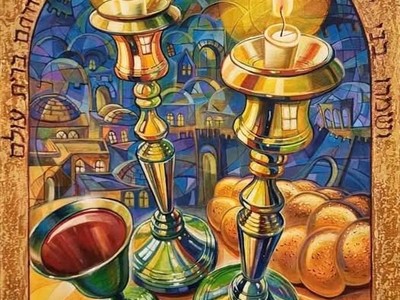
Shabbat. Every 7 days is a priceless gift from G-d.
Community
When we got married over a decade ago, we made some important, fundamental decisions.One thing sounded like this: we will learn to live Jewish all our lives, while our children are already living and will live a full-fledged Jewish lifeThe second thing was this: on Shabbat, we will always have guests, because this is an extremely important commandment. Because all Jews are one family, one living organism, one whole at the metaphysical level.Even the Rebbe wrote in a letter: if you want children to grow up to be good people, make sure that the door is always open in your house and there are always guests.And now, after more than ten years of Shabbat and more than three thousand guests, I want to share my thoughts on Shabbat.Because every Friday evening, each person has a unique opportunity to "teleport to eternity." But it depends on how a person lives these holidays for 25 hours.When you live the Sabbath both quantitatively and qualitatively — at a high spiritual level — you come out of it a holistic and full of strength person.This is because Judaism as a concept is the constant connectionof each person with eternity, truth, and wholeness.It is a holistic system of knowledge, worldview and lifestyle that makes a person harmoniously happy and balanced in everything — from sports to business, from medicine to biohacking, from culture to moral ethics.Therefore, you should not look at Shabbat superficially as a dry technical adherence to the rules:turn off the phone, light the candles, after 25 hours light the candle again, make Awdala and turn on the phone again.But that's not the case. This is just the tip of the iceberg of perception.The Sabbath will fill life as much as you treat it, as much as you fill it, and how long — in time and in inner feeling — you cherish it.And in the end, you realize that he cares about you much more than you care about him.If you have the correct order of living on Shabbat — it does not matter whether you are married or not, have ten children or do not have any children — you are still moving according to the scenario of maximum happiness in life.Because this scenario is thousands of years old. This is how people have lived Shabbat for decades.It does not matter when Shabbat comes — in winter or in summer.If you turn off your phone, light candles and just lie at home for 24 hours, then, of course, at three o'clock you will start to get bored. And every such Sabbath will seem monotonous.But if you turned off the phone, lit candles, went to the synagogue, listened to the lesson, prayed, made a meal and Kiddush at home or at a party;then plunged into the mikvah in the morning, prayed the morning prayer, made the Kiddush and the meal again, read, talked, prayed the afternoon prayer, learned, maybe slept a little or walked;and then I did the evening prayer and to Awdal — then you completely rebooted.Therefore, you create the Sabbath yourself.There is an entry point, there is an exit point. And inside — 25 hours of absolutely fantastic, timeless intellectual adventures, content, inspiration and inner changes.You fill these 25 hours with the right set of actions, thoughts and words: prayers, painters, books and the right people who also fill the Sabbath with meaning and values.This is a large chain reaction of lighting candles — at the entrance and exit — around the globe during the 25 holy hours of Shabbat. It involves millions of Jews every seven days.And this undoubtedly brings joy to G-d and fills the next week with blessings.This has been the case for many centuries.And so on. Findings:no matter what level you are at, you need to move forward in observing the Sabbath and dive deeper into it, filling your life with an increasing sense of happiness and joy every week.source: urokitorijew

Psychologist page: We are all born with the need for connection.
Community
Emotional attachment is that invisible thread that keeps us close to those who are important to us.It's more than love or sympathy.It is a feeling of "I can trust you", "you are there when I am afraid", "I am not alone".🧶 When attachment is secure:– we can be vulnerable without fear of loss– conflicts are not the end, but an opportunity to better understand each other– support appears: inside and between us⚠️ But when attachment is traumatized, we can:– hold on to the relationship even in harm's way– Fear of being abandoned and being overly controlled– or vice versa — to withdraw in order to prevent painAttachmentis not a sentence.It's a space that can be healed.Through therapy. Through a new experience of intimacy. Through tenderness for oneself and the other.Because being around is a skill that grows in safe soil.What was the attachment experience like for you?source: InstitutPsihoterapiiResurs

Iom-yom: 26 Adara II
Community
All that is holy to the people of G-d Abraham and constitutes the foundation of the house of Israel — the creation and upbringing of the righteous generation, the kosher diet, the exalted pure holiness of the Sabbath — has been entrusted by the great and formidable G-d to Jewish women to preserve and perfect it.A woman who fulfills her duty and her purpose in the life of the family, in the management of the home, in education in the spirit of the Torah — about such a woman it is said:“A woman's wisdom builds her house.”

Our dates: 27 Adars
Community
📌27 Adar 3363 (397 BC) — The death of Zidchia, the last king of Judah.Tsidkiah was the last king from the house of David to rule in Eretz Yisrael (Moshiach will be next). He ascended the throne in 434 BCE, after Nebuchadnezzar led his nephew, King Jehoiachin, to Babylon. In 425 BC, Zedekiah rebelled against Babylon, and Nebuchadnezzar besieged Jerusalem (see Teta 10). In the summer of 423 BC, he breached the city wall (see 17 Tammuz), destroyed the First Temple (9 Av), and led many Jews to Babylon.It is said that the king fled from Jerusalem through a cave that stretched all the way to Jericho, but chasing the deer that ran into the camp, the Babylonians reached the exit from the cave at the very moment when the fugitive left it. The sons of Zidkiah were killed before his eyes, after which he himself was blinded and shackled to Babylonia.Zidkiah was held captive until the death of Nebuchadnezzar (see 25 Adar) in 397 BC. 27 Adar son of Nebuchadnezzar freed Zidkiah and Jechoniah, but on the same day Zidkiah died.📌27 Adar I 5752 (March 3, 1992) — Rebbe's Disease.On this day, the Rebbe was praying at the grave of his father-in-law, the sixth Lubavitcher Rabbi Yosef-Yitzchak (Rabbi Rajac), when he suffered a stroke. On the same day, two years later, there was a second stroke, and three months later, 3 tammuz, he left this world.source: chabad.odessa

Our dates: 28 Adars
Community
*28 adarcirca 3900 (2nd century) — Abolition of the prohibition of circumcision and Sabbath observance.At the time of the compilation of the Talmud, this day celebrated the abolition of the decree of the Roman authorities, which prohibited circumcision and the observance of the Sabbath. The decree was revoked thanks to the efforts of Rabbi Yehuda bin Shammua and his associates.*28 adar5701 (March 27, 1941) — Yorzeit (anniversary of the departure from this world) Rabbi Moshe Ornstein, son-in-law of the fourth Rabbi — Rabbi Shmuel (Rabbi Maharash).Rabbi Moshe Ornstein was married to Rebbe Maharash's daughter Khaya-Mushka and owned one of the largest sugar factories in Russia. The Russian revolution forced him to take up another business and move to the Polish city of Otwock, where he spent the last decades of his life. At the beginning of World War II and the invasion of Poland by German troops, Rabbi Moshe fell ill and could not escape the persecution of the Nazis.source: chabad.odessa