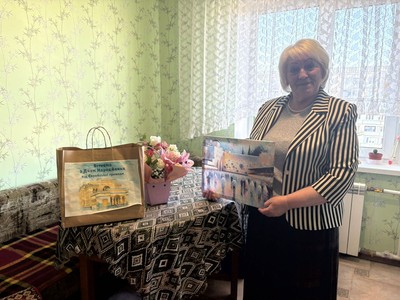
Mazal tov, Faina Yakivna!
Community
Yesterday, on 27 Nisan/ 14 Kitnya, representatives of the Community sincerely congratulated Kuzmenko Faina Yakivna on her respectful anniversary — the 80th anniversary.This is a special date, behind which stands a whole life — full of experience, wisdom, warmth and humanity. Faina Yakivna is a person with whom sincerity, kindness and inner strength are felt.On this day, we had the opportunity to personally express our gratitude, give attention and share the joy of this event. May your health be strong, your heart be calm, and every day bring light, care of loved ones and quiet joy.Happy anniversary! Mazal Tov! To 120!

⚡️ “Now it's in your hands”: the night the Rebbe handed over the keys to the future to us
Community
Imagine: the spring of 1991. Brooklyn - The Rebbe, who has led the Jewish people through the toughest trials for decades, walks out to his followers after an evening of prayer. But instead of the usual guidelines, words are heard that even today, 35 years later, make the heart beat faster.This was the “official sikh” of 28 Nisan 5751 (1991) — the moment when responsibility for the fate of the world was officially transferred to each of us.📉 "Incomprehensible!" — pain and scream of the heartThe Rebbe began his speech with an impressive confession. Despite all the wonders of the time, he expressed deep pain at the fact that the world has not yet reached perfection:“How is it possible that despite everything that has happened and is happening, the Liberation (of Geula) has not yet come in reality? It's completely incomprehensible!”His criticism was aimed at indifference. He wondered how people could go to bed peacefully knowing that the world was still full of darkness:“When ten Jews come together… and at the same time they do not “ make a fuss”to demand the immediate coming of the Messiah! It seems perfectly acceptable to them, God forbid, that he does not come tonight, tomorrow, or the day after tomorrow!”⚡️ The main task: "Do everything in your power!"The Rebbe said bluntly that he had done all he could, and now that work was on our shoulders. This is not just a request from a leader — it is a transfer of responsibility:“What else can I do? Everything that has been done so far has not led to the final result, because we are still in exile. The only thing left for me to do is to hand this case over to you.”After that, words were uttered that became the motto for an entire generation:“Do everything in your power to bring the Deliverance immediately, right now!”💡 What does this mean for us today?Many people then asked: "What exactly should we do? We're just people." Later, the Rebbe explained that the path to the goal is through:Conscious learningWe must study the Torah, especially those chapters that deal with the future world and Liberation. This changes our thinking and helps us see the world differently.Sincerity, not habitWhen we ask for change, it shouldn't be a formality. We have to really want it.Personal initiativeThe Rebbe said, “Let there be one, two, or three among you who will make a plan — what to do and how to do it.”"I made my own — from now on, you do it"These words are not a reason for despair, but the highest level of trust. The Rebbe believed that our generation had enough strength to complete the beginning. Every good deed, every minute of learning and every act of helping another is the same step that brings us closer to a perfect world.📢 Share this post! Today, the responsibility for Gaul in this world lies with each of us.Source:📖 Lubavitcher calendar
The thirteenth day of Omer's countdown.
Community
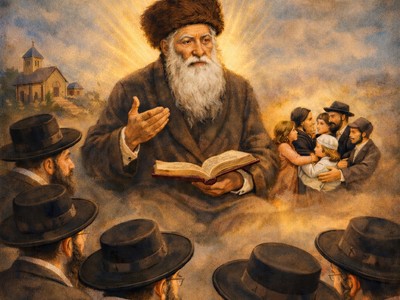
28 NisanThe thirteenth day of Omer's countdown.The Hasidim asked Alter Rebbe: "Which ministry is higher — the fulfillment of the commandment to love the Almighty or the fulfillment of the commandment to love the Jews?"He replied that the love for the Almighty and the love for the Jews are together engraved in the soul of every Jew — namely, at the levels of "neshamah", "ruach" and "nefesh" (levels of the Jewish soul). The Scripture says plainly (Malachi 1:2), “I have loved you,” says the Most High. It follows that the highest is the fulfillment of the commandment of love for the Jews — "to love what the Beloved loves."Notes:.In the letter from which the above teaching is taken (volume 3, p. 425), the Hasidic farbrand was described, on which Miteler Rebe was present. During the paint brangen, one of the Hasidim raised a glass and said: "May G-d help me to gain true love for Him!"Shortly thereafter, Miteler Rebbe raised his glass and said, “May God help me earnestly love my Jewish brother!”Disputes among the Hasidim about which ministry was more sublime lasted for several weeks. In the end, they addressed this question to the Alter Rebbe, who gave the above answer.Source:https://moshiach.ru/yom-yom.php

📸 Levi-Itzhak Freudin: the photographer who captured the era
Community
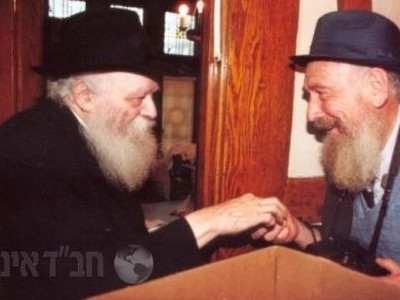
Meet the man with whose eyes we see thousands of moments from the life of the Rebbe — the River Levi-Itzhak (Levi-Iche) Freudin (1921–1992).He was not just a photographer, but a real "court chronicler" of the court of the Lubavitcher Rebbe, who left behind tens of thousands of photographs and invaluable hours of video chronicles.📜The path from the USSR to "770"Levi-Itzhak was born in the town of Postavy (Vilna province) in the family of a rabbi. He went through World War II in the ranks of the Soviet army, where he began to return to his roots because of the Lubavitcher Hasidim. Unfortunately, in 1942, his entire family died at the hands of the Nazis.After his repatriation to Israel in 1975 (5736), he first came to the Rebbe for the month of Tishrei with his own camera. From that moment, his unique mission began.🎥Special treatment for the RebbeFreudin received signs of attention that went beyond the usual:With humor:one day in 1976, when Levi-Itzhak was lying on the ground to catch the best angle for the photo of the Kiddush of Levana, the Rebbe smiled and said:“Write down that you took this photo while lying down.” Subsequently, the Rebbe personally signed this picture.Protectionwhen he first tried to shoot Brach's Kos Shel, the students wanted to stop him, but the Rebbe personally intervened and asked to leave the photographer alone.Companion:The Rebbe repeatedly stopped the car to give Freudin a clear shot, and sometimes even invited him to go together — from home to “770”.🧔"The Divine Image"The Rebbe personally influenced Levi-Itzhak to grow a beard. When he arrived with a beard in 1983, the Rebbe thanked him with the words:"Thank you for coming with both tools (cameras) and the image of G-d (Elokim's goal is a hint of a beard)."🎞️InheritanceFreudin had a deep Hasidic feeling. He refused to take pictures of people as they passed by the Rebbe if he saw that they thought of a “good shot” more than the very moment of meeting the righteous.After his departure on 29 Nisan 5752 (1992), his vast archive was redeemed by the JEM organization. Today, almost every high-quality video or photo of the Rebbe of the 70-80s is the fruit of his selfless work.Light memoryof the master who gave us the opportunity to see the Rebbe today! 🕯️source: 📖Lubavitcher Calendar (https://t.me/+8KbDy9dQVqAxZWE8)

Ayom Yom: Nisan 30
Community
Today is 30 Iyar 5786. 15th day of Omer, 1st day of Rosh Chodesh, Shabbat Eve. The weekly chapter is Tazria-Metzora.📌 1 Iyar 5716 (1956) — a murder occurred at a vocational school (Beit Sefer le Melaha) in Kfar Chabad.📌 1 Iyar 5736 (1976) — The Rebbe chose the first six of the Twelve Verses and asked that each Jewish child learn them by heart and repeat them at any time.Farbrangens during the third meal, on Shabbat Mevarhim, on the holidays of the Chabad calendar ("Yomei de Pagra"), as well as in Rosh Chodesh, should be held in the synagogue.Farbrengen "Melave Malka", in turn, should take place in the homes of community members (Anash).📖 Lubavitcher Calendar (Lubav(https://t.me/+8KbDy9dQVqAxZWE8 ))
🕯 70 years of tragedy in Kfar Chabad
Community
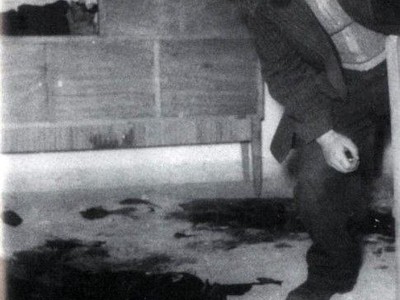
Tomorrow (1 Iyara), the Hasidim of Chabad around the world will celebrate the mournful and at the same time heroic date — the 70th anniversary of the terrorist attack in Kfar Chabad. This event, which went down in history as the “Yad HaHamish Massacre,” became one of the most difficult tests for the young Israeli settlement, but it was she who determined its future.🌑 The night the lights went outApril 11, 1956 (night of 1 Iyar 5716). In a small building of a vocational school ("Beit Sefer la Melaha") in Kfar Chabad, the evening prayer of the Maars continued. About 50 students and their mentors prayed the Amida prayer.Suddenly, three figures — fedayeen terrorists — appear at the door. Silence of prayer is broken by automatic bursts. One of the students, Asher Kadosh, starts throwing the children out the windows, saving their lives. Another student, Moshe Shapira, manages to rip the plugs from the switchboard so that complete darkness prevents the killers from aiming.When the light turned on again, a terrible picture opened up. On the floor, in puddles of blood, lay the bodies of Simha Silberstrom's mentor and five students: Nishima Assis, Moshe Pepper, Shlomo Mizrachi, Albert Edri and Amos Uzan.📜 “No step back”: Rebbe's responseThe settlement plunged into a deep crisis. Fear binds the inhabitants: many thought to leave Kfar Chabad. But the answer of the Seventh Lubavitcher Rebbe was firm and uncompromising: "Ish bal yazuz mi-mekomo" — no person will move from his place.The Rebbe was not only comforting — he was calling for action. His motto was: “Where the quality of the Court (Guur) has manifested, now the quality of Mercy (Rahamim) must manifest.”The Rebbe demanded:Not to flee, but to build. Expand settlements, erect new buildings.Increase light: In response to the murder, the Yad HaHamisha (Memory of the Five) printing press was established to print Torah books wherever blood was spilled.Living ConnectionThe Rebbe sent a special delegation of 11 of his envoys (Shluchim) to Israel to raise the spirits of the Hasidim. This was an unprecedented event for the time.✨ Waidom Aaron — Silence and ActionAt Shavuot that year, the Rebbe spoke publicly about the tragedy for the first time. He said the astounding words:“Many try to explain it with lofty concepts… But in fact this is not an explanation. It is said of Aaron,“And Aaron was silent. ”There are things that cannot be comprehended by the human mind. But one thing is certain: double salvation will grow out of it.”📸 Inheritance in PersonnelIn the archival photos of that time, we see strong moments:The chief rabbis of Israel, Yitzhak Nisim, examine a prayer book drenched in blood.The laying of the first stone of the printing house 30 days after the terrorist attack, where thousands of people were present, including ministers and Knesset deputies.For each surviving child, the Rebbe sent the book “Tania” with a personal dedication, turning their trauma into a mission.🛡 Lesson for us todayThe story of 1956 is Chabad's DNA. When the enemy tries to intimidate and destroy, the Hasidic response is even more creation. Today, 70 years later, large institutions stand on the site of that small school, and Kfar Chabad has become the world center for the spread of Judaism.We 🕯 rememberthe dead. We continue their journey. "Va-ba-gem" — and live them!📖 Lubavitcher calendar
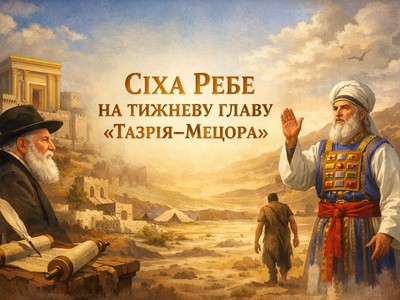
XIXA REBBE FOR THE WEEKLY CHAPTER "TAZRIA-MEZORA"
Community
📖IntroductionAt the beginning of the chapter "Tazriya", the Torah describes the laws of tsaraat — a spiritual ailment that struck the skin of a person for the sin of slander (lashon a-ra). The process was as follows: a person came to the Expert Sage, who determined the nature of the spot. But the final verdict — "Unclean!" — was to be pronounced by Cohen. Only after Cohen's words did a person leave the boundaries of the settlement.🤔QuestionsWhy did the Torah entrust this decision to Cohen? Wouldn't it be more logical to leave the last word to the Sage, who understands the laws more deeply? And more: why does Cohen, whose essence is to bring holiness and blessing, take on the role of someone who declares a person “unclean”?💡ResponseCohen is a “man of mercy” (ish ha-hesed). His main mission is to love the Jewish people and bless them with love.The condition of the person affected by the tsaraat (metsora) was extremely grave: she became an exile, left her family and friends, she was forbidden to be even near other unclean people.Only one who sincerely loves a person, who truly empathizes with his pain and feels his suffering as his own, has the right to make such a harsh sentence.📌A lesson for usBefore condemning another for not (as it seems to us) observing the commandments enough or behaving incorrectly, even the greatest "sage" should check himself: "Do I love this person?"One can judge only from the space of love and compassion.Based on a conversation with Lubavitsky Rebbe(Likutey Sikhot, v. 27, p. 103)📖 Lubavitcher calendar

Three events — three moods, like three shades of light in one space.
Community
We invite you to the Fiddler on the Roof gallery:▫️ Exhibition "Ornament of Fragility" by Larisa FilippenkovaApril 14 – May 14Meeting with the author — April 20 at 18:00▫️ Lecture cycle "Pages of Jewish history and culture"Irina KlimovaApril 19 at 15:00▫️ Finish of the exhibition "My Haggadah"Meeting with artist Iryna KlymovaApril 19 at 14:30Place: Skripal on the Roof Gallery, Kyiv, Shota Rustaveli, 13


Our dates: 3 Iyar
Community
3 Iyar about 3600–3700 (I–II century BC) — Yorzeit (anniversary of the departure from this world) Rabbi Honi (Yochanan) ha-Meagel.In the Talmud, in the tractate Ta'anit, it is said: "One year, the month of Adar was coming to an end, and there had been no rain for three years. They turned to Rabbi Hony (Yohanan). He prayed, but the rain did not come. Then he drew a circle on the ground, stood inside it and said: "Lord of the world! Your children have turned to me, and I swear by Your name that I will not move until You look down on Your children." A few drops dripped. Rabbi Honi said, "Lord of the world! I ask that the rain be heavier." There was a very heavy torrential rain that threatened to turn into a flood, but Rabbi Honi said: "Lord of the world, I asked for rain, which will not be the destruction of the world, but a blessing." And then the usual rain fell, and Rabbi Hony was nicknamed ha-Meagel ("the one who outlines the circle")."Josephus says that one of the last descendants of the Hasmonean dynasty, Aristobulus II, fighting with his brother Hyrcanus II, who challenged his right to the throne, besieged the Temple Mount. Besieged supporters of Hyrcanus turned to Rabbi Honi, who was then in the Temple, with a request to curse the hated Aristobulus, but Rabbi Honi refused to curse Aristobulus and asked the Almighty not to accept the prayers of both sides. Hirkan's angry supporters stoned Rabbi Honi to death.Rabbi Honi's grandchildren, Abba Hilkiah and Canaan ha-Nehba, also enjoyed popular affection and were known for their ability to cause rain.3 Iyar 5703 (May 8, 1943) — during the uprising in the Warsaw Ghetto, one of the leaders of the uprising, Mordechai Anilevich, was killed. Since 1948, this day has been proclaimed the Day of Remembranceof Underground Soldiers and Dead Soldiers.source: chabad.odessa

Our dates: 4 Iyar
Community
4 Iyar4925 (April 11, 1165) — Rescue of the Rambam family.In 1165, the family of Rabbi Maimon left the Moroccan city of Fez and went to Eretz Israel. The day of departure from Fez was celebrated by the descendants of Maimon as a family fast, and the day of the family's arrival in the port of Acre became a holiday. A separate post was also celebrated on the day of Iyar 4, when the ship on which they sailed was saved from the storm.source: chabad.odessa