📖 Lubavitcher calendar
Community
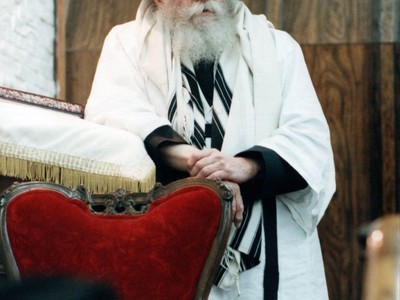
One day after Neil's prayer, a Jew approached the Rebbe and said:“I don't want Yom Kippur to end. I want to stay in the sanctity of this day.”The Rebbe smiled and answered him:“You don't have to come out of the light. You can take the light of Yom Kippur and live with it all year long.”Source:https://t.me/LubavitcherRebe770
📖 Lubavitcher calendar:Rebbe Shmuel Schneerson — Rebbe Maarash
Community
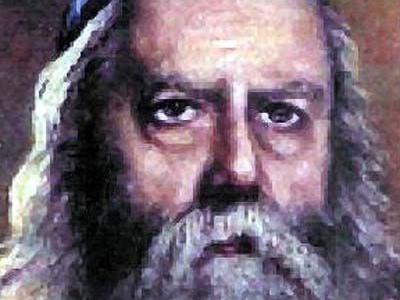
On 📅 2 Iyar 5594 (1834), exactly one hundred years after the beginning of the revelation of Baal Shem Tov, Rabbi Shmuel, the seventh son of Tsemakh-Tzedek, was born in the town of Lyubavichy.His birth was accompanied by special signs, and his father emphasized that the day of his brit milah — "Tiferet sheb-Netsakh" (cabalistic aspect) — symbolizes the future path.📚 From an early age, Reb Shmuel had a brilliant memory and genius. At the age of 13, he knew byheart all six orders of the Mishnah and the entire "Tania". He was engaged not only in Torah — he wrote scrolls (sofer stam), owned crafts, did kosher slaughter (shechita), was engaged in wood carving.💍 He married twice: the first wife died shortly after the wedding, the second wife was Rebbetzin Ryvka, the granddaughter of Admora Aemtsai. She played a prominent role in his life and in the history of Chabad.👑 In 5626 (1866), after the departure of Tsemakh-Tzedek, Rebbe Shmuel was appointed the fourth Lubavitcher Rebbe. Although he was the youngest son, the father directly pointed to his election. Some of the Hasidim followed him, others followed his brothers, which led to the division of Chabad into several centers.🌍 Rebbe Maarash was actively involved in public affairs: he repeatedly traveled to St. Petersburg, Kyiv, as well as to Germany and France, met with influential people, defending the rights of Jews. During the years of pogroms, he personally intervened, risking his life to stop the violence.📖 His Hasidic maamarim were marked by the clarity and depth collected in the Torat Shmuel series of books. He owns a well-known statement and approach:"Lehathila aribar" (from Yiddish — "immediately from above") — do not wait for hopelessness, but from the very beginning go "from above", boldly and decisively, despite the obstacles.🎶 To this day, its niguns have survived: "Ashrei ish", "Shuvu shuvu", "Tsama le-ha nafshi" and nigun "Le-hathila aribar".🕯️ In the last years of her life, Rebbe Maarash's health deteriorated sharply: severe lung disease undermined her strength. But he continued to receive the Hasidim, pronounce the Maamarim, and attend to the affairs of the community, as if unaware of the suffering. His relatives said that he endured the disease with unusual peace and dignity, completely relying on the Almighty.📖 Even in the most difficult days, he found the strength to study the Torah and write his deep treatises. His last maamarim are imbued with a special inner strength, as if he was preparing the Hasidim for future trials.📅 On 13 Tishrei 5643 (1882), shortly after the festival of Sukhoth, the soul of Rebbe Maarash rose to its source.He was only 48 years old. For the Hasidim, this was a terrible blow: the young, energetic leader, who had just begun to reveal his special line — "lekhathila aribar" — suddenly departed.👑 The funeral took place in Lyubavichy and gathered many Jews from all over. He was buried next to his great father, Tsemakh-Tzedek. Since then, his grave has become a place of pilgrimage, where the Hasidim came to ask for blessings and help.🔥 His death left a deep wound, but the legacy of Maarash — to go straight “from above”, not to be afraid of obstacles and to act with faith and determination — became an eternal guide for the Hasidim of Chabad and the entire Jewish people.In the photo: Portrait of Rebbe Maarash (Reb Shmuel) according to the legend of the Ginsburg family — descendants of Rebbe Maarash.Source:https://t.me/LubavitcherRebe770
📖 Lubavitcher calendar: Calabrian🍋 etrog — the pearl of the Chabad tradition
Community
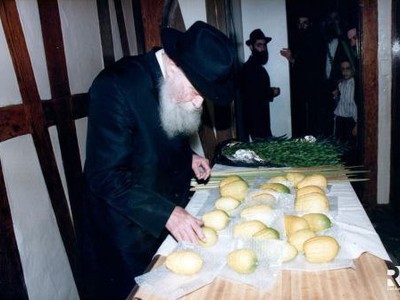
📖 The Hasidim of Chabad from generation to generation preserve a special custom — to take an etrog from Calabria (Italy). These etrogyms are known for their purity, beauty, and for not being grafted or crossed. For centuries, the masoret (oral tradition) has been preserved that these etrogim are the most kosher and the best to fulfill the commandment of arbaat aminim.👑 Rebbe and Erotrog of CalabriaIt is known that the Rebbe personally chose an etrog from those brought from Calabria and emphasized the importance of preserving this tradition. Even during the difficult years of the war and exile, the Hasidim of Chabad did everything possible to get the etrog from Calabria.🌱 Etrogim in Kfar ChabadAt the direction of the Rebbe, Calabrian etrog seedlings were transported to Eretz Yisrael in the mid-1950s. This is how the first plantations in Kfar Chabad appeared.Subsequently, entire gardens grew there, and every year a delegation from Kfar Chabad sent the Rebbe carefully selected by the Etrogim.Each year, the Rebbe also received several ergs directly from Kfar Chabad — grown from the same Calabrian seedlings. For the residents of Kfar Chabad, it was a great honor and a special spiritual connection with the Rebbe.📚 Today, books have been published and research has been conducted on the etyrogim from Calabria, but for the Hasidim of Chabad, everything is obvious:👉 The etrog of Calabria is an etrog with a special holiness, beauty and tradition. It is on it that the commandment of the arba amin is carried out in Sukhoth, continuing the instructions of the Alter Rebbe and all the Lubavitcher Rebbe.In the photo: The Rebbe chooses an etrog from Calabria.jerlot:https://t.me/LubavitcherRebe770
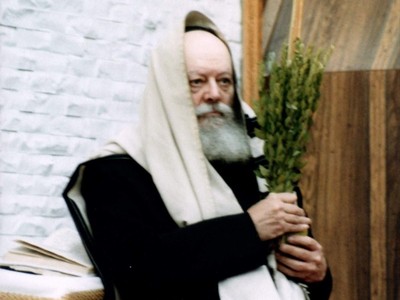
📖 Lubavitcher calendar: 🌿 Special customs of Chabad on the holiday of Sukhoth
Community
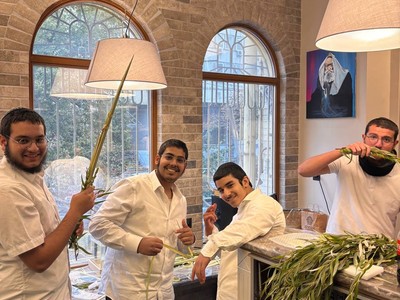
️1ლ🌱 Lots of adasim (myrtle) in lulavThe Lubavitcher Rebbe followed the custom of taking more than three adasim (sprigs of myrtle) into Lulav and instructed his Hasidim to do the same.️2ლBitch 🖼 decorationIn Chabad, it is not customary to decorate a bitch with garlands or products. But it is customary to hang photos of the Lubavitcher Rebbe, especially the last Rebbe, as a sign of connection and devotion.️3ლ😴 Sleeping in a bitchChabad does not practice sleeping in a bitch. This custom is based on the words of the Miteler Rebbe (the second Rebbe), and the last Rebbe explained it in detail in his conversations. The commandment is fulfilled through eating and being in the bitch, but not through sleep.4️ლ🙌 Blessing of guests in the bitch 770On the first night of Sukhothu, the Rebbe would enter the large bitch in the courtyard 770 and bless the guests who came from all over the world. Since 1981, he first uttered words in the prayer hall, and then went out into the bitch and blessed those present.5️ლ🕺 Simhat Beit ha-ShoevaAt the initiative of the Rebbe, joyful celebrations of Simhat Beit HaShoeva took place every evening of Sukhoth with songs and dances in the streets. Thousands of Hasidim and guests participated in them — a tradition that continues today.6️ლ📖 Reading Tehilim in Hoshan RabOn the night of Hoshan Rab, chabadniks read Tehilim until morning. This custom is ingrained in all Chabad communities and is an important part of this night's service.7️ლ✡️ Hasidic ushpizinIn addition to the traditional ushpizin from the Zohar, Chabad daily mentions seven leaders of Hasidism — from Besht to Rebbe Rashab. The Rebbe added that King Shlomo and Rebbe Rajac also come to Shmini Atzeret.8️ლ🍋 Etrogim of CalabriaIn Chabad, there is a custom to take an etrog from the region of Calabria in Italy. This custom is passed down from generation to generation and is considered a special decoration of the commandment.9ლ🥮 Blessing "Leshev Basuka" after LulavaAfter fulfilling the commandment of the lulava, it is customary to immediately eat something to say the blessing "Leshev Basuka". This is how two commandments are combined — lulav and stay in the bitch.🔟🤝 Mivtsa "Lulav"At the direction of the Rebbe, Chabadniks take to the streets, hospitals, and workplaces during the holidays to enable each Jew to fulfill the commandment of four types of plants.Photo taken from "Rebbe Drive" websiteSource:https://t.me/LubavitcherRebe770

OUR DATES: 13- 15 Tishrei
Community
13 Tishrei5598 (October 12, 1837) — Yorzeit (anniversary of the departure from this world) Rabbi Akiva Eiger.Rabbi Akiva ben Moshe Hins Eiger was born in 1761 in Austria to a famous rabbi family. He studied in the yeshivas of Mattersdorf and Vrojlav, headed the communities of Markesh-Friedland and Poznan, where he lived the rest of his life. The yeshiva he created in Poznan was the largest in Europe, and he himself was considered one of the greatest Talmudic scholars and the most prominent halakhic authorities of the time.His grandson, Rabbi Yehuda-Leib Eger, first studied with Gursky, then with Kotsky and Izbitsky rabbis, and later he himself became the head of one of the Hasidic currents (its center is now in Israeli Bnei Brak).13 Tishrei5643 (September 26, 1882) — Yorzeit (anniversary of the departure from this world) of the fourth Lubavitcher Rabbi Shmuel (Rabbi Maarash).Rabbi Shmuel ben Menachem Mendel was born on 2 Iyar 5594 (1834) and after the departure of his father, the third Lubavitcher Rabbi, Rabbi Tsemakh Tzedek in 1866, the Chabad movement headed from this world.Despite the fact that he was very sick all his life and his illnesses caused him pain, Rebbe Maharash worked intensively, leaving behind him more than 1000 mimorim (Hasidic preaching) and traveling all over Europe, trying to organize pressure on the tsarist regime in order to alleviate the situation of Jews in Russia.The sixth Lubavitcher Rabbi, Rabbi Yosef-Yitzchak, said that about 25 minutes before leaving this world, his grandfather (that is, Rabbi Shmuel) took a pocket watch and removed it from the chain, inserted a sheet of paper into the clock so that it stopped when the hand reached 11 hours 51 minutes. After that, he asked to call his sons to him in order to express his last will to them. And at 11 hours 51 minutes 13 Tishrei 5643, he left this world.Rebbe Maharash is buried in Lyubavichy.14 tishrei5775 (September 28, 1814) — Yorzeit (the anniversary of the departure from this world) Rabbi Israel of Kozhnytsia (Kozhnytsia Magid).Rabbi Yisrael, one of the founders of Polish Hasidism, was born in the town of Apti in a poor family (his father was a binder). He studied with four great Hasidic tzaddiks — Rabbi Shmuel (Shmelke) ben Zvi-Hirsh Ha-Levi Hurvits from Nicolsburg, Rabbi Dov-Ber from Mezherich (Mezheritsky Magid), Rabbi Elimelech from Lizhensk and Rabbi Levi-Itzhak Derbaremdiker from Berdychiv.For a time, Rabbi Israel lived in the Polish town of Pshisha, where he taught children, and then moved to Kozhinets (Each), which became a prosperous Hasidic center.In Each Rabbi, Israel lived for almost 50 years, becoming a close friend of the Seer ("ha-Jose") from Lublin (Rabbi Yaakov-Yitzchak ha-Levi Horowitz) and Rabbi Menachem-Mendel from Rymanow.15 tishrei2266 (1496 BC) — Yorzeit (the anniversary of the departure from this world) of the forefather Jacob ben Isaac.Jacob was the youngest of the twin sons born to Isaac and Rivka after a twenty-year infertile marriage. The Torah explains that the name "Yaakov" comes from the word "ekev" — "fifth", since Yaakov left his mother's womb, grabbing the heelof his older brother, Eyav.Esau was the elder brother and had the rights of the first-born, but he sold them to his younger brother (for a lentil soup) and the right of primogeniture (together with the corresponding blessings of his father) passed to Jacob.Fleeing from his older brother, who wanted to kill him and still take possession of the lost property, Yaakov runs to his relative Laban, who lived in the city of Haran (the country of Aram-Naraim, the territory of present-day Syria).Along the way, Jacob enters into martial arts with the messenger of the Almighty and receives a hip injury, as well as a new name — Israel (another name under which he is mentioned in the Torah — Yeshurun).In Haran, Yaakov marries two women (Laban's daughters) — Leah and Rivka, and also receives Bilga and Zilpa from their maids. Jacob's four wives have 13 children — 12 sons, who became the ancestors of the 12 tribes of Israel, and one daughter.The story of Jacob's life is told in the first book of the Torah, Breishit.15 tishrei5695 (September 24, 1934) — Yorzeit (anniversary of the departure from this world) Rabbi Moshe-Leib Ginsburg, son-in-law of Rabbi Maarash.In 1871, Rabbi Moshe-Leib Ginsburg from Vitebsk married Dvor-Leya, the eldest daughter of the fourth Lubavitcher Rabbi, Rabbi Shmuel. They lived in Vitebsk almost all their lives.Rabbi Moshe-Leib left this world on the first day of the Sukkot holiday and was buried the next day (on the first day of the holiday it is forbidden to bury) in the Jewish cemetery of the suburban village of Malakhovka.Source:chabad.odessa

Patience for the Rabbi:Do they wear tefillin on Sukhoth?
Community
ShalomDo they wear tefillin on Sukhoth?📌Answer:Tefillin is not worn on Saturdays and holidays (yom tov). But on the so-called "semi-festive" days (Hol ha-Moed), there are different customs. The site already talked about this (see the answer "When not to wear tefillin?"). We will only supplement the previous explanation here.In the Torah, tefillin is called a "sign of distinction", a symbol of the Union between the Creator and His people (see Two 6:8 and three more locations).Just as a sign of the Union is the observance of the laws of the Sabbath and holidays. Therefore, as the Sages (Talmud, Menakhot 36) note, on these days — Shabbat and holidays — tefillin are not worn.But the question remains: how to deal with semi-festive days — Hol ha-Moed Sukhoth and Passover?In the Talmud, this is not unambiguous. Most commentators have ruled that tefillin is not worn in Hol HaMoed. However, some great Sages (including the disciples of Rashi and their disciples — the authors of Tosafot, as well as Ritva, Rabbi Yom Tov ben Abraham, Spain, the 14th century, and Rosh — Rabbeinu Asher ben Yechiel, Germany-Spain, the 14th century) believed that in Hol ha-Moed tefillin should be worn, but the blessing (bracha) should be spoken quietly, about oneself.In Shulchan Aruch, Rabbi Yosef Karo (Spain-Turkey-Bulgaria-Israel) ruled that tefillin are not worn these days (Orach Chaim, §31). However, Rama (Rabbi Moshe Isserles, Poland, 16th century), who described Ashkenazi customs, decided otherwise — to wear.Gaon of Vilna (Rabbi Eliyahu of Vilna, 18th century), like all Hasidic teachers, believed that tefillin was not worn in Hol ha-Moed. All Sephardic Jews do the same.Why was there such a difference in the fulfillment of such an important commandment?A definite answer can be found in the book "Zohar" (section "Zohar Hadash" to "Shir ha-Shirim"). It says that in a spiritual sense, the Creator Himself “wears tefillin” on those days when we do not do this — on Shabbat and holidays. On Shabbat and yom tov, He "puts on" tefillin shel rosh (on the head), filling the higher worlds with a special Light. And in Hol ha-Moed - tefillin shel poison (on the hand), which brings the Light of a slightly lower level.The difference between the customs lies in the question — whether it is necessary to additionally "add Light" by our action (dressing tefillin), or not. And it is worth remembering: the principle "you can't spoil porridge with butter" does not always work in spiritual matters.In Eretz Yisrael, even among Ashkenazim in Hol HaMoed, tefillin is usually not worn. The reason for this is understandable given the special holiness of the Land of Israel, as the Zohar passage explains.Source:https://evrey.com/
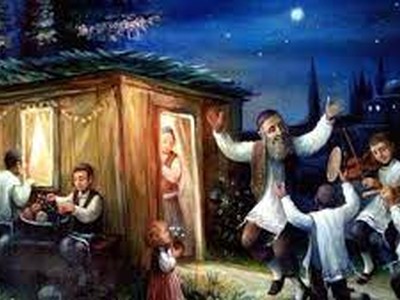
Topic of the day: Why don't they sleep in a bitch in Chabad?
Community
Answer:To begin with, this custom arose long before the appearance of Chabad.For the first time, he is mentioned in the comments of Mordechai ben Hillel, one of the most prominent rabbis of Europe of the 13th century, who lived in Southern Germany. In his interpretation of the second chapter of the treatiseSukkahhe writes that it is customary to rely on the Talmud's permission not to sleep in the bough of someone who suffers there from the cold. Almost three hundred years later, Rabbi Moshe Isserles (Rameau), whose comment onShulchan Aruchbecame the legislative basis for Ashkenazi Jews, mentions the widespread custom of not sleeping in a bitch.Ramo explains that the reason for this is not only cold, but the desire to more fully fulfill the commandment"live in a bitch", when it is not possible to arrange a sleeping place in it not only for yourself, but also for your wife. After all, the commandment "to live in a bitch" implies that a person moves there as a family member.Since the time of Israel Baal Shem Tov, the founder of Hasidism, many of its followers — even those who strictly adhere to the commandments and do not leave the bitch even to drink a sip of water — do not sleep in it.This approach did not become common among all Hasidim, but among Lubavitcher, Belgian and some others it spread as a form of reverence for the commandment of the bitch and related holiness.Their feeling can be expressed in the words:“It is not fitting to be in a state of complete loss of control over the body that occurs during sleep, when we are under the cover of the tents where God's Providence is revealed, which accompanied the generation of the Exodus from Egypt.”The merit of the Seventh Lubavitcher Rebbe was that he gave an in-depth analysis of this custom, explaining it not only from the point of view of the inner content of the commandment, but also on the basis of the Talmudic literature.It is not possible to provide all the details in a short answer format, but they are published and available to those who wish to explore the topic further.It is important to add that in one of his letters the Rebbe writes: if a person does not feel that sleeping in a bitch interferes with his personal perception of the holiness of this place, he is obliged to sleep there.Let's pay attention to another aspect related to the development of Jewish customs.In Ashkenazi communities, where many traditions have been formed that have transferred family life from the public to the private sphere (for example, the custom of not advertising the day when a woman attends a mikva), the transfer of the bedroom to the bitch no longer corresponds to the spirit of the commandment.My teacher, the slave Abraham-Zvi Cohen, may his righteous memory be blessed, drew my attention to the words from the book of the 17th century Rabbi Ishayahu HorowitzSchnee Luhot HaBrit (The Two Tablets of the Union)ofThis book, which had a great influence on the formation of Hasidism, quotes the author's teacher, who explains:“A bitch is the home of the person she lives in. Just as in the house there is a living room from which he goes to the bedroom, where he sleeps with his wife, so from the bitch he goes to the bedroom.”According to Rav Cohen, the concept of "home" in the context of a bitch is close to our modern understanding of the living room. That is why the Talmud prohibits adding pots and other kitchen items to a bitch — they belong in the kitchen.With the change in living conditions, the boundaries of the "living room" gradually narrowed, and the bedroom became a private space.Findings:All Jewish customs, despite their diversity, are holy and have a deep justification. Their study is an important part of the Torah, the main thing is that the discussions do not contradict the love for our neighbor and joy in the holidays given to us by the Almighty.Source:chabad.org

Parable "Bitch in the Rain"
Community
One year, it rained incessantly on Sukhoth. Streams fell from the sky, the roofs flowed, the streets were empty.In the small town of Kotsk, people were sitting at home — they were sad that they would not be able to fulfill the commandment to sit in a bitch.Only one man, a poor man named Leib, still built his bitch.It was crooked, from old boards, the roof leaked, and the wind blew off the branches. But he sat there, wrapped in an old cloak, and whispered:“Almighty, if You sent rain, then this is Your will.” Let me be in Your house, even if it's cold.He walked past Rabbi Menachem Mendel of Kotzk and told his students:— Look how happy this man is! He sits in a wet bough, as if in a palace.“Rebbe,” the students were surprised, “but he's all wet!” Isn't that a joy?The Rebbe replied:“There are two kinds of bitches. One is from the branches, and the other is from the faith. If a person builds a bitch from his faith, even the rain will not destroy it.🍋🌿 Sukkot teaches us not only to build a house under the sky, but also to look for a place where the soul does not get wet.Sometimes rain is a test, but if a person has trust, it sits under a roof made of light.Source:breslev.com
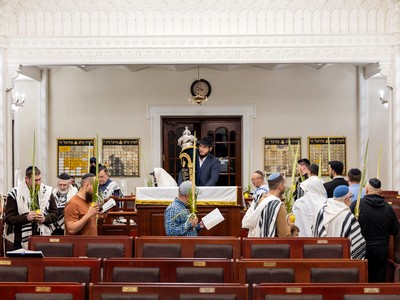
Hol HaMoed Sukhoth Prayer 🌿
Community
On the intermediate days of Sukkot, the men of our community gathered for prayer in the Central Synagogue of Kyiv.This is a special time — when the light of joy of Sukhoth permeates everyday life, filling them with a holy atmosphere.Prayer these days is not only the fulfillment of the commandment, but also a feeling of unity, gratitude and connection with the Almighty.Hol HaMoed reminds us that even in everyday life one can find holiness if the heart is turned to the Creator.May these days bring peace, blessing and joy to all who find peace and spiritual strength under the roof of Sukkah. 🌤️
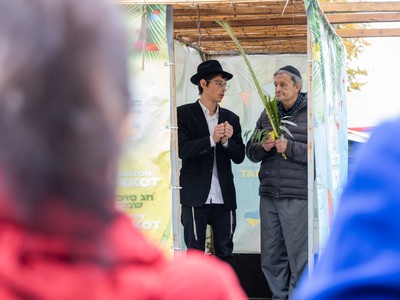
The 📖 Lubavitcher Calendar:Mivtsa Sukka (מבצע סוכה) is one of the major campaigns of the Lubavitcher Rebbe for the Sukot holiday.
Community
🏠 At the direction of the Rebbe Hasidim of Chabadand shluchim (Rebbe messengers) began to install sukkahs on wheels and in the centers of cities, and even in small settlements, so that every Jew would have the opportunity to fulfill the holy commandment of staying in sukkah.🥯In each such sukkahjews are treated to mezzanines, raised a glass of "lechaim" and feel festive joy.👶 The Rebbe stressed: Children should not be forgotten even during the holidays. It is necessary that they also feel the holiness of the holiday and touch the tradition. Sukkah on wheelsx come to IDF military units, remote bases and kibbutzim, where there are no permanent sukkot. This is how soldiers and residents of distant places get the opportunity to feel the warmth of the holiday.✨The Rebbe said,that the real "noei sukkah" (decoration of a sukkah) is when you invite another Jew to it.🌿 Mivca Lulaw(Arbaat ha-Minim) is another of the first campaigns of the Rebbe, launched in the United States in 1953 and soon spread around the world.📖 Since then, every year the Hasidim of Chabad have taken to the streets, parks, offices, markets, and even airports to invite every Jew to fulfill the commandment of Arbaat ha-Minim — to take the etrog, lulav, adasim and aravot and say a blessing.💫 The main goal of the campaign is to make as many Jews as possible, regardless of the level of adherence, feel the unity of the people and the holiness of the holiday.Rebbe's 📜 instructions and explanations:✅ It is best to perform the blessing of Arbaat ha-Minim in the succa and at the same time taste the mesonot with the blessing "Leyshev Basukka".✅ The one who takes Arbaat ha-Minim for the first time this year (not even on the first day) says "Sheheheian".✅ On the first day, lulavs are given only as a "return gift".✅ Women also take Arbaat ha-Minim with a blessing — this emphasizes their connectionto the holiday.✅ On other days, it is enough just to let the Jew hold Arbaat ha-Minim — and this is already considered the fulfillment of the commandment.🔥Thus, the mivtseim of the Rebbe on Sukhothis more than just campaigns. It is the living energy of the holiday, embracing thousands and thousands of Jews around the world, uniting them and filling them with joy, light and Jewish pride.photo of the Jewish CommunitySource:https://t.me/LubavitcherRebe770
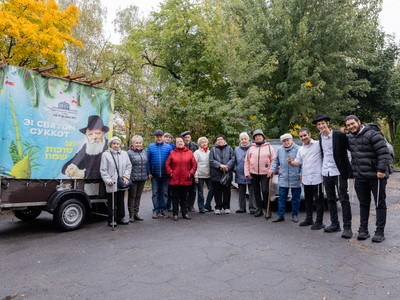
Mivtsa Bitch — the warmth of a holiday on wheels 🚐🌿
Community
The holiday of Sukhoth is not only a hut and a commandment to sit in a sukkah, but also an opportunity to share light and joy with others.On the days of Hol HaMoed Sukhothour staff and volunteers departed from“Bitch on wheels”in small communities so that every Jew, even in the remotest corner, can fulfill the holy commandment —to sit in the sukkah, say a blessing and feel the unity with the Almighty.💫 As the Lubavitcher Rebbe used to say, the real decoration of a sukkah is another Jew who entered it.We treated the guests with goodies, said “Lechaim” and saw how people's eyes were filled with joy.The holiday of Sukkah is a time when even a simple sukkah becomes a place of divine presence,and every good deed is part of the great mission of the Rebbe:to spread light, warmth and love among the Jewish people.✨Hag Samah!Let everyone feel the joy of the holiday in their heart and home.