Shabbat Shalom!
Community
Dear readers! We do not work on Shabbat ( from Friday 18:00 to Sunday 10:00)At the specified timeWe're not answering your messages or calls!We kindly ask you not to write comments on our pages, and not to send requests on Shabbat!Shabbat Shalom!Peace and harmony to all of us!

☀️ From June 27 — the opening of the summer terrace of the Beit Yehuda cafe!
Community
Meet the summer with us — we open a cozy terrace on the balcony of the 2nd floor (Simkha Hall) for delicious breakfasts and a pleasant stayin the heart of the city.Waiting for youfavourite dishes, delicious kosher breakfasts and a pleasant open-air atmosphere.<bx id="1"/>Looking forward to it! 🧡#BeitYehuda #SummerTerrace #KosherKitchen #BreakfastUcity #JewishCommunity

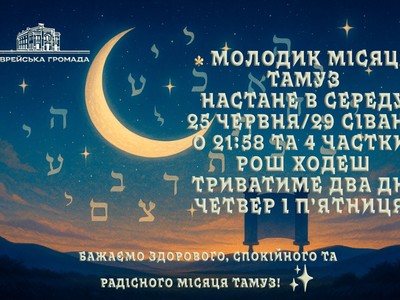
Our dates: 4 tammuz
Community
*4 tammuz 4931(June 9, 1171) — Yorzeit (anniversary of the departure from this world) to the rabbi Jacob ben Meir (rabbin Tam).Rabbi Yaakov ben Meir, the grandson of the great Torah commentator Rabbi Shlomo-Itzhaki (Rashi), began his studies under his father, Rabbi Meir ben Shmuel, and his older brother, Rabbi Shmuel ben Meir, known by the acronym Rashbam.Rabb Yakov is known as a rabin (our teacher) there (from the word "there", holistic, one who has no shortcomings. Tora calls our ancestor Yakakov - Ish there, a perfect man, a righteous person). The rabin there was recognized as the most prominent Jewish scientist of his generation, and students of such distant places from France as Bohemia and Russia came to him. Together with several sages of that period (among them the second son-in-law of Rashi Rabbi Yehuda Bar Nathan (Rivan), Rashi's grandchildren-Rashbam and Rivam (Rabi Izhak Ben Meir), and the great-grandson Ri-Zaken) he participated in the creation of a huge range of additions to Rashi's comments. This work was called "Tosahot" ("supplement"), and the scientists themselves are called tosaphists.One of the most famous solutions of Rabbin Tama is “Tefilin Rabbinu Tam”: according to Rabbi Yaakov (an opinion based on a long tradition), the arrangement of passages inside Tefilin boxes is somewhat different from the generally accepted one (known as “Tefilin Rashi”). Both of these traditions are very ancient, and during archaeological research in Khirbet Qumran (the so-called Dead Sea Scrolls), both variants of tefillin were discovered.Rabbi Yaakov lived in the town of Ramruh, where there was a yeshiva, which he headed, and earned a living by issuing loans and engaged in winemaking. This forced him to maintain contacts with the French nobility and authorities, with whom he had numerous conflicts.During the Second Crusade in 1146, Rabbi Jacob, being a wealthy wine merchant, suffered from pogroms: he was cleanly robbed, five deep knife wounds were inflicted and probably would have been killed if there had not been a knight nearby who personally knew Rabbeina Tama and appreciated his righteousness. The knight repulsed him from the insane crowd and led him out of the dangerous place. The sage was saved, after which he left Ramruh, moving to Troyes.*4 tammuz 5565(June 1, 1805) — Yorzeit (anniversary of the departure from this world) Rabbi Pinchas ben Zvi Hirsch Ha-Levi Hurwitz.Rabbi Pinchas was born in the Ukrainian town of Chortkiv and together with his brother, the future Rabbi Shmuel-Shmelke from Nicolsburg (he studied first with his father, Rabbi Zvi Hirsch, and then in a non-Hasidic ("Lithuanian") yeshiva, but after a trip to Mezhyrich and a meeting with the Magid — Rabbi Dov-Ber, the brothers became his devoted disciples and followers.At first, Rabbi Pinchas was an assistant to the rabbis in Witka and Lechowice, but in 1772 he received a prestigious invitation to lead a yeshiva in Frankfurt am Main. The kind-hearted and gentle Rabbi Pinchas enjoyed thelove and respect of all citizens, including non-Jews. In Frankfurt, Rabbi Pinchas lived for 33 years, until his departure from this world.Rabbi Pinchas led an active struggle against the "father of reformism" Moses (Moshe) Mendelssohn, in particular, strongly opposed his planned translation of the Tanakh into German (Mendelssohn himself considered this as the first step towards the assimilation of Jews).The son of Rabbi Pinchas, Rabbi Zvi Hurwitz, known as Rabbi from Frankfurt.*4 tammuz 5579(June 27, 1819) — Yorzeit (anniversary of his death) Rebbetzin Esther-Miryam, daughter of the second Lubavitcher Rabbi, Rabbi Dov-Ber (Miteler Rebbe).In 1990, a tin plate with a partially damaged inscription was found at the Lubavitcher Jewish cemetery. It followed that the Rebbetzin Esther-Miryam died during the life of her father (the words “let his years continue” were added to the name of the Rebbe Miteler, which is used only with the names of living people).Interestingly, until this moment, no one knew (or, more precisely, did not remember) about the existence of Miteler's daughter's rabbi Esther-Miryam.

Our dates: 5 tamuz
Community
*5 tamuz 3332(429 BC) — The prophet Ezekiel's vision of the Merkabah (God's chariot).On this day, the prophet Ezekiel, the first of the prophets who prophesied outside Eretz Israel, had a vision of the Divine Chariot (maase merkava), the description of which is an allegory of the spiritual infrastructure of this world.*5 tamuz 5046(29 June 1286) — Arrest of Rabbi Meir of Rothenburg.Slab Meir Ben Barukh, known as Maryaram, was an unsurpassed authority for European Jews of the XIII century. After the ascent in 1286, an additional tax was imposed on the German throne of Rudolf and Habsburg on the Jews, which simultaneously changed the status of German Jewry and transformed them and their property into the emperor's personal property. The answer to this was the mass exit of Jews from Germany. The leader of the exit was Rabbi Meir, who was arrested and imprisoned. Since the authorities demanded a huge amount (equal to the amount of tax), the rabies forbade the community to buy themselves so as not to create a precedent and prevent extortion from the authorities (in the Talmuda that if the prisoner is asked for a amount that is much exceeding smart borders. Rabbi Meir died in prison in 1293, but his remains were not issued for burial until 1307, when the Jews were redeemed for a large amount.chabad.odessa

Our dates: 6 tammuz
Community
*6 tammuz 5736(July 4, 1976) — Operation Yonatan (aka OperationEntebbe).Arab terrorists who hijacked a plane carrying Israeli hostages have taken refuge at the airport in Entebbe, the capital of the African country of Uganda. The ruler of Uganda was the brutal anti-Semitic dictator Idi Amin, so the terrorists were sure of their impunity. However, as a result of the daring operation of the Israeli "commandos", the hostages were released. During the operation, the head of the special forces group, Yonatan Netanyahu (brother of Israeli Prime Minister Benjamin Netanyahu), was killed.

Our dates: 8 tammuz
Community
*8 tamuz 5651(July 14, 1891) — Engagement of Rebbetzin Hai-Mushka, the youngest daughter of the fourth Lubavitcher Rabbi, Rabbi Shmuel (Rabbi Maharash) and Rabbi Moshe Ha-Kohen Horenstein.Rabbi Moshe Jorenstein was an outstanding sage and righteous man, so the Hai-Mushki brothers, in particular the future fifth Rabbi, Rabbi Sholom-Dov-Ber (Rabbi Rashab), made a lot of efforts to make the engagement happen.*8 tamuz 5659(June 16, 1899) — Yorzeit (anniversary of the departure from this world) Rabbi Eliyahu Mani.Rabbi Eliyahu Mani was born in Baghdad (Iraq), however, after a brahi (blessing) received from the great cabalist Rabbi Yosef-Haim bin Eliyahu al-Haham (Rabbi Ben Ish Hai), he moved to Eretz Israel, where he settled in Hebron and headed the Jewish community.Rabbi Eliyahu was respected not only by the Jews, but also by the Arab residents of Hebron, who called him “sheikh”. After the departure of Rabbi Eliyahu from this world, he was buried in a Jewish cemetery, but the Arabs stole his body and reburied it in a Muslim cemetery. The Jewish community had to not only obtain the return of the body of Rabbi Eliyahu, but also put a guard at his grave.

Our dates: 9 tammuz
Community
*9 tamuz 3338(423 BC) — The Babylonians broke through the wall of Jerusalem.On this day, the army of the Babylonian king Nebuchadnezzar broke through the walls of Jerusalem and broke into the city. King Zedekiah of Judah surrendered and was taken to Babylon. A month later, Jerusalem was completely captured by the enemy, the First Temple was destroyed, and most of the Jews were taken into exile.For many years, this day was celebrated by fasting, but after 490 years of Roman legionaries 17 tamuz broke through the gap in the walls of Jerusalem (this led to the destruction of the Second Temple), the dates of both fasts were combined.*9 tammuz 5004(June 17, 1244) — Burning of Talmud treatises on Grevskaya Square in Paris.In 1240, King Louis IX St. Saint arranged a debate between Jews and Christians in his residence, and Jews were brought there under the escort. The Jews were represented by four rabbis, Christians-the most famous of the monks, Franciscan, Professor Sorbonne, Vyhhrest Nikolai Donin from La-Roshel. Witnesses report that Nicholas "looked weak", but the advantage of "true faith" "could not but prove itself", so that, according to a sentence, Jews were recognized as defeated. And 4 years later, two dozen carts filled with Talmud were burned.This was the first time in the history of the burning of Jewish books and a fast was established in memory of this event. However, as it is written in the book "Tanya Ravta", "Fasting is not tied to the days of the year, because it was revealed to the sages that the Torah text predicted this event in advance", that is, they fast not 9 tammuz, but on the sixth day of the week, when they read the chapter "Khukat".chabad.odessa

As a ☀️ reminder, the summer terrace of the Beit Yehuda Cafe is already open!
Community
We invite you to the balcony of the 2nd floor (Simkha Hall), where a cozy outdoor terrace is open.Delicious kosher breakfasts, a favorite menu and a pleasant atmosphere in the heart of the city are already waiting for you.<bx id="1"/>Looking forward to it!

What is faith in Judaism?
Community
Questions:Shalom: If possible, explain what faith is? Or is it just to believe — to tell myself that I believe and that's it? Is this something supernatural that we do not understand, but only believe? I'm not sure if my question is correct. Rabbi's ❗answer:There are no incorrect questions in Judaism. It is important that everyone who seeks to know asks their own questions — to get to the truth. We see that all Jewish religious literature is full of questions, including those that have not been answered. There are no forbidden topics for reflection in Judaism. 📌What is faith?In Ephraim's explanatory dictionary, the concept of "faith" is explained as follows: "the recognition of something as true by a force that surpasses the power of arguments, facts and logic." If you accept this definition, then your words in the formulation of faith — "you just need to believe, tell yourself that I believe, and that's all" — are absolutely accurate. All religions of the world (except Judaism) are built on this faith. And to give such a blind faith a more sublime meaning, representatives of different religions describe it like your second formulation: “this is something supernatural that we cannot understand, but only believe.”For example, a Russian biblical dictionary defines faith as: “the sacred gift of God.”But Judaism, unlike other religions, is not based on blind faith, but on knowledge, as the Torah says (2 Timothy 4:39):“And you have known today, and take it to heart, that the Lord is G-d in heaven above and on earth below-there is no other.” ❗Please note: the verse says "knew", not " uwrыв".That is, the truth of the Torah can be proved by the arguments of the mind — and there is no need for blind faith. according to satu: imrey.org
“The righteous shall live by his faith.”
Community
After we explained to https://jewishukraine.info/post/435 that Judaism is based on knowledge and not on blind faith, it is important to understand the words of the prophet Havakuk, who says (2:4): “…but the righteous shall live by his faith.”At first glance, might it seem that faith is a great foundation in the life of the righteous?However, this question arises only for those who are not familiar with the holy (Jewish) speech.This verse uses the word emunah, which in modern Hebrew is mistakenly associated with the concept of "faith" (for example, the Even-Shoshan dictionary explains emunah as "the state of the soul of a believer").However, in the holy languageWordemunameans the ability to rely on someone, to trust.That is why Mishna says in Pirkei Avot (2:4):“Do not rely (al-taamin, from the word emun) on yourself until the day of your death.”From these words of the Mishna, it can be seen that emuna is precisely trust, the ability to rely on another.In this sense, the word emunah is used in all other places of the Tanakh and in the words of the sages. It is in this sense that the prophet Havakuk uses it when he says that “the righteous will live by his faith.”This means that since a person knows that the Almighty loves him, he must rely on the Almighty, trust Him, understanding that everything He sends is for the better.And this is the great foundation in human life: the ability to rely on the Almighty.Vilna Gaonin his commentary on the book, Mishley writes:*“The main condition on which the Torah was given to Israel is that they rely on the Almighty… For the basis of everything is complete trust in the Almighty, and this is the basis of all the commandments.”according to the materials of the site: https://imrey.org/
Reading the Torah on Monday and Thursday
Community
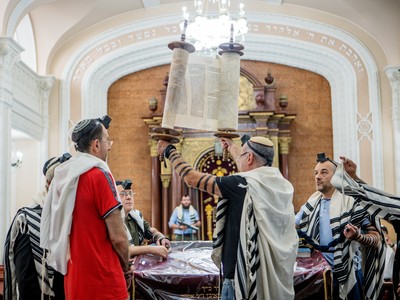
Moshe Rabbeinu established the obligationto read the Torah onmondays and Thursdays, except for reading on Shabbat, so that no more than three days would pass without reading the Torah.Ezra decided that before reading the Torah, one should callat least three peopleand readat least 10 sentences.They read the beginning of that chapter of the Torah, which falls on the nearest Shabbat. In some cideras, the relevant passages are presented for reading and their distribution among the three people.Torah is readonly in the presence of minyan(a prayer quorum of ten men).When they openaron ha-kodesh(holy closet) and take out the Torah scroll,shliach cibur(community representative) together with those present speak special texts given in cider.During the removal of the Torah scroll from the aron a-kodesh and while it is being carried around the synagogue —accepted to stand. The scroll is held in the right hand and brought to the table (bima), on which the Torah is read, —From right.Thismitzvah — to follow the one who carries the Torahshowing respect and reverence for her.https://imrey.org/