
Question to the Rabbi: How to help the poor according to the Halakhah?
Community
According to Jewish law, if you already separate a maaser (tithe) from your income for the needs of the poor or for the study of the Torah, you are not formally obliged to give alms to everyone you meet. However, the Torah teaches us to be above the letter of the law. If you have a person standing in front of you with an outstretched hand, the right thing to do is to give them at least a small amount.The Rambam gives important advice: it is better to give a little to many than a large amount to one. The purpose of the commandment is not only to help the poor, but also to instill in us the habit of giving. The more often we do this act, the more merciful our character becomes.Charity should not be reckless. The Torah warns against charitable spending that could jeopardize the support of your own family. Your five children are your first priority.It is also worth being careful with "suspicious types" if there is a reasonable suspicion that the money will go to malicious purposes. But if you are in doubt, it is better to give than to refuse.We are often annoyed by people who seem healthy but prefer to beg instead of work. The great Hofetz Chaim explained it as follows: the poor are not only an empty wallet, but also poverty of spirit.The Almighty endows people with various qualities. Someone is given energy and a knack for things, while someone is born without the will to act. A person who is ready to live in rags if only not to work is deeply unhappy and poor in spirit. She also needs our support.Rav Yitzchak Zilber gave money to everyone indiscriminately. His logic was simple: "It is better to serve the wrong person ten times than to refuse once to someone who is really dying of hunger."The Book of Zohar calls the poor man on the threshold a special gift from the Creator. The Almighty sends us the opportunity to fulfill the commandment exactly when we need it to correct our soul. If you look at the beggar not as a "resource eater", but as a messenger who has brought you a chance for blessing, the burden in the heart gives way to peace.Your tzdakah is not a loss, but an investment in your family's protection and spiritual well-being.source:https://toldot.com/
History Page: Wailing Wall
Community
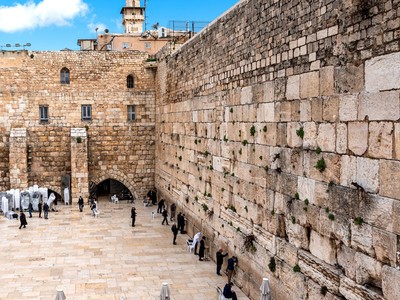
The western wall of the Jerusalem Temple is the holiest place of prayer since the destruction of the Temple almost 2,000 years ago. Here we leave notes with requests to God, here we pray for the revival of the Temple.According to tradition, G-d's presence never leaves the Wailing Wall... The Western Wall of the Temple is the Cauldron of Maarawi. Customs, facts and dates.What is the Wailing Wall and why is it called thatThe Wailing Wall is the only fragment of the Temple Mount wall that has survived to this day. In the midrash (oral tradition), written two thousand years ago, it is said that the Creator swore: this part of the wall will not be destroyed.Actually, the wall itself is not a shrine of Judaism. The sanctuary of the Jews is the Temple built on the Temple Mount. The significance of this wall to the Jews after the destruction of the Temple is that it is the only thing left of it. However, the midrash (Bemidbar Rabah 11:2) says that the Shechinah (G-d's presence) never departs from this wall.It is not called the "Wailing Wall" in Hebrew. Its name is Kotel Maarawi, which means "Western Wall". This is how it is often called in English - The Western Wall. It has this name because it is a fragment of the western wall that surrounded the Temple Mount.The Arabs, seeing that Jews come to the wall to pray to God and mourn the destruction of the Temple, called it the "Wailing Wall." From here, this name spread to some other languages, including English (The Wailing Wall) and Russian.Some facts about the Western WallThe Shekhinah never departs from the Western Wall (midrash on verse 2:9 of the Song of Songs: "... behold He stands behind the wall").There are different opinions as to which part of the building the Wall was: the temple yard - azar (so, for example, Radbaz believed) or the Temple itself (so most sages of recent generations believe).The tradition of praying at the Wall for forty consecutive days without a break comes from Rabbi Shlomke of Zvil.Rav Moshe Alberstam, a righteous man of blessed memory, conveyed on behalf of R. David of Lelov that on the eve of every Saturday after noon, the souls of the holy forefathers and foremothers descend to the Western Wall.Rav Y.-Kh. Sonnenfeld came to the Wall no more than once a month, so that the sublimity of the prayer (Aleph ke-tav) would not fade.Rav Chaim Kanevsky taught that it is better to pray near the part of the Wall where there is a covering than near the openOnce upon a time there was a custom of driving pegs and nails into the Wall in front of a long road to protect the traveler. Later, this custom was abolished, because such actions seemed disrespectful to the Wall (response "Ismakh the Lion").The area adjacent to the Wall is not considered a "courtyard" for carrying things on the Sabbath, as it is intended for prayer, not commerce.The length of the Western Wall is about half a kilometer (488 m).The length of the visible part of the Wall is only a ninth of its total length (57 m).The height of the visible part of the Wall is 19 m, the full height is 40 m, that is, the underground part is 21 m.The wall seems to be tilted inward: each successive row of masonry recedes a little deeper, so some people do not come close to the stones, fearing to "step" on those that are underground.The "tunnel" in the men's section was built by the Muslims around 4400 (640) to hide the Wall, and was only recently cleared; opened in 5745 (1985).A thousand years ago, in the year 4793 (1033), a strong earthquake occurred, which destroyed many structures that were still preserved on the Temple Mount.After the destruction of the Temple, Hadrian built a pagan sanctuary on the Temple Mount.Later, the Byzantines built a Christian church.In the year 4398 (638), Muslims conquered Jerusalem and built the "Dome of the Rock" - Kipat a-Sela (4451-691) and Al-Aqsa Mosque (4473-713).In 4859 (1099), the Crusaders captured Jerusalem, killed the Jews, but did not touch the Temple Mount.Later, Salah al-Din, a Muslim ruler, conquered Jerusalem and expelled the Christians.As a result of the Sixth Crusade, the Temple Mount was under the power of Christians for forty-five years (from 5059-1299 to 5104-1344).The Mamluks came after them and ruled until 5277 (1517).Then the Turks owned the Land of Israel for four hundred years. After World War I, they handed over authority in Eretz Israel to the British.Beginning in 5708 (1948), the Temple Mount was under Jordanian rule, and Jews could not come to the Wall until the liberation of the Old City in 5727 (1967) during the Six Day War.Today, more than two million people a year come to the Wall on average.source: https://toldot.com/
History of Hasidism: Sabbath clothing
Community
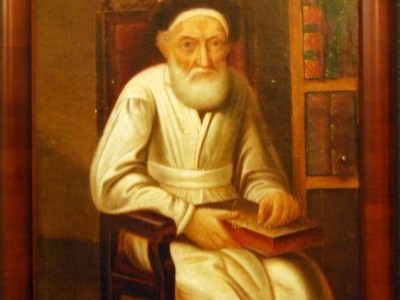
🟡Sabbath clothes in halas and HasidismAmong Jewish customs, wearing separate clothes for Shabbat occupies a special place. It is not just an external attribute, but an expression of respect for the holy day and an internal transition from everydayness to holiness. Already the sages of the Talmud emphasized the importance of clean and special clothing for Shabbat, connecting it with the commandment: "and you shall call Shabbat a pleasure, the sanctuary of the Lord honored." Therefore, they try to change clothes closer to the beginning of Shabbat, after preparations and washing, showing that this action is done precisely for the honor of the day. Even if a person is alone and no one sees him, the obligation remains the same - because the honor does not concern the person, but the very sanctity of Shabbat. And if it is not possible to wear other clothes, then at least they clean and arrange the ones that are available.✨The meaning of Sabbath clothingThe books explain that special clothing is connected to the spiritual reality of Shabbat: it helps a person to feel the separation of this day from everyday life, supports a mood of exaltation and reminds of the sanctity of the time, so as not to treat it as a habit. Just as a person appears before the king in a dress of honor, so on Shabbat a Jew dresses in more refined clothes. The tradition also has a special attitude toward white clothing, which the Zohar mentions: from the Baal Shem Tov to the Rebbe Maarash, the Rebbe is known to have worn white Shabbat robes, while today this custom is most often expressed in at least a white shirt.🕯HaBaDi customIn the Hasidic environment of HaBaDu, Shabbat clothing has acquired a special significance. Rebbe RASHAB established that silk clothes should be worn on Shabbat - on this basis, the custom of the silk coat and the silk gartel spread. Even those who pray in a suit on weekdays try to wear a long coat on Shabbat as a more honorable and elevated garment. In the books, it is noted that in essence Yom Tov clothing should be even more solemn than Shabbat, although outwardly today this difference is almost imperceptible.🌿In the light of the teachings of HasidismHasidic thought explains that everyday clothing is associated with concealment and restriction, while Shabbat clothing corresponds to the light that is revealed on that day. Therefore, it belongs to a higher spiritual level, similar to the world of Briah, in contrast to everyday clothing, which is associated with the world of Yetzir. This is also associated with the preference of silk fabrics - matter that comes from "living matter", in contrast to vegetable fibers, which symbolically belong to the level of everyday reality.👑In our RebbeIn the Hasidic history of HaBaDu, there are many testimonies related to the Rebbe's Shabbat clothing. It is known that the Alter Rebbe wore white Shabbat robes and passed them on to Tsemach-Tzedek; the image of Tsemach-Tzedek in white clothing is associated precisely with the moment of Sabbath holiness. Rebbe Maharash was said to wear a shtreiml and had a special nigun that he sang when putting on his Shabbat clothes and when taking them off at the end of Shabbat. Rebbe RASHAB also wore Shabbat robes when receiving Yechidut and emphasized the importance of silk clothing, bringing it to the level of a strict requirement.In the later years, beginning in the early 90s, the Rebbe began to wear Shabbat clothes as well as weekdays, and the Hasidim associated this with the idea that the world was already on the threshold of the "evening" before the great Shabbat - the time of Geula.🟣ResultTherefore, Shabbat clothing in the Hasidic tradition is not an external custom or formality. It expresses an inner attitude to Shabbat, helps a person to get out of the rhythm of everyday life, to feel the sublimity of time and to give a material appearance a touch of spiritual holiness.🖼In the picture— the third Lubavitch Rebbe Tsemach-Tzedek in the Sabbath clothes he inherited from his grandfather the Alter Rebbe.source:📖Lubavitch calendar

Question to the rabbi: how to treat the New Year?
Community
✨ Attitude of the Rebbe to the beginning of the "civil year"🟡 Although in the Jewish tradition it is not customary to attach special importance to this date, in some cases the Rebbe used the moment itself as an opportunity for a blessing - as it is said in the verse: "G-d enumerates, writing down the nations...".🟡 It is said that once, at the moment of the new year according to their calendar, the Rebbe wished someone standing next to him: "Happy New Year", and then added an explanation: Rebbe Levi-Yitzhak from Berdychev blessed at such moments, because any time is appropriate for a blessing.🟡 Thus, the Rebbe did not give this day a religious meaning, but emphasized the idea:if there is an opportunity to bring good and give bracha - it is worth taking advantage of this moment.source:📖 Lubavitch calendar
The Dollar as a Blessing: The Spiritual Meaning of the Rebbe Tradition
Community
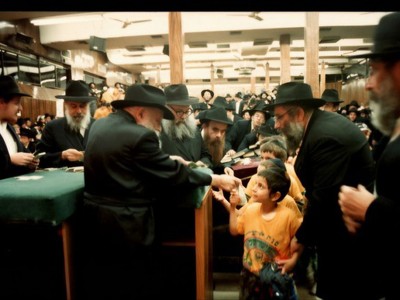
✨Handing out dollars in the Rebbe: a story of tradition🟡What is the "distribution of dollars"The distribution of dollars was called a special moment of the meeting with the Lubavitcher Rebbe, when the Rebbe handed over to everyone who passed one dollar with the words of blessing — so that this dollar was transferred to the tzedakah. In the same way, the meeting became the fulfillment of the commandment and participation in good, aimed at the benefit of the third Jew.Over time, the distribution became regular — on Sundays — and often lasted many hours in a row. The Rebbe stood on his feet and received thousands of people from all over the world: those who sought advice, blessing, and spiritual support. This replaced the personal “echidus” - a private audience in the Rebbe.🟡How custom aroseEven before the establishment of a permanent order, the Rebbe from time to time sent people a dollar as “a blessing and success.”The first public distribution of dollars in the tzadak took place on the paint brand 18 Elul 5734 (1974), when the Rebbe instructed to transfer dollars through "tankers" — those who ride on mitzvah tanks.In the following years, the custom took root.In 5746 (1986) — 11 Nisan, which fell on Sunday — the Rebbe personally started a regular Sunday distribution of dollars. Since then, it has become an established practice, which the Rebbe treated as a matter endowed with the power of “hazak” — strength and immutability.🟡Rebbe's Ideological ExplanationThe Rebbe associated this custom with the words of his father-in-law, Rebbe Rajaca:"When two Jews meet, it is necessary to make sure that the third Jew benefits from it."The dollar transferred to Tzedakah turned a personal meeting into a chain of good:meeting an → assignment → to help another person.When the Rebbe was asked if he was tired of such long hands, he replied:“Every Jew is a diamond. Can you get tired of counting diamonds?”🟡How the distribution took placeThe distribution took place at the entrance to 770.In front of the Rebbe was a stand-up table, next to them were assistants who handed over bundles of dollars and packed books and gifts brought by people into a separate package.The order was designed to allow many to pass and at the same time maintain personal contact: you could say a few words, ask for a blessing, ask a short question.First there were men, then there was a queue for women.Sometimes representatives of public structures or families with children passed without waiting in a long queue.At the end, the Rebbe handed over dollars to assistants, took one dollar for himself — and took the bag of gifts to his office.🟡Special distributions and exceptional casesIn different years, distributions took place:◽️ after dye brands and children's gatherings,◽️ in the days of special events of the community,◽️ in the period after the death of Rebbetzin Hai-Mushka — even in the Rebbe's house.Sometimes the Rebbe distributed dollars to children, students, messengers — as a sign of spiritual support and as a "material support" for blessing from above.After the event of 27 Adar I 5752, the regular Sunday distributions almost ceased, and only once in 5754 did a special short distribution take place for bar and bat mitzvahs, brides and grooms.🟡The meaning of tradition todayThe distribution of dollars has become one of the most recognizable symbols of the Rebbe's spiritual work: a combination of personal encounter, caring for another, and acting for the sake of the tzedakah.The idea of the Rebbe remains relevant:every meeting of Jews is an opportunity to multiply the good and attract another person to it.Source:📖 Lubavitcher calendar

Psychologist's page: Emotions in line with the Torah
Community
Question: Please tell us about emotional control. How do you advise to do this and to what extent, because a person should not be somehow dry. Thank you!Esther IsraelAnswer: To begin with, the ability to manage your emotional state is a kind of project that you work on throughout your life, at least if you want to achieve a high level of self-control. And it is necessary in order not to succumb to the destructive influence of anger, fear, envy, groundless anxiety and other similar feelings.However, this is not about simply restraining the emotional response. Even those emotions that can cause significant harm are sometimes justified and even necessary. For example, anger can be justified if it is directed against the enemies of the Jewish people, and the feeling of rivalry between those who study the Torah, bordering on envy, according to the instructions of our Teachers, multiplies wisdom (Mishnah, treatise "Pirkei Avot", sect. 4).The feeling can be likened to the flow of a powerful river, which rages, then calms down, but its flow does not stop for a moment. The goal is not to block the flow with a dam, but to steer its course in the right direction, making sure that water does not overflow the banks and flood coastal settlements.Despite the fact that the work on emotions in the Jewish tradition is of great importance, we will not find in it the concept of "control over emotions". The Jewish approach to this issue is based on other principles. Usually it is about the ability to be aware of your feelings and express them selectively, in accordance with certain benchmarks. More precisely, to direct their emotions in line with the Torah and the religious worldview.For example, the Torah teaches not to keep evil in the heart of another person, not to envy someone else's property, to love other Jews, etc. All these guidelines relate to the world of feelings, and the Jew is expected to work on himself, which makes it possible to manifest them properly or, conversely, to refrain from manifesting some of them.This also applies to positive emotions. Thus, the Almighty commands the Jew to rejoice in the holidays, which, of course, is not easy to accomplish if a person is in difficult life circumstances.Work on emotions in the Jewish tradition is closely related and subordinate to work on midot — personal qualities. It is the word "mead", meaning measure or size, that indicates the need to measure the desired measure of emotions, depending on the purpose of the behavior and the specific context. Showing mercy to the cruel is inappropriate, as is cruelty to the weak and defenseless.In fact, almost any emotion can be involved, but the degree and circumstances of its application must be commensurate and appropriate. And landmarks are needed to determine how relevant they are. They are intellectual and spiritual foundations: they are partly dictated by reason and intuition, and partly by the laws of the Torah.Thus, the Jewish worldview requires putting emotions, where necessary, at the service of the Almighty, engaging the mind in addition to the instinctive and spontaneous expression of feelings.The basis of such work on emotional improvement is knowledge of the Torah, its constant study, especially books on Jewish ethics and morality — the so-called sifrei musar (emphasis on the last syllable). As well as a deep and constant awareness that each manifested emotion affects the environment, as well as the inner image of the person himself.The feeling of love can generate a corresponding love, softening and enriching the inner world. And anger can be disastrous not only for those to whom it is directed, but also cause destruction in the soul of the one who feels it.All of the above should lead to the idea that the Jew is not threatened by emotional dryness, because the feelings themselves are a legitimate and necessary side of human life.Let's use the river metaphor again. The power of emotional flow can be huge, and there is no harm in that. On the contrary, the ability to experience strong emotions can be seen as a blessing from Above. By the way, they do not necessarily have to have an external manifestation, and behind a restrained facade there may be an extraordinary internal force.It is only important that this flow is directed correctly and usefully. River waters can be beneficial and nourish large expanses. This is the case when a chaotic flow, flowing along a properly laid channel, brings good, not destruction.Source:http://evrey.com/sitep/askrabbi1/q.php?q=otvet/q8726.htm
Alter Rebbe Handwriting as a HaBaDa Spiritual Tradition
Community
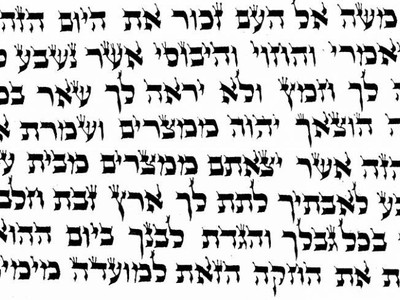
Alter Rebbe Fontis a special form of writing the holy texts of the STAM (Sefer Torah, tefillin and mezuzah), formed on the instructions of the Alter Rebbe and combining two directions: the halakhic tradition of the poskim (halakha masters) and the explanation of Kabbalah.Over time, this handwriting became the main one among the HaBaDa soifers and acquired the status of a separate spiritual and textual tradition of the movement.📜How did the Alter Rebbe font originateAccording to the transferred legend, during his stay with the Magid of Mezherich, Alter Rebbe was instructed to develop a form of writing letters that would exactly meet the requirements of halakha and the internal content of the letters, as explained by the teachings of Kabbalah. For several weeks he was engaged in refining the outlines and structure of the letters.The new handwriting was transferred to his student and personal soyfer — Rabbi Reuven Mianovich, who wrote tefillin and mezuzah for Alter Rebbe.It was his works that became the main example of what today is called the "Alter Rebbe font".🧩Place of font among other writing traditionsIn the Ashkenazi tradition of STaM, there are several established forms of writing:— Beit Yosef font— Arizal font— Alter Rebbe font (HaBaDa tradition)— Sephardic form of writing— Yemeni tradition of writing.The Alter Rebbe's handwriting is distinguished by a number of fine details in the contours and connections ofthe strokes.These differences are not a decoration or an artistic style — they reflect the accuracy, balance and semantic integrity of the shape of the letters.🕯️Transmission of tradition and preserved specimensOver time, the transfer of this handwriting "from hand to hand" was partially interrupted. However, the original tefillins attributed to Rabbi Reuven-Soifer were preserved; they were reviewed by the Rebbe and used as an important example of the writing tradition.The main difficulty of the study was to distinguish which details of the shape of the letters are mandatory and which are a feature of the handwriting of a particular soyfer.Therefore, the topic of clarifying the exact shape of the letters remained the subject of discussion and study among rabbinical scholars and soifers.📝The Rebbe's Attitude and HaBaDa's Practical Position📝 In his letters and conversations, the Rebbe has repeatedly stressed the importance of:— studying the exact shape of the letters of the handwriting of the Alter Rebbe,— strengthening the tradition of Chabad soyphers,— the acquisition of tefillin and mezuzahs in this handwriting.The Rebbe encouraged Habad soifers to study the preserved specimens and work on their basis, viewing the Alter Rebbe font as a natural part of the spiritual heritage of the Habad Hasidim.⚖️Controversy and arguments of the parties⚖️ Over time, a controversy arose around this topic. Some rabbis and soifers expressed doubts due to the lack of a fully continuous tradition.Supporters of the tradition answered that:— The Rebbe has repeatedly encouraged the practical use of this handwriting,— Arizal's handwriting has also changed throughout history,— for Habada, the handwriting of the Alter Rebbe is an organic and hereditary tradition,— the return of Chabad soyphers from the USSR helped to restore important elements of the transfer.Discussions on this issue were published in Chabad scientific publications and research collections.🏁The meaning of the font todayThe handwriting of the Alter Rebbe became a symbol:— loyalty to spiritual continuity,— the desire for accuracy and comprehension in objects of holiness.For many Habad Hasidim, it expresses the connection between halakhah, the inner meaning of the Hebrew letter, and the living tradition of generations.📸Client Name:part of the tefillin, which was written by Reuben a-soyfer — personal soyfer Alter Rebbe.source: 📖Lubavitcher calendar
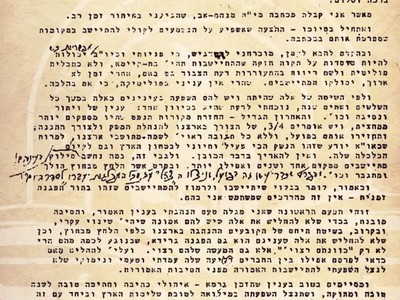
Page of History: Special Letter from Lubavitsky to the Rebbe Regarding Settlements in Judea and Samaria
Community
In the letter below, addressed to Geula Cohen, a member of the Knesset, in 1981, the Lubavitcher Rebbe clarifies his position on the issue of settlements in Judea and Samaria.He emphasizes that his approach is not policy-related, but is based on Halakha demands and responsibility for the possible consequences of temporary or demonstrative settlements.This is one of the few places where the Rebbe openly reveals the motives of his line of conduct in this sensitive issue.With God's help, 24 elul 5741Brooklyn, New York, U.S.Dear Mrs Geuli Cohen, MP for the Knesset, may her life be blessed.Greetings and blessings!I acknowledge receipt of your letter dated 18 menahem-av, which was received by me with great delay.And I will start with its final part — with a proposal to influence those who listen to my voice to settle in the places listed in your letter.And, looking ahead, I must emphasize: my appeals and similar steps are possible only when they can be based on the firm hope that the settlement will be long-lasting and sustainable, and not a political action and is not intended to cause a temporary revival of public opinion — even if later, in a short time, the settlers will be evicted. Because my business is not politics, but Halakha.And according to the line of those who have been and are influential in matters of this kind for the whole thirty-two years, I have come to the conclusion that their course is one: concessions and retreats, etc. And the last step surpassed the previous ones - the return of oil sources, which provided more than half, and according to some statements - three quarters of our country's needs for the functioning of the economy and for the needs of defense; and they were indeed returned - without any serious reaction from the residents of our country, despite the fact that everyone understands: this is the most effective and vitally necessary "weapon" for the security of the state and for the existence of its economy. No need to dwell on the obvious.And compared to this — what does the eviction of settlers from one, two, or even more places mean in their eyes? Moreover, the external pressure continues to increase, etc. And especially — since this has already been done in practice, and for this purpose the IDF was involved, and all parties moved to the "agenda"!And, as I said, openly declaring that they should settle, and at the same time hinting to the settlers that this is only a temporary demonstration, is not one of the ways I use.This is the first time I reveal the motive of my line of conduct on this issue, and the reason for this is clear: in order not to weaken those who believe that there will be a radical change — and soon — in the approach of those who determine the leadership of our country regarding external pressure; and also not to weaken those for whom it is only a demonstration, because for some of them not only "their intention is worthy", but their actions themselves are desirable.And it is up to her to decide whether to publish — even among those close to her position — my opinion and my arguments as to why I do not use my influence for the said settlement, for the reasons set out above.And we conclude with good, in accordance with the time, with the wishes of the record and seal for a good and sweet year; that its influence be fully used for the benefit of the integrity of the Earth, and with it for the benefit of the integrity of the people and the integrity of the Torah, which are all interrelated.And, of course, my “hint” regarding the integrity of the Earth, the people and the Torah is understandable — the correction of the known unfortunate law by its formulation as “hyur according to Halakha”. And to my great surprise, I received strange news about her position on this issue.With respect and blessing.Source:Lubavitcher calendar

Our dates: 24 tevet
Community
*24 teveta5573 (January 9, 1812) — Yorzeit (anniversary of the departure from this world) Rabbi Schneur-Zalman ben Boruch of Lyad (Alter Rebbe).The founder of the Chabad Alter Rebbe movement (also known as Baal Ha-Tania, after the title of his main work — the book "Tania") in 1812 was forced to flee Lyad in connection with the beginning of the Napoleonic invasion. Three months later, Alter Rebbe and his companions arrived in the village of Pena, Kursk region.The inhabitants of Pena (it was a large village, almost 300 yards, but due to the outbreak of the war, many houses were empty) gave food and firewood to all the arrivals, but in the harsh winter health conditions of the 68-year-old Alter Rebbe, 24 teveta shook, at the end of Saturday of the weekly chapter "Shmot", Rabbi Schneur-Zalman left this world.Alter Rebbe was transported to the town of Hadiach, where the nearest Jewish cemetery was located. In addition, it is said that Alter Rebbe asked to be buried in Hadiach, because the local cemetery was the burial place of many nistarim — secret righteous kabbalists.*24 teveta5597 (January 1, 1837) — Earthquake in Safed.This catastrophe devastated the northern areas of Israel. 4,000 Jews died in Safed and almost 1,000 in Tiberias. Many of the survivors, having lost their homes and earnings, moved to Hebron, where ten years ago the Hasidim of the second Lubavitcher Rabbi Miteler Rabbi settled and there was a strong community.Source:chabad.odessa

Our dates: 25 Tevet
Community
*25 Teveta3448 (313 BC) — Visit to Jerusalem by Alexander the Great.On this day, the famous meeting of Shimon HaTsadik (the righteous Shimon) and the Macedonian ruler Alexander the Great took place.The Samaritans, sworn enemies of the Jews, convinced Alexander that the refusal of the Jews to establish his image in the Temple was an attempt to rebel against the authorities and that the Temple needed to be destroyed. The high priest (kohen Ha-gadol) in those years was Shimon HaZadik, the last of the men of the Great Assembly, one of those people who, together with the prophets Ezra and Nehemiah, rebuilt the Temple and revived Jewish life in Eretz Israel.Oleksandr, at the head of the army, moved to Jerusalem. Rabbi Shimon in the robe of the high priest, accompanied by a delegation of prominent dignitaries, went to congratulate the king. The two groups moved towards each other all night and met at dawn. Seeing the high priest, Alexander jumped off his horse and bent down in front of him, explaining to others that a similar man often appearedto him before the battle.The high priest led the king to the Temple and explained that Judaism prohibits the installation of any images in the Temple, and proposed, as a proof of devotion and to glorify the name of the king, to call all the boys who will be born in the families of Jerusalem priests this year — Alexandra (from this moment the name "Alexander" became a traditional Jewish name).*25 Teveta5319 (January 4, 1559) — The first publication of the book "Hovot Ha-Levovot".Hovot Ha-Levavot (Duties of the Heart) is a famous treatise by Rabbi Bahia bin Yosef ibn Pakud (Rabbin Behaye). The book was written in Arabic and was called Kitab al-Hidaya ila pharaide al-Kulub (The Book of Instructions on the Duties of the Heart) and was translated into Hebrew by the famous translator Yehuda ibn Tibon, which had a significant impact on all subsequent literature and poetry. And, of course, the book "Hovot HaLevovot" for centuries served as a practical guide for Jews in matters of moral behavior.source: chabad.odessa

Our dates: 27 Tevet
Community
*27 teveta5648 (January 11, 1888) — Yorzeit (anniversary of the departure from this world) Rabbi Simchon Raphael Hirsch.Rabbi Simshon-Raphael was born in Hamburg in 1808 and was the chief rabbi of the Principality of Oldenburg, Emden, Moravia and Austrian Silesia, Frankfurt am Main. During the revolution of 1848–49, he was elected to the Austrian Reichstag and became chairman of the committee for the struggle for the civil and political rights of the Jews of Moravia.He lived in the years when the ideas of the “Enlightenment” movement and the Reform movement, which called on Jews to assimilate, increasingly mastered German Jews. Especially for them, Rabbi Hirsch published "19 Letters on Judaism" and the book "Horev, or Studies on the Obligations of Israel in the Diaspora", explaining the moral principles of Judaism. These works laid the foundations of the neo-orthodox current in Judaism.In his activities, Rabbi Hirsch sought to implement the principle of the Torah named after Derech-retz, which became the motto of the community he headed — a combination of religious prescriptions with participation in the life of the surrounding non-Jewish society.Source:chabad.odessa

Our dates:
Community
*28 Teveta3680 (81 BC) — Expulsion of the Sadducees from the Sanhedrin.Rabbi Shimon ben Shetah managed to remove the tzedukim (Sadducees), followers of a sect that denied the Oral Torah and the authority of the sages, from the highest Jewish legislative body, the Sanhedrin. Until a certain point, the Sadducees were in the majority in Sanhedrin, but Rabbi Shimon managed to win a victory with the help of the Prushim (Pharisees), who remained faithful to the Torah.*28 Teveta5640 (January 12, 1880) — Birthday of Rebbetzin Hana, the Rebbe's mother.Rebbetzin Khana was born in Mykolaiv, her father was Rabbi Meir-Shlomo Yanovsky of Mykolaiv, and hermother was Rebbetzin Rohl, the daughter of Rabbi Yitzhak Pushnich, Rabbi of the city of Dobryanka. In 1900 she married Rabbi Levi-Itzhak Schneerson and in 1902 they had their first child, Menachem Mendel (our current Rebbe).Source:chabad.odessa