Today — 5 Tishrei 5787
Community
🛑 Three additional psalms per month Elul: 97–99Iom Yom“Shiviti Ashem le Negdi tamid” — “I always imagine the Almighty in front of me.”Thename Awaii (הוי׳) refers to the continuous creation of the world and all creatures. It is the origin of all existence and its vital force that comes from absolute non-existence — "ish me-ain" — in a way incomprehensible and incomparable.This is the ministry of teshuvah — the return to the Almighty: a person always keeps in front of his inner vision the continuous creation of the world and everything in it.Source:Lubavitcher calendar

🐓 Kaparot in Anativka
Community
We invite everyone to join the Kaparot, an ancient Jewish custom that is part of the spiritual preparation for Yom Kippur.📍Anativka📅September 17th,🕔17:00–21:00🚗 At the specified time, you can come to Anativka on your own.🚌 A transfer will also be arranged for the participants.Departure from the synagogue is at 18:00.Please register in advance so that we can properly organize and prepare everything you need.🔗Please register at:https://forms.gle/8SFH6VtxvW6PBAZd9☎️Recording and additional information:Adam — 097 121 11 33

🙏 What is Neil's Prayer?
Community
Neila— the closing prayer of Yom Kippur, which is said only once a year — at the end of this holy day.Its name means"closing the gate". By tradition, these are the last moments when the gates of heaven are still open for our prayers.Neila is the most trembling and piercing part of the day, the last opportunity to sincerely turn to the Almighty before the end of the Day of Atonement.At the end of the prayer, a long sound of a shofar is heard.Fasting ends at 7:48 p.m.📍Neil's prayer will be held in the Central Synagogue of Kyiv:📅21 September / 10 Tishrei🕰️at 18:40

A moment of silence.
Community
Every day at 9:00, Ukraine stops for a minute.In this silence, we honor the memoryof the military and civilians, adults and children — all who were taken by the Russian war.This is a moment of our common pain, honor and promise to remember.Let's stop together. Let's bow our heads.We remember everyone.

It is a 🕯️ special custom to light "Teshuva candles" on the eve of Shabbat Shuva, in addition to Sabbath candles.
Community
🕯️ The Sefer HaMingagim notes that it was the family custom of the Lubavitsky Rebbe to light a special "teshuvah candle" on the eve of Shabbat Shuv.The Seventh Lubavitcher Rebbe said that this custom applies to every Jew.🕯️ From the stories of Rebbe Rajac, the sixth Lubavitcher Rebbe, it is known that it was customary to cook several presses in one candle — one for each family member.If this was not possible, the candle was divided into parts, and during the ignition, the names of all family members were called aloud.🕯️ Later in the Sihot Kodesh it is noted that according to the custom of Chabad, three candles should be lit on the eve of Shabbat Shuva.These three candles symbolize the three directions of service to the Creator: “stay away from evil,” “do good,” and “seek peace.” So did the Rebbe himself.📖Lubavitcher calendar
🗓️ Today — 7 Tishrei 5787
Community
On the eve of Shabbat Shuva, there is a tradition of lighting, in addition to Sabbath candles, three more special candles, which are called "teshuv candles" —תשובה ליכט.📖 The weekly section of the Torah is "Haazin".🛑 Three additional psalms in the order begun in the Month of Elul: 106–108.Iom 📜 YomA brief explanation of Ofen Dalet — The Fourth Way:“In all your ways, know Him.”A person who turns his heart and mind to everything that happens to him and around him sees with his own eyes the manifestations ofDivinity.As Miteler Rebbe explained, this is the advantage of people engaged in business over those who sit in tents [training]: the first can directly observe the manifestations ofG-d.From here arises the ministry of teshuvah — a return to God, which is born from the awareness of the personal Divine Providence — ashgah pratit.🕯️ Shabbat, 8 Tishrei 5787🛑 Three additional psalms in the order begun in the Month of Elul: 109–111.📌 5552 (1791) — the day of the departure from this world of Rabbi Baruch, father of the Alter Rebbe.Iom 📜 YomA short explanation of the words “walk modestly”:“Walk humbly with your G‑ m” (Micah 6:8) is a call for great caution so that there is nothing ostentatious about spiritual ministry.As the Sages say, “Man must always be inventive in the thrill of Heaven.”The essence of this “ingenuity” is to ensure that spiritual ministry remains completely invisible to others. It is known that many Hasidim of previous generations carefully concealed their ministry, and when it became obvious, they were very worried about it.This is the deep essence of teshuvah, which follows from the principle of "walking modestly".📖 Lubavitcher calendar
Today — 11 Tishrei 5787
Community
These four days between Yom Kippur and Sukhoth are called"Gotse Nomen" — "Days of the Name of G-d"about themselves.”Iom YomAt the conclusion of Yom Kippur 5556 (1795) in Liozno, Alter Rebbe gave a public exhortation — as was customary then, in the form of short sieges — to the words:“For what great nation has a G-d so near to it as the Lord our G-d, whenever we turn to Him (elav)?”To Himself, and not to His attributes, is the midot."Pardes" explains: "To Him" is the light absorbed in the vessels of the ten sefirot of the world Atzilut.Baal Shem Tov teaches: "To Him" is the very Divinity that resides in the vessels of the ten Sefirot of the world of Atzilut.The simple meaning — pshat - is that "to Him" means an appeal to the very Essence of the Infinite — Ein Sof, which can be comprehended through the simple faith of every Jew.This is the meaning of the words: “The Lord is near to all who call on Him, to all who call on Him in truth”, and also: “Whenever we turn to Him”.The essence of the Infinite and the essence of the soul are combined. Prayer, spoken with simple and sincere faith, unites the essence of the soul with the Essence of Ein Sof, so that He becomes the Healer of the sick and the One who blesses the years.Source:📖 Lubavitcher calendar

What NOW? The days when the REAL TCHUVA begins — and why is it pure joy!
Community
Yom Kippur is behind us. White clothes are removed, and preparation for Sukhoth is gaining momentum.It would seem that you can exhale! We had just spent a whole day in the synagogue, cleansed ourselves completely, and received redemption. We are as pure as angels. What other remorse can we talk about?And this is where the incredible depth opens up.Once, after completing Yom Kippur, Rebbe Rayatz came to his father, Rebbe Rashab, with a simple and reverent question:—“Now what?”And I heard an answer that changes our whole perception:—“Now you really need to do teshuvu!”💡How is that possible?! We've just been cleansed!Think about this paradox. The Talmud tells about the righteous Bava ben Buta, who offered sacrifice every day for a possible unintentional sin — just in case. But the day after Yom Kippur, the wise men forbade him to do so. Why? Because Yom Kippur has already erased everything. There are no more sins.So what teshuvah is the Rebbe talking about?!The mystery lies in understanding what real teshuvah is — a return to G-d.As long as a person is at his usual level, his ministry remains imperfect. But on Yom Kippur, we rise to dizzying spiritual heights — down to the level of, “Before the Almighty, cleanse yourselves.”And when you reach this incredible peak, you suddenly look back and realize that the service that seemed wonderful to you yesterday is no longer enough today. From the height of your new, spiritually grown self, the previous state seems to be stagnation, almost a remoteness from G-d.These are not tears of repentance for sins. These are tears of admiration and awe at the realization that G-d expects even more from you. Real teshuvah is a state when the soul itself is directed to the Creator on a completely new level, previously unattainable for it.🌟"Hots Nomen" — the Nameof the AlmightyIt is no coincidence that the day after Yom Kippur was called "Hots Nomen", which means "Nameof the Almighty" in Yiddish. This special name has several deep levels.●First, the simplest and most immediate content:during the Ten Days of Awe, we said “Holy King” in prayer, and now we return to “Holy G-d.” We again pronounce the Nameof the Creator — that is why this day is called theName of the Almighty.●Second,the four days between Yom Kippur and Sukkot correspond to the four letters of the sacred four-letter Name of G-d. Today reveals the first and highest letter — “yud”, the spark of the Divine mind in our soul.●Thirdly.on Yom Kippur, we climb so high that we even break the veil of the Name. After all, after the sevenfold proclamation of the words "The Lord is G-d" at the end of Neil's prayer, the divine light is revealed beyond any names. Therefore, the next day in the folk tradition was called the "Name of the Almighty" — a day that stands above any framework and human definitions.🔨From spiritual heights to a hammer and a sukkah!But Hasidism never leaves us in the clouds. The whole point of these days is to bring this light into the material world.All the tremendous energy, purity and love of Yom Kippur need to be taken — and brought on weekdays. How? Because of a specific case!It is these days that we begin to build a sukkah, choose a lulav and an etrog.Do you know why? The sages teach that preparing for the fulfillment of the commandment expresses our love for the Creator even more than just fulfilling it. When you drive nails into the walls of a succa with a smile, you attract the divine light directly into the physical world.And rememberthe most important thing:The Rebbe emphasized that these days are days of absolute joy. Teshuva after Yom Kippur is carried out not from darkness and a broken heart, but from unrestrained inspiration, love and dance!Hasidim pass on from generation to generation:the great Rebbe on this day used to pronounce the deepest Hasidic maamarim. After all, the light of this day overcomes any obstacles.✨Now what?Now we go to build a sukkah — with joy, new breath and the understanding that today we are closer to the Source than ever.

Our Dates: 12 Tishrei
Community
12 Tishrei 5537(September 25, 1776) — Yorzeit (anniversary of the departure from this world) Rabbi Abraham ben Dov-Ber "Malakha" ("Angel").Після відходу з цього світу рабі Ісраеля Баал Шем-Това рабі Дов-Бер, відомий як Межеричський магід (проповідник), очолив хасидський рух. Серед учнів магіда були товариші по навчанню — його син рабі Авраѓам, прозваний «Малах» («Ангел»), та Шнеур-Залман бен. Що означає «товариші по навчанню»? У єшивах існує така практика: двоє рівних за знаннями та інтелектом студентів утворюють хавруту (товариство) і займаються разом, удвох доходячи до розв'язання складних проблем та незрозумілих місць у матеріалі, що вивчається. Рабі Шнеур-Залман став відомий як Алтер ребе — засновник руху Хабад, а онуком рабі Авраѓама, який відійшов із цього світу у 26 років, був рабі Ісраель Фрідман (Ружинський ребе). Ну, а нащадки Ребе з Ружина стали родоначальниками рухів ружинських, садигорських та боянівських хасидів.source: chabad.odessa

Our Dates: 13 Tishrei
Community
13 Tishrei 5598 (October 12, 1837) — Yorzeit (anniversary of the departure from this world) Rabbi Akiva Eiger.Rabbi Akiva ben Moshe Hins Eiger was born in 1761 in Austria into a famous rabbinical family. He studied in the yeshivas of Mattersdorf and Wroclaw, headed the communities of Markesh-Friedland and Poznan, where he lived the rest of the time. The yeshiva he created in Poznan was the largest in Europe, and he himself was considered one of the greatest Talmudic scholars and the greatest Halachic authorities of that time.His grandson, Rabbi Judah-Leib Eger, studied first with Gursky, then with Kotsky and Izbitsky rabbis, and later he himself became the head of one of the Hasidic directions (his center is now in the Israeli Bnei Brak).13 Tishrei 5643 (September 26, 1882) — Yorzeit (the anniversary of the departure from this world) of the fourth Lubavitcher Rabbi Shmuel (Rabbi Maarash).Rabbi Shmuel ben Menachem Mendel was born on 2 Iyar 5594 (1834) and after the departure of his father, the third Lubavitcher Rabbi, Rabbi Tsemakh Tzedek, in 1866 the Chabad movement headed from this world.Despite the fact that he was very sick all his life and his illnesses tormented him, Rebbe Maharash worked intensively, leaving behind him more than 1,000 mimorim (Hasidic exhortations) and traveling all over Europe, trying to organize pressure on the tsarist regime to alleviate the situation of Jews in Russia.The sixth Lubavitcher Rebbe, Rabbi Yosef-Itzhak, said that about 25 minutes before leaving this world, his grandfather (that is, Rabbi Shmuel), taking his pocket watch and removing it from the chain, inserted a sheet of paper into the clock so that it stopped when the hand reached 11 hours 51 minutes. After that, he asked to call his sons to him to express his last will to them. And at 11:51 a.m. on the 13th of Tishrei, 5643, he departed from this world.Rebbe Maharash is buried in Lyubavichy.source: chabad.odessa

Our Dates: 14 - 15 Tishrei
Community
📌14 Tishrei 5775 (September 28, 1814) — Yorzeit (the anniversary of the departure from this world) Rabbi Israel of Kozhnytsia (Kozhnytsia Magid).Rabbi Yisrael, one of the founders of Polish Hasidism, was born in the town of Apta in a poor family (his father was a binder). He studied with four great Hasidic tzaddiks — Rabbi Shmuel (Shmelke) ben Zvi Hirsch HaLevi Hurwitz from Nicolsburg, Rabbi Dov-Ber from Mezherich (Mezherich Magid), Rabbi Elimelech from Lizhensk and Rabbi Levi-Itzhak Derbaremdiker from Berdychiv.For some time, Rabbi Israel lived in the Polish town of Pshisha, where he taught children, and then moved to Kozhinets (Each), which became a prosperous Hasidic center.In Each Rabbi, Yisrael lived for almost 50 years, becoming a close friend of the Seer (Ha-Jose) from Lublin (Rabbi Yaakov-Yitzchak ha-Levi Horowitz, see 9 Av) and Rabbi Menachem-Mendel from Rymanow.📌15 Tishrei 2266 (1496 BC) — Yorzeit (the anniversary of the departure from this world) of the forefather Jacob ben Isaac.Jacob was the youngest of the twin sons born in Isaac and Rivka after a twenty-year infertile marriage. The Torah explains that the name "Jacob" comes from the word "ekev" — "fifth", since Jacob came out of his mother's womb, grabbing the fifthof his older brother, Eyav.Esau was the elder brother and had the rights of the first-born, but he sold them to his younger brother (for a lentil soup), and the right of primogeniture (along with the corresponding parental blessings) passed to Jacob.Fleeing from his older brother, who wanted to kill him and still take possession of his lost property, Jacob flees to his relative Laban, who lived in the city of Haran (the country of Aram-Naaraim, the territory of present-day Syria).Along the way, Jacob enters into martial arts with the messenger of the Almighty and receives a hip injury, as well as a new name — Israel (another name under which he is mentioned in the Torah is Yeshurun).In Haran, Yaakov marries two women (Laban's daughters) — Leia and Ryvka, and also takes their maids Bila and Zilpa as wives. Jacob's four wives have 13 children — 12 sons, who became the ancestors of the 12 tribes of Israel, and one daughter.The story of Jacob's life is told in the first book of the Torah, Breishit.📌15 Tishrei 5695 (September 24, 1934) — Yorzeit (anniversary of the departure from this world) Rabbi Moshe-Leib Ginsburg, son-in-law of Rabbi Maharash.In 1871, Rabbi Moshe-Leib Ginsburg from Vitebsk married Dvore-Leya, the eldest daughter of the fourth Lubavitcher Rabbi, Rabbi Shmuel. They lived in Vitebsk almost all their lives.Rabbi Moshe-Leib left this world on the first day of the Sukkot holiday and was buried the next day (on the first day of the holiday it is forbidden to bury) in the Jewish cemetery of the suburban village of Malakhovkasource: chabad.odessa
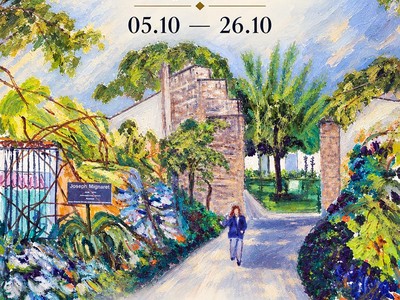
🎨 The Fiddler on the Roof Gallery invites you to the opening of the exhibition "In the Garden of Memory" by Olga Kravchenko
Community
Opening of the exhibition of Olga Kravchenko "In the Garden of Memory"📅October 5🕕18.00Memory has an amazing ability to bring distant spaces together, turn voices and faces, and preserve the elusive light of days gone by. In the painting of Olga Kravchenko, these impressions continue to live their own lives: they change over time, acquire new colorful shades and find unexpected inner resonance.🌿 The figurative world of the artist grows out of Krasylov's childhood, where Yiddish still sounded in the post-war years, and memories of neighbors were an integral part of the near and home world.Subsequently, this experience was enriched by the stony slopes of Israel, ancient oils, the turquoise coast of Eilat, and the Jewish quarter of Mare in Paris. Each of these places left a deep mark on the artist's worldview.Meetings with Jewish culture and art in different years echoed in the artist's work with subtle allusions, affinity of moods and new semantic connections. What she saw and experienced was organically woven into her artistic language, becoming part of a long and quiet dialogue.Exhibition"In the Garden of Memory"combines these visual reflections, gathering memories and sensations in a single space. Once nearby, the canvases reveal hidden connections that previously went unnoticed, and add up to a holistic story about the mutual echo of cultures in the life and art of one person.✨ We invite you to enter this garden together — a space where memory comes to life in colors, images and light.