Lubavitcher calendar: Today 8 Tammuz
Community
Today 8 Tammuz 5786📌 5551 (1791) — Rebbetzin Chaya-Mushka Ornstein, the daughter of Rebbe Maarash, became engaged (entered into the shiduh) to Rabbi Moshe Ornstein.📌 5658 (1898) — A big fire broke out in Lyubavichy. Sixty-three houses were burned, among which were the houses of the Rebbe family.📌 5661 (1901) — With the participation of Rebbe Rashab, a solemn celebration of the housewarming ("Hanukat ha-Bait") of the Great Hall of the Yeshiva "Tomhei Timim Lubavitch", the construction of which was financed by philanthropist Ishai Berlin, took place.📌 5750 (1990) — The Rebbe distributed the Asara She-Yoshvim kuntres (brochure) to the community.Source:Lubavitcher calendar
Psychologist page
Community
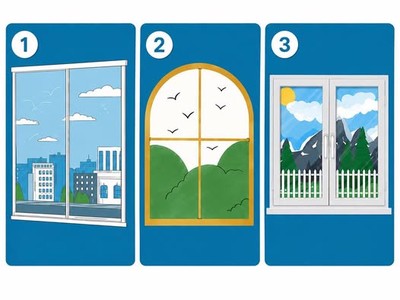
Which window will you choose?It is said that the first choice often prompts what we are not always aware of.Don't analyze too long — just look at the image and choose the window that first caught your attention.And look for the transcript in the comments under this postRemember: this is an entertaining psychological test that is not a diagnostic tool, but can be an interesting opportunity for self-reflectionEnd of responseWindow %1You are a cautious and restrained person. Before acting, think carefully and do not rush to open up to others.It is this trait that often helps you avoid unnecessary mistakes and make informed decisions.Tip: Sometimes allow yourself a little more spontaneity. The most interesting opportunities often appear when we go beyond the usual.Window No.2You are able to find a balance between caution and determination. Easily adapt to new situations and interact well with people.That's why you're valued at work and among friends.Tip: Don't be afraid to insist on your own opinion sometimes. Your decisions are trustworthy.Window No.3You are an open, emotional and sincere person. Love life, are not afraid to show your feelings and often act on the call of the heart.Your energy inspires others, although it can sometimes lead to hasty decisions.Tip: Take a short break from time to time before important steps — this will help you use your courage even more effectively.Source:https://iapht.webnode.com.ua/
Preparing for Tammuz Fast 17: What is Tammuz Fast 17?
Community
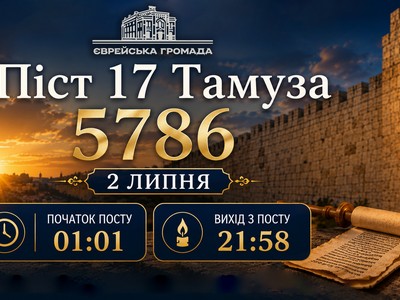
Part 1📌Fast 17 of Tammuz is one of four nationwide fasts established to commemorate the destruction of the Temple in Jerusalem. They also include the fast of Gedaliah (3 Tishrei), 10 Tevet and 9 Ava.📌Fast 17 of Tammuz is associated with the tragic events that preceded the destruction of the First Temple. It was 10 Tevet the Babylonian king Nebuchadnezzar II (Nebuchadnezzar) who began the siege of Jerusalem, and 17 Tammuz his army broke through the city walls. This was the beginning of the fall of the Jewish state.Three weeks later, on the 9th of Av, the most tragic event occurred — the Jerusalem Temple was set on fire.That is why the fast of 17 Tammuz opens a special mourning period in the Jewish calendar,which lasts three weeks — up to 9 ABA. This period is called "Bein HaMetsarim" ("Between the Cramps"), because it takes place between two mourning posts —17 Tammuz and 9 Ava.📌Five tragic events that occurred on 17 TammuzThe Talmud (Taanit treatise) mentions five major disasters that occurred on this very day:1. Moshe Broke the Tablets of the CovenantSeeing that the people of Israel worshipped the golden calf, Moshe-Rabein broke the Tablets of the Covenant received from the Almighty on Mount Sinai.2. The daily sacrifice of Tamid has stoppedDuring the siege of Jerusalem (before the destruction of the First Temple, according to Rambam), it became impossible to deliver sacrificial animals to the Temple. Because of this, the daily sacrifice of "Tamid" stopped, which became a sign of the approach of a major catastrophe.3. The walls of Jerusalem were brokenAccording to the prophet Irmeyahu (chapter 52), during the siege of the First Temple, the city walls were breached by 9 Tammuz, and in the era of the Second Temple, the same tragedy occurred on 17 Tammuz.4. The Torah scroll was burnedThe Apostomos, the viceroy of King Antiochus, ordered the Torah scroll to be burned, realizing that the best way to subjugate the Jewish people was to strike at its spiritual foundation.The burning of the Torah was the beginning of the brutal persecution of the Jewish people and one of the reasons for the Maccabee uprising.5. An idol was installed in the TempleOn this day, a statue of a pagan deity was erected in the Temple.According to one tradition, this was done by the same Apostomos during the Second Temple period.According to another (as the Jerusalem Talmud says), this was done by the Jewish king Menashe during the time of the First Temple. Menashe went down in history as a king who “drenched Jerusalem with innocent blood” and surpassed all his predecessors in idol worship.King Menashe and the Power of TeshuvahInterestingly, King Menashe was the son of the righteous King Hizkiyahu, one of the greatest kings of Judah.In the Babylonian Talmud (Brachot treatise), it is said that Hizkiyagu knew prophetically what his son would become, so he did not even want to marry so as not to have children. However, the prophet Yeshayahu rebuked him for this and ordered him to fulfill the commandment of the Torah — to marry and have children.Hizkiyahu obeyed, and Menashe was born.Despite numerous grave sins, at the end of his life, Menashe sincerely repented — he did teshuvah. The Talmud says that the Almighty opened the “secret gate” of Heaven for him, through which his prayer was received.tree : https://toldot.com/
Preparing for Lent 17 of Tammuz
Community
Part 2Fasting Short Order 17 TammuzFast 17 of Tammuz begins at dawn and ends with the release of the stars. It is followed in the same way as other public posts.In the synagogues on this day, special slihot (penitential prayers) are read, as well as the Avina Malkeyna prayer.During Shaharit and Minhi, they read a passage from the Torah, which tells how Moshe-rabein begged the Almighty to forgive the people of Israel after the sin of the golden calf.After reading the Torah during Minchah, they read Aftarah from the book of the prophet Yeshayah (chapter 55).During the repetition of the Shmona-Esre prayer for Shakharit, the chazan says the blessing "Answer us...", and at the Minh this insert is already read by the entire community (its place is indicated in the cidur).📌Three weeks of grief: from 17 Tammuz to 9 Ava📌The period between 17 Tammuz and 9 ABA is called “Bein ha-Metsarim” (“Between the constraints”).These are days of grief when the Jewish people recall the most tragic events in their history. It was during this period that the First and Second Jerusalem Temples — the largest shrines of the Jewish people - were destroyed.In memory of these tragedies, our sages established special laws of grief. Some of them begin to be observed already with 17 Tammuz.With Rosh Hodesh Ava, additional ordinances and mourning customs come into force.Separate laws are also in force on the eve of the 9th of Av — the day of the destruction of both Temples. The fast of 9 ABA itself is the most severe among all the complaining posts.Special laws also apply to the 10th of Av, because, according to tradition, it was on this day that Jerusalem and the Temple still continued to burn in the fire.📌Laws that begin to be observed with 17 Tammuz1. Period of increased cautionTradition considers these three weeks an unfavorable time for the Jewish people, so it is recommended to be especially careful.Desirable:*not to apply corporal punishment to children or students;*Avoid potentially dangerous places such as swimming pools, beaches, or hiking trips*unnecessarily avoiding uninhabited areas during the hottest part of the day (approximately 10:30 am to 4:30 pm).❗If the medical intervention or surgery can be safely postponed until the end of this period, it is advisable to do so.There is also a custom not to start important cases at this time, which are associated with major changes, although there are different opinions on individual cases.source: https://toldot.com/
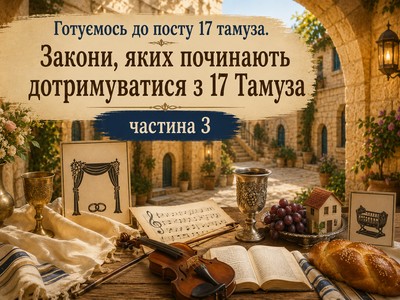
Preparing for the fast of 17 Tammuz: Laws that begin to be observed with 17 Tammuz
Community
Part 3📌 Wedding & MusicIn Ashkenazi communities of 17 Tamuz, there are no weddings. In most Sephardic communities, these restrictions begin with Rosh Chodesh Ava.Ashkenazim are allowed to participate in Sephardic wedding celebrations as long as they take place in accordance with their tradition.Familiarity with the purpose of creating a family (shidukh), as well as engagement (erusin) are allowed even during this period. It is also allowed to hold a festive meal on the occasion of engagement. 📌Starting from 17 Tammuz, it is customary not to listen to music and not to arrange dances. This applies to both live performance and music from radio, recordings, or other media. ❗It is allowed to listen to singing without musical accompaniment, although it is undesirable to sing secular songs independently.At the same time, singing, which promotes spiritual elevation, approach to the Almighty and strengthening of faith, is allowed.For children, these restrictions are not so strict.Teaching music as a means of earning money is allowed. However, it is advisable to postpone students' home musical exercises, if they are not urgently needed.An Ashkenazi musician is allowed to play at a Sephardic wedding if this is his professional activity. 📌 Festive mealsAfter 17 Tammuz, it is allowed to hold the Seven Blessings (Sheva Brahot) meal for the newlyweds, if their wedding took place before the beginning of this mourning period.Holiday meals are also allowed on the occasion of:*brit mils (circumcision);*Bar mitzvahs*redemption of the first-born (Piñón HaBen);*housewarming;*completion of the study of the Talmud (Siyum).❗Such meals are held without musical accompaniment. 📌 Blessing to “Sheheheyan”Of the 17 Tammuz, it is customary not to utter the blessing "Shehehean", which thanks the Almighty for letting us live to this time.Therefore, during this period, they try not to buy new things or fruits that need this blessing. ❗At the same time, there are exceptions: if the fetus after 9 ABA is already impossible to find, the blessing can be said;the blessing of Sheheyan on the fulfillment of the commandments (for example, during circumcision, redemption of the firstborn or immersion of the hero in the mikvah) is allowed to be spoken;if a person has already said the blessing "Creator of the fruit of the tree" and then mentioned the custom of not saying "Sheheyanu", he can still complete the blessing of "Sheheyanu".❗On the Sabbath, which falls during this period, as well as on Rosh Chodesh Ava, many authorities allow this blessing to be recited. At the same time, according to Arizal, it is desirable to refrain then.Also during this period, it is allowed to say the blessings "Gomel" and "Atov ve-Gametiv". source: https://toldot.com/
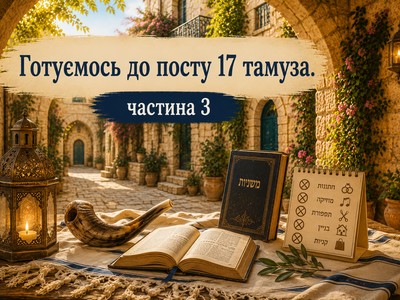
Preparing for Tammuz Fast 17: Part 3 (Completion)
Community
📌 Construction, repair and plantingSince 17 Tammuz, there is a custom to refrain from works that involve special joy or decoration.In particular, it is not accepted without urgent need:*whiten or paint the room;*start construction or large-scale repairs;*plant ornamental plants if it is done only for beauty and pleasure.📎If the works are necessary or related to safety or life needs, they are allowed to be performed.In the Ashkenazi tradition, 17 Tammuz are not cut or shaved.In most Sephardic communities, these restrictions begin to apply only from the week of 9 ABA, although some Sephardic communities also refrain from haircuts already from 17 Tammuz.❗The ban applies to both men and women and applies to any hair trimming.*It is not allowed to professionally trim or insert a wig, but it is possible to comb it.❗If a mustache or beard interferes with eating or drinking, it is allowed to trim them a little.❗Haircut or shaving for medical reasons is also allowed, for example, before surgery.🕯If a person was in a personal grievance for a close relative and because of this did not have the opportunity to get a haircut to 17 Tammuz, he is allowed to do so after the end of the personal grievance period. EXCEPTIONSIf brit milah (circumcision) occurs between 17 Tammuz and the week of 9 ABA, then: the father of the child; sandakah (the one who holds the child during circumcision); moilah (the one who performs circumcision) is allowed to get a haircut and shave on the eve of the celebration.However, if circumcision falls on the week in which 9 ABA is celebrated, there are opinions that even these people should not do this.📌Bar mitzvahIf a boy's thirteenth birthday (bar mitzvah) falls between 17 Tammuz and the week of 9 Ava, some rabbis allow him to get a haircut.Other authorities hold a stricter view and do not allow it.❗In the week of 9 ABA, haircut is prohibited.📌Haircut for childrenThere are different traditions about children.Some rabbis believe that restrictions apply to them as well.Others allow children under the age of six to have their hair cut.📎In the week of 9 ABA, it is not customary to cut children's hair.❗At the same time, the first haircut of the boy (halake) according to all opinions is allowed until the beginning of the week, which falls on 9 ABA.PurchasesSince 17 Tammuz, it is customary to refrain from acquiring things that bring special joy.At the same time, casual clothes, the purchase of which is not a significant event (for example, underwear, shirts, socks, etc.), are allowed to be bought and worn until the month of Av.❗All these laws and customs take effect from the evening after 16 Tammuz, that is, from the beginning of 17 Tammuz according to the Jewish calendar.May it be the will of the Almighty, for the Jerusalem Temple to be rebuilt as soon as possible, and the days of sorrow turned into days of joy, fun, and celebration. Amen.🙌
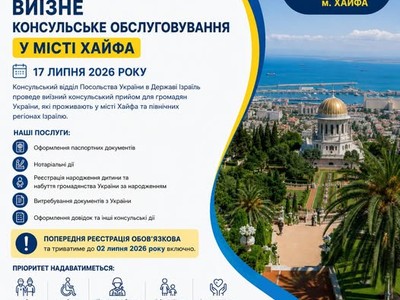
🇺🇦🇮🇱 On-site consular services for citizens of Ukraine in the city of Haifa
Community
In order to ensure the availability of consular services for Ukrainian citizens living in the city of Haifa and the northern regions of Israel, the Consular Section of the Embassy of Ukraine in the State of Israel will hold an on-site consular reception in Haifa on July 17, 2026.As part of the on-site reception, it is planned to provide a wide range of consular services, in particular:• execution of passport documents;• notarial acts;• registration of the birth of a child and the acquisition of citizenship of Ukraine by birth;• requesting documents from Ukraine;• registration of certificates and other consular actions in accordance with the legislation of Ukraine.Pre-registration is mandatory and will last until July 2, 2026 inclusive .Completing the registration form does not automatically mean making an appointment for a consular appointment. After processing the applications, the persons to be included in the appointment lists will receive a separate notification with confirmation and detailed information on the time and place of the consular service.In case of a significant number of applications, priority will be given to:elderly persons.persons with disabilities;military personnel and members of their families;families with children under the age of 7 inclusive;other vulnerable categories of citizens.Before registration, please read the list of documents required to obtain the relevant consular service:If you have any additional questions, please contact:consul_il@mfa.gov.uaLink for registration for consular reception:The Embassy of Ukraine in the State of Israel continues to work to ensure that consular services are as accessible as possible to Ukrainian citizens in all regions of the country.https://israel.mfa.gov.ua/konsulsk.../perelik-konsulskih-dij
History 📜 page: Jerusalem aqueducts
Community
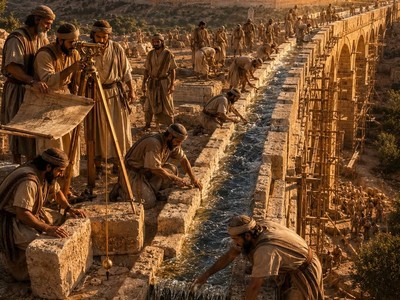
💧 Imagine supplying an entire city with fresh water-without electric pumps, engines, or modern machinery.Ancient Jerusalem had a unique water supply system, created thanks to impressive engineering solutions. Skilled craftsmen built aqueducts that delivered water over long distances using only gravity, precise calculations, and exceptional skill. Even the slightest error in determining the elevation difference could make the entire project unusable.🏛️ These grandiose waterworks provided water for Jerusalem's growing population, numerous pilgrims during the holidays, public buildings, and the city's daily life. Some aqueducts stretched for tens of kilometers, crossing valleys and hills with such accuracy that today they cause sincere admiration among modern engineers.The Jerusalem aqueducts were a clear indication that the combination of knowledge, perseverance and skill allowed the creation of structures that have survived for centuries and still remind of the high level of development of ancient engineering.Source: HiddenTribeStories
Iyom-yom: Today 10 Tammuza
Community
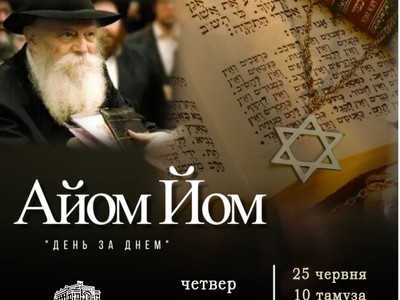
In the early years of his leadership, Alter Rebe taught:"It is written: "The Almighty directs man's steps. "When a Jew finds himself in a certain place, this happens according to Providence from above in order for him to fulfill the commandment — either in the relationship between man and the Almighty, or in the relationship between people.The Jew is the messenger of the Almighty. Wherever the messenger is, he carries the power of the One who sent him. The advantage of souls over angels is that souls are messengers of the Almighty through the Torah. ”Source: chabad.org
Mazal tov our birthday people!
Community
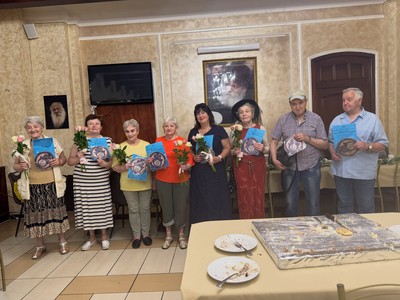
There are days when the synagogue is filled not only with prayer, but also with special warmthWe gathered again to congratulate the birthday people of our community - people who are part of its heart, memory and soulIt is an opportunity for us to say: we appreciate you, we remember you, you are not alone. Especially when it comes to our dear believers of the Golden Age, who have seen, experienced and continue to give us wisdom, strength and lightChief Rabbi of Ukraine Moshe Asman and ex-Minister in the UK Government Brooks Newmark, who has been a volunteer since the beginning of the invasion, and is very helpful to Ukraine - personally congratulated our birthday peopleWe prepared a gift for each birthday person, congratulated our women with flowers, and the large birthday cake became a symbol of the fact that joy in the community should always be sharedWe also conveyed greetings to those who this time could not be near. Because even from a distance, they remain part of our large Jewish familyMazal tov our birthday people!May the Almighty grant health, peace, long years, joy and strength.up to 120

Happy Constitution Day of Ukraine!💙💛
Community
The Jewish community of Ukraine sincerely congratulates everyone on the Constitution Day of Ukraine!On June 28, we celebrate the holiday of the Basic Law of our state — a day that recalls the values that are the foundation of independent Ukraine: freedom, human dignity, responsibility, unity and the pursuit of justice.Today, these words are gaining special weight. Ukrainians defend not only their land every day, but also the right to live in a free, independent state and independently determine their future.On this holiday, we pray for our defenders and defenders, for peace, for the safety of each family and for the speedy Victory of Ukraine.May the Almighty bless our state, give it peace, unity, wisdom and strength,and to all its citizens — prosperity, hope and confidence in the future.Happy Constitution Day of Ukraine!