Hevrat Kadisha of the Central Synagogue of Kyiv"
Community
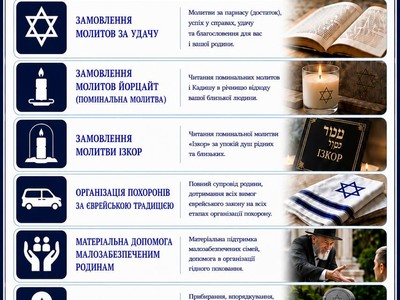
Core services:Ordering prayers for healthReading prayers and psalms for the health and recovery of relatives and friends.Ordering prayers for good luckPrayers for parnassus (abundance), success in business, good luck and blessings for you and your family.Ordering the Yorzeit PrayerMemorial prayer.Reading memorial prayers and Kadisha on the anniversary of the departure of a loved one.Order of prayer IzkorReading the memorial prayer "Izkor" for the repose of the soul of relatives and friends.Organization of funerals according to Jewish traditionFull family escort.Compliance with all requirements of Jewish law.Support at all stages of the funeral organization.Financial assistance to low-income familiesSupporting families.Assistance in the organization of a decent burial.Caring for gravesCleaning and landscaping of burial sites.Installation of commemorative plaques.Regular care of the graves.Help with "Cargo 200"Organization and support of transportation of the deceased to Ukraine, Israel and other countries of the world.Contacts+380 63 770 04 43messengers for communication (WhatsApp, Viber, Telegram)Contact person: Zalman"Hesed Shel emet" — "True Mercy".

📖 Lubavitcher calendar: Today — 4 Tammuz 5786
Community
Friday, Shabbat EveWeekly chapter: in Israel — "Khukat", in the diaspora — "Korah".5755 (1995) — the mashpiyah of Rabbi Mendel Futherfas, one of the main figures who organized the departure of Jews from the Soviet Union in 5706 (1946), one of the founders of Chabad institutions in London and the mashpiyah of the Tomhei Timimim yeshiva in Kfar Chabad, died in Eternity.Iom-yomEven when only one Chassid or one student directs his heart, mind and soul to the Torah and its strengthening, he works real miracles in the big city in all its affairs. And this happens in a supernatural way — thanks to the merits of the forefathers of the world.
Lubavitcher calendar: Ayom-yom on Shabbat 5 tamuz
Community
Shabbat — 5 Tammuz 5786📖 Ayom-yom on ShabbatOnce during a personal audience. (yehidut) our Old Master (Alter Rebbe — Rabbi Schneur-Zalman of Lyad) asked one of his closest and most prominent Hasidim about his affairs.Hasid began to complain that he had gone completely bankrupt and lost all his property.To this, Alter Rebe replied:“You are required to illuminate your surroundings with the Torah and the ministry of the heart (prayer). And the means of subsistence and all your other needs are what the Almighty is obliged to give you. Do what is assigned to you, and G-d will do what is assigned to Him.”📖Lubavitcher calendar

📖 Xiha Rebe for the Hukat Weekly Chapter | Song of the Favorites
Community
INTRODUCTIONOur weekly chapter talks about the song of the sons of Israel — “Then Israel sang” — as thanks to the Almighty for saving them from enemies who were chasing in the ravines of the rocks near the Arnon River, intending to destroy the people.The Almighty brought the two mountains closer to each other, and they crushed the enemies who were between them.We find a similar expression of gratitude after the miracle of the sectioning of the Red Sea (Yam Suf). Then the sons of Israel also glorified the Most High with a song: “Then Moses and the sons of Israel sang.”QuestionThe question arises: why did the sons of Israel consider it necessary to sing a song after these two miracles?After all, during the entire journey from the Exodus from Egypt to this point, many other miracles occurred, for which they did not sing praise.RESPONSEUnlike all other miracles, these two cases were distinguished by a special way of salvation: in both situations, the sons of Israel had to do absolutely nothing to defeat their enemies.Near the bed of the Arnon, the Almighty destroyed the enemies without any prior knowledge of the Jews themselves. In the same way, when the Red Sea was cut, they did not need to fight with the Egyptians, as it is said: “The Lord will fight for you, but you keep calm.”In these two miracles, the tender love of the Almighty for the people of Israel was especially clearly manifested. Therefore, the people, for their part, responded to this love with sincere mutual love — through a song.lessonEvery Jew should be aware of the exclusive love that the Almighty has for him and sincerely thank Him for it.(Adapted from Likutey Sikhot, vol. 23, p. 179.)📖Lubavitcher calendar
Iyom-yom: Today 14 Tammuza
Community
Tsemakh Tzedek writes in one of his works:“On the Tuesday of the weekly Balak chapter of 5562 (summer 1802), our teacher Alter Rebbe, blessed in his memory, said to his son:"How to solvethe question raised by astronomers: if the Earth is round and spherical, like an apple, then why do people living on the opposite side of the globe, in America, not fall?.. The answer offered by the scientists themselves is incorrect..."The Rebbe then explained,that the answer is contained in the teachings of Etz Chaim, where it is said that the nine celestial spheres (galgalim) receive life force from the very essence of the so-called circles (igulim), and there is neither top nor bottom in the circle.Therefore, for those who live on the opposite side of the globe from us, the sky above them is the "top" just as for us the sky above us is the top. Accordingly, the earth beneath them is the “bottom” with respect to the heavens above it. ”source: chabad.org

Izkor: more than a memorial prayer
Community
We often believe that the memoryof loved ones lives only in our hearts.However, Judaism teaches: real memory is manifested not only in memories, but also in good deeds.That is why there is a prayer Izkor ("Let him remember"). This is a special memorial prayer in which we ask the Almighty to remember the souls of our parents, relatives and friends who have gone to Eternity.But Izkor is more than a prayer. When reading it, it is accepted to make a commitment to give a tzedakah (donation) or do a good deed for the sake of raising the soul of the deceased.Judaism believes that after leaving this world, the soul continues to live, and the good deeds of children and loved ones can be a great merit for it. Therefore, the best way to honor the memoryof a loved one is not only to remember him, but to continue to do good on his behalf.Izkor also reminds us of one of the most important commandments — honoring parents. This commandment does not end with the death of a person. It continues through prayer, charity, Torah study, and good deeds.Memory in Judaism is not the past. It's the intergenerational bridge we build with our deeds today.May the memoryof our loved ones be a blessing, and their souls be bound in the knot of eternal life.

Our dates: 9 tammuz
Community
📌9 Tammuz 3338 (423 BC) — The Babylonians broke through the wall of Jerusalem.On this day, the army of the Babylonian king Nebuchadnezzar (Nebuchadnezzar) broke through the walls of Jerusalem and broke into the city. King Tzidkiah of Judah surrendered and was taken to Babylon. A month later, Jerusalem was completely captured by the enemy, the First Temple was destroyed, and most of the Jews were taken into exile.For many years, this day was celebrated by fasting, but after 490 years of Roman legionaries 17 tamuz broke through the walls of Jerusalem (this led to the destruction of the Second Temple), the dates of both fasts were combined.📌9 Tammuz 5004 (June 17, 1244) — Burning of Talmud treatises on Grevskaya Square in Paris.In 1240, King Louis IX the Holy arranged a dispute between Jews and Christians in his residence, and the Jews were forcibly escorted there. The Jews were represented by four rabbis, the Christians by the most learned of the monks, a Franciscan, a professor at the Sorbonne, and the Rev. Mykola Donin from La Rochelle. Witnesses report that Nicholas "looked weak", but the superiority of the "true faith" "could not fail to show", so according to the verdict, the Jews were declared defeated. And after 4 years, two dozen wagons filled with Talmud volumes were burned.This was the first-ever burning of Jewish books, and a fast was instituted to commemorate the event. However, as it is written in the book "Tanya Ravta": "Fasting is not tied to the days of the year, because the sages became aware that the Torah text predicted this event in advance", that is, fasting is not 9 tammuz, but on the sixth day of the week, when they read the chapter "Khukat"source: chabad.odessa

Our dates: 8 tammuz
Community
8 tamuz 5651 (July 14, 1891) — Engagement of Rebbetzin Hai-Mushka, the youngest daughter of the fourth Lubavitcher rabbi, Rabbi Shmuel (Rabbi Maharash) and Rabbi Moshe ha-Kogen Gorenstein.Rabbi Moshe Gorenstein was an outstanding sage and righteous man, so the Hai-Mushki brothers, including the future fifth Rabbi, Rabbi Sholom-Dov-Ber (Rabbi Rashab), made a lot of efforts to make the engagement happen.8 tamuz 5659 (June 16, 1899) — Yorzeit (anniversary of the departure from this world) Rabbi Eliyahu Mani.Rabbi Eliyahu Mani was born in Baghdad (Iraq), but after receiving a brah (blessing) from the great cabalist Rabbi Yosef-Haim bin Eliyahu al-Haham (Rabbi Ben Ish Hai), he moved to Eretz Israel, where he settled in Hebron and headed the Jewish community.Rabbi Eliyahu was respected not only by the Jews, but also by the Arab residents of Hebron, who called him “sheikh”. After the death of Rabbi Eliyahu, he was buried in a Jewish cemetery, but the Arabs stole his body and reburied it in a Muslim cemetery. The Jewish community had to not only get the body of Rabbi Eliyahu back, but also put a guard at his grave.source: chabad.odessa

Our dates: 11 tammuz
Community
📌11 tamuz 5591 (June 22, 1831) — Yorzeit (anniversary of the departure from this world) Rabbi Zvi Hirsch from Zhidachev.Rabbi Zvi Hirsch was born in the Galician town of Sambir and, together with his younger brother, Rabbi Moshe of Sambir, studied under Rabbi Jacob-Itzhak ha-Levi Horowitz, a blind seer from Lublin.Rabbi Zvi Hirsh was friends with the famous Hasidic tzaddik Rabbi Naftali Zvi from Ropshyts, and among his students were such outstanding leaders of the next generation as Rabbi Yitzhak-Ayzik from Komarna, Rabbi Zvi Elimelech from Dinov (also known as Bnei Issachar), Rabbi Yitzhak-Ayzik from Zhydachiv, Rabbi Shimon from Yaroslavl and Rabbi Shalom from Kamenka.Rabbi Yitzchak-Yizik of Komarna wrote that the soul of his teacher was a part of the soul of Rabbi Chaim Vital, the best student of the great kabbalist Rabbi Yitzhak Luria Ashkenazi (Arizal), and that, in turn, was a part of the soul of Rabbi Akiva. Another of his students, Rabbi Yitzhak-Aysik from Zhidachev, narrated from the words of the teacher that in a past life he was one of the students of the most prominent kabbalist, Rabbi Shimon bar Yochai. Some of the Hasidic tzaddiks — Rabbi Zvi's contemporaries — believed that his soul was that of the famous sage Yanuka (baby) mentioned in Rabbi Shimon bar Yochai's Kabbalistic book Zohar. Rabbi Zvi-Hirsh himself told his brother, Rabbi Moshe of Sambor, that his soul in one of the previous incarnations was the soul of Rabbi Ishmael, the high priest.📌11 tamuz 5696 (July 12, 1935) — Yorzeit (anniversary of the death) Rabbi Schneur-Zalman Slonim, grandson of Rebbetzin Menuchy-Rochl, daughter of the second Lubavitcher Rebbe — Miteler Rebbe.Rabbi Schneur-Zalman was born in 5622 in Hebron (Eretz-Israel) in the family of a rabbi and a great Hasidic Rabbi Mordechai-Dovber Slonim, the son of Rabbi Menuhi-Rohl. He himself was also a great connoisseur of Torah and Hasidic philosophy (Hesidus or Hasidut). His wife was Rebbetzin Mushka, the daughter of his uncle, Rabbi Levi-Itzhak Slonim. In 1885, when Chabad was headed by the fifth Lubavitcher Rabbi Sholom-Dovber (Rabbi Rashab), Rabbi Shneur-Zalman came to the Lubavitchers and stayed there for a long time.The Rebbe approached him, and in the winter of 1886 he took him on a famous Yalta trip, where they spent many hours studying Hasidism together. In addition, during his stay in Yalta, Rabbi Schneur-Zalman was the melamed (teacher) of the young Rabbi Yosef-Yitzhak (the future sixth Rabbi — Rabbi Rayats).After returning to the Holy Land, he began correspondence with Rebbe Rashab, and published collections of Rebbe Rashab's messages contain dozens of messages to Rabbi Schneur-Zalman.It is interesting that, addressing Rabbi Schneur-Zalman, Rebbe Rashab jokingly called him "my grandson", and his father, Rabbi Mordechai-Dovber, "son-in-law". The fact is that when Rabbi Mordechai-Dovber came to the Lubavitchers to the fourth Rebbe — Rabbi Shmuel (Rebbe Maharash), the son of the Rebbe (the future Rabbi Rashab) spent long hours with him, listening to stories about the previous Rebbe, which Rabbi Mordechai heard from his mother, Rabbi Menuhi-Rohl.Once, Rebbe Magarash also listened to Rabbi Mordechai's stories, and he liked them so much that he said to his son: "Invite him to your table as a son-in-law." (In those days, wealthy Jews wanted to marry their daughters, even if they were poor, but educated young men, and undertook to support their son-in-law for a certain time, giving him the opportunity to continue his studies. So the phrase about "inviting a son-in-law to the table" meant recognizing the wisdom of Rabbi Mordechai, who was able to decorate any family). And so it became established. And the son of the "son-in-law" became, accordingly, the "grandson".In 1900, he received an offer from Rabbi Schneur-Zalman of Lublin (author of Torat Hesed) to lead the community of Jaffa. With the blessing of Rabbi Rashab, Rabbi Slonim headed the community of Tel Aviv-Jaffa and remained in this position for 35 years, until the end of his days.Rabbi Schneur-Zalman is buried in Tel Aviv.source: chabad.odessa

Our dates: 12 tammuz
Community
12 tamuz 5100 (July 8, 1340) — Yorzeit (anniversary of the departure from this world) to Rabbi Jacob ben Asher ben Yechiel (Baal HaTurim).Rabbi Yaakov was the son of Rabbi Asher, the son of Yechiel (known as Rabbi Rosh). He was born in Germany, but then moved with his father to Spain, to Toledo, where, having given up the position of rabbi, he lived in great poverty, devoting all his time to the study of the Torah. The greatest popularity of Rabbi Yaakov ben Asher was brought by the book "Arba gya-turim" ("Four rows"), which gave him, as is often the case, a middle name. Believing that by that time "arguments had become fallacious, disagreements had increased, opinions had multiplied, so that there was not a single halachic rule left upon which there was agreement," Rabbi Ya'akov decided to write a book that would cover all the laws and customs concerning both the individual and the community.Arba Ha-Turim presents in a concise form the opinions of all the leading authorities of previous generations on each issue, so that any rabbi who uses this book can independently draw a final conclusion, assessing and comparing different opinions.According to the title, the book consists of four parts. Orach Chaim (“Lifestyle”) brings together the rules of daily conduct, as well as the laws of the Sabbath, holidays and weekdays; Yore dea (“Teacher of Wisdom”) is devoted to kashrut, the laws of circumcision, complaint, etc.; Even ha-zer (“Rock of Help”) contains provisions on marriage and divorce; Khoshen mishpat (“Sign of the Court”) is devoted to legal proceedings and commandments governing property relations.According to legend, Rabbi Jacob died on the way to Eretz Israel.12 tamuz 5640 (June 21, 1880) — Birthday of Rabbi Yosef-Yitzhak (Rabbi Rajac), the sixth Lubavitcher Rebbe.His mother, Rebbetzin Stern-Sara, said: “It's been a few years since our wedding. I was very young and away from my parents' house. We still had no children, and it was very traumatic for me.One day, on the holiday of Simchat Torah, during the kiddush that took place at the home of my father-in-law, Rabbi Shmuel (the fourth Lubavitch Rebbe, Rebbe Magyarash), they read the Misheberach (prayer for health) for all the women and girls of the Rebbe's House, but for some reason they forgot about me. I was very upset, and although I was later blessed, the sediment remained. I went to my room and began to think about the fact that I still do not have children, about my loneliness, about this story from "Misheberakh". I cried and fell asleep in tears. And then I had a dream.I saw in a dream a man of imposing appearance who came into my room and asked me: "My daughter, why are you crying?" I told him about everything that was in my heart, and he said, "Don't cry, my daughter! I promise you that this year you will have a son, but immediately after the holiday you have to give away 18 rubles from your personal money in the tsedak."When he had finished speaking, the man left the room and disappeared. A few minutes later, he returned accompanied by two more people and repeated the condition imposed on me in front of them. Those who came with him agreed, and all three, blessing me, left the room.A few hours later, my husband returned. I told him about the dream, and he hurried to his father and told him about it. My father-in-law called me and asked me to tell him the dream in detail. When I finished the story, my father-in-law said, “The first one to visit you was Rebbe Zemach-Tzedek, and the other two were Miteler Rebbe and Alter Rebbe.”After the holiday, I had to complete the task set for me in a dream, but where could I get "18 rubles of my personal money"? I had a dress made in the latest fashion of those times, but my father-in-law did not want me to wear it. Then I called a woman who cared for the needs of the community and asked her to sell this dress. And out of the money raised for the dress, I saved 18 rubles in the tzedakah.That same year, I had a son, Rabbi Rajac," the Rebbetzins of Stern-Sar finished her story.12 tamuz 5625 (July 6, 1865) — Yorzeit (anniversary of the departure from this world) Rabbi Eliyahu-Yosef Rivlin from Dribin, author of the book "Ogel Yosef"Rabbi Eliyahu-Yosef of Drybin was a great sage, one of the most prominent Hasids of the second and third Lubavitz Rebbe - the Miteler Rebbe and Rebbe Tzemach Tzedek, and one of the pillars of Hasidism of those times. Rebbe Tsemach-Tzedek said: "He has two and a half Hasidim, one of whom is Rabbi Eliyahu-Yosef." At first he was the rabbi of the town of Dribin, then he moved to Polotsk, and from there in 1847 he moved to Eretz Israel, where he became a rabbi and mentor of the Hasidic community. Among other things, he built the Zemach-Tzedek synagogue in the Old City of Jerusalem.He is buried by Rabbi Eliyahu-Yosef in Jerusalem, on the Mount of Olives.12 Tamuz 5655 (July 4, 1895) — Rebbe Rashab (Rabbi Sholom-Dov-Ber) appointed his son, Rabbi Yosef-Yitzhok (the future Rebbe Rajac), as his secretaryAt that time, the future sixth Lubavitcher Rebbe was only 15 years old, but Rebbe Rashab appointed him as his secretary for general administration. That same year, Rabbi Rajac attended the Rabbinical Convention as a representative of Rebbe Rashab.Since Yosef-Yitzchak was still young, Rebbe Rashab sent Rabbi Shmuel-Betzalel with him, warning him that although he, Shmuel-Betzalel, was very intelligent and Yosef-Yitzchak was very young, the less Shmuel-Betzalel interfered with his actions, the better.12 tamuz 5687 (July 12, 1927) — "The Feast of Liberation". On this day, the sixth Lubavitcher Rebbe Yosef-Yitzhak (Rebbe Rayats) received a notification of his release from Kostroma exile.Rebbe Rajac was exiled to Kostroma for three years instead of being shot, but the council set up to free him decided to continue working for his full release. The members of the council again appealed to Mrs. Peshkova, the representative of the Red Cross in the USSR, and she tried to get the liberation of the Rebbe from the Soviet leadership. In contrast, the Leningrad Chekists said that if the Rebbe returned to Leningrad, he would be immediately arrested.Rebbe Rajac was ordered to report to the Kostroma branch of the GPU every Tuesday, but when 12 Tammuz, on Tuesday, Rabbi Rajac and Rabbi Eliyahu-Haim Altgoiz, who accompanied him, came there, the Chekist welcomed them and said: "Your release has been ordered, and I am pleased to inform you of your release."Since the Kostroma branch of the GPU did not work that day, they could not issue a certificate of dismissal, and the Rebbe was forced to wait for a certificate until the 13th of Tammuz.

Lubavitcher calendar: Today is 7 Tammuz 5786
Community
Today7 Tammuz 5786📌5710 (1950)— The Rebbe edited for the first time the sycha, pronounced by him during the farbrangen and recorded by the "manihim" (listeners-composers). It was a conversation said inShabbat Mevarhimmonth of Sivan, about a month before that.📌5742 (1982)— The Rebbe joined the"Kol Kore"(public address) of the rabbis of the Holy Land to all the people of Israel with a call to abide by"taanite shaot"(fasting for several hours) for the good and salvation of the inhabitants of the Land of Israel dueto the state of emergency during the First Lebanon War.Iom-yomMy father, a teacher and mentor, Rebbe Rashab, said:"The beginning of Hasidism is rooted in its future, and the future is in its origins. This is the secret of the celestial circles (igulim), where there is no beginning and no end, but over everything there is an inviolable order.”Baal Shem Tov was an example of perfect order in everything. Magid from Mezhyrich was distinguished by his rigor and accuracy in his observance. And my great-grandfather, our great teacher Alter Rebbe, taught the Hasidim to be people of order.This is clearly seen in his teachings, letters, and spiritual niggas. A certain time of arrival in Liozna was established for each Hasidic once and for all, and later — in Liad. No one dared to change this term without the permission of the Rebbe, and in order to obtain such permission, it was necessary to provide a good reason.Under the Rebbe himself, there was a special advisory body that took care of the ordering of Hasidic life. It was headed by the Rebbe's brother, Maharil (Rabbi Yehuda-Leib). Separately, there was another council that was engaged in the upbringing and spiritual direction of young Hasidim. It was headed by Mitler Rebbe.
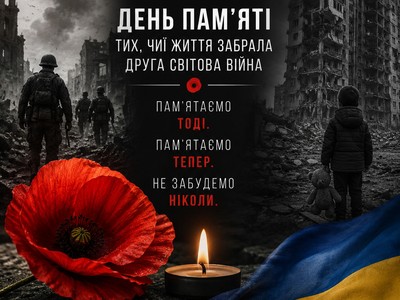
June 22 is the Day of Sorrow and Commemorationof the Victims of the War in Ukraine.
Community
It was on this day, in 1941, that the war came to Ukrainian soil with the first explosions over Kyiv. It has brought millions of human tragedies, ruined fates, devastated cities and villages, pain that does not disappear with generations.Today, decades later, Ukraine is again experiencing the horror of war. Our cities are waking up from explosions again, civilians are dying from Russian attacks, and the enemy is again trying to deprive us of the right to live on our land.We remember everyone whose lives were taken by World War II. And we remember everyone who died in the current struggle for the freedom of Ukraine.Bright memoryto all innocent victims.Eternal honor to those who defended and protect our land.We remember. We fight. We win.