
Siha Rebe: The Weekly Section of the Torah "Dvorim"
Community
Moshe📜 's work on the translation of the TorahINTRODUCTIONAt the beginning of our chapter, it is told that shortly before the entry of the Jewish people into the Land of Israel, Moshe-Rabbein translated the Torah into seventy languages of the world.QuestionWhat exactly did Moshe want to achieve with this translation and why did he do it at that time?RESPONSEThe explanation lies in a deep spiritual principle: if we want to change something in the material world, first we need to carry out this action in its spiritual root — in the Higher Worlds. And only after that the inherent potential descends into our physical reality.Similarly, the Jewish people, before entering the Holy Land, had to conquer it from the seven nations that lived there. In a spiritual sense, these seven nations personified and embraced all seventy nations of the world. To defeat them in the material world, it was first necessary to win on a spiritual level.This was the meaning of translating the Torah into seventy languages before entering the Land of Israel: it was the spiritual liberation of the sparks of holiness hidden among all the seventy nations of the world.It was only after Moshe rooted the Torah in the languages and cultures of these peoples on a spiritual level that the Jews were able to achieve real victory in the physical world.📌 A lesson for usThe life of each of us in all its details is inextricablylinked with the Torah. All events — both joyful and those that require overcoming difficulties — directly depend on the extent to which we adhere to her wisdom.When a person has a personal, tangible connectionto the Torah — for example, by acquiring his own letter from a Torah scroll — he attracts a powerful flow of blessing into his daily life, both spiritually and materially!According to the materials of the conversation of the Lubavitsky Rebbe to the section "Vaera", 5730 (1970).📖 source: Lubavitcher Calendar
Ayom-yom: 5 Menachem-Ava
Community
“Avoid evil and do good; seek peace and pursue it.” ¹Baal Shem Tov explained:“Every material thing permitted by the Torah contains elements of good and evil.² Its material side is evil, and the divine life force that animates the physical is good.Using something material, a person should "avoid evil", that is, not seek the physical pleasure that a material thing carries, and "do good" — seek to receive nourishment and support from the Divine life force contained in this thing.“Seek peace and pursue it” means that one who “avoids evil and does good” must seek and find the means by which “peace”³ is established between the material and the Divine life force that animates it. ”

Psychologist page: Confidence comes after the first step
Community
We often postpone important decisions, waiting for the moment when doubts disappear and full confidence appears. But psychologically, everything often happens the other way around: first, a person acts, and only then, having received the first experience, becomes more confident.Prolonged reflection can create the illusion of preparation, but at the same time increase anxiety. The more we imagine possible failures, the more dangerous even a small step seems to be. So there is a vicious circle: fear forces us to avoid action, and avoidance only convinces us that we are not able to cope.The action breaks this circle. Even a small step gives a real experience, returns a sense of control, and builds self-confidence. In psychology, this is called self-efficacy — an inner belief: "I can influence my life and overcome difficulties."But action does not mean recklessness. You don't have to make a big jump right away. Sometimes the wisest thing is to divide the path into small, safe steps: gather information, talk to the right person, try, evaluate the result, and only then move on.Confidence is not always a prerequisite for action. More often, it is its consequence. We do not wait for the fear to finally disappear, but we learn to go forward with it. Because courage is not the absence of doubts, but the decision not to allow them to control our lives.
Ayom-yom: Today 6 Menachem-Ava
Community
Returning from St. Petersburg after his imprisonment, Alter Rebbe uttered for his son, Miteler Rebbe, a maamar consisting of only a few lines:“It is said, 'Raise your hands in holiness and bless G-d. G-d, the Creator of heaven and earth, will bless you from Zion.' ¹The words “Raise your hands in holiness…” indicate the elevation of emotional qualities to intelligence² and the “illumination” of these qualities by intelligence.“…and bless³ G-d” — thanks to this, the higher Nameof Awayye is involved. And as a result — “… G-d will bless you from Zion…”: from the very essence of the soul, the Name of Avaie is also involved.Thanks to this, the meaning of the words "... the Creator of heaven and earth" is revealed, because this is what supports the existence of worlds."📖source: chabad.org

Our dates: 7 Awa
Community
7 Av 3328 (432 BC) — Capture of the First Temple.After nearly a month of fierce street fighting inside Jerusalem, the army of Babylonian ruler Nebuchadnezzar (Nebuchadnezzar) broke through inside the temple complex. Here the Babylonians began to riot, crashing everything that happened at hand. This continued until the morning of 9 Av, when the Temple was set on fire.source:chabad.odessa

Our dates: 8 Awa
Community
📌8 Av 2449 (1311 BC) — Return of scouts sent by Moses to survey Canaan.The scouts, sent by Moshe 40 days before to survey the Promised Land, returned from their mission, carrying with them visual evidence of the fertility and wealth of that land. The fruits were impressive with their excellent taste and gigantic size, for example, to carry a huge bunch of grapes, at least two adult men were needed. But at the same time as demonstrating the wonderful properties of the land promised to the Jewish people, the spies began to frighten the people with stories about the mighty giants living in the land of Canaan, and that they, the spies, looked like ants in their giant eyes. After that, the scouts declared that, they say, despite the promise of the Most High, this land cannot be conquered. What this led to became clear the next day, 9 ava.📌8 Av 3827 (67 AD) — The beginning of the civil war in Jerusalem.After the Roman army besieged Jerusalem, strife broke out among the besieged. Some of the townspeople believed that they should fight the hostages to the end, some believed that they should surrender and keep the city and the Temple intact. As a result of the conflict, one of the parties set fire to food warehouses. Thus, they cut off the path to retreat, but also doomed the Jerusalemites to starvation. After that, for three years, the Jewish capital confronted the Roman legions, but famine and fratricidal war took their toll.source: chabad.odessa

Our dates: 9 Awa
Community
📌9 Av 2449 (1311 BC) — The Exodus generation was condemned by the Almighty to death in the desert.On this day, the generation of Jews who had left Egypt 16 months earlier under the leadership of Moshe-Rabein (Moses) was condemned by the Almighty to death in the desert. At the same time, they were predicted that they would reach Eretz Yisrael only after 40 years of wandering in the desert.After the spies returning from their mission on the 8th of Av had frightened their listeners with tales of the dreaded giant inhabitants and predicted the inevitable death of the people if they attempted to conquer this land, the Jews bewailed their sad fate all night, declaring that they would rather return to Egypt than attempt to conquer this land and live in it. And then G-d decreed that this generation would wander in the desert for 40 years, until all the people over the age of 20 died and only their children, under the leadership of Yehoshua ben-Nun, could enter the land promised to the house of Israel as an eternal possession.📌9 Av 3337 (423 BC) — the destruction of the First Temple by the Babylonians.The destruction led to the fact that the location of the Temple left the Shekhinah (Divine Presence), most of the evidence of the events described in the Torah was lost — the Ark of the Covenant, the Tablet of the Covenant, the staffs of Aaron and Moshe, the menorah, etc. However, most sages believe that on the eve of the upcoming tragedy, these things were previously hidden in the depths of the Temple Mount, so with the arrival of Moshiach and the restoration of the Temple, all this will be again obtained from secret places.📌9 Av 3829 (69 AD) — the destruction of the Second Temple by the Romans.After the destruction of the Second Temple, sacrifices were stopped (they will be restored after the arrival of Moshiach and the restoration of the Temple), and temple utensils were lost or destroyed. And if the destruction of the First Temple led to the Babylonian exile, which lasted 70 years, then the destruction of the Second Temple was the prelude to the current Edom exile, which has been going on for almost 2000 years (Edom is the ancestor of the Romans and most European nations).📌9 Av 3893 (133 AD) — The fall of the Beitar fortress.Beitar was the last stronghold defended by the soldiers of the army of Bar Kokhba, the leader of the Great Uprising, and on this day, after a three-year siege, Beitar fell. His fall put an end to this rebellion. In total, almost 600,000 Jews died of starvation or at the hands of the Romans, including Bar Kokhba himself.📌9 Av 3895 (135 AD) — Jerusalem was razed to the ground and its territory plowed.Seeking to obliterate all memoryof the Jews who had done so much damage to Rome with their uprising, Emperor Hadrian ordered that the Roman province of Judea be renamed Palestine, and that Jerusalem be destroyed and its territory ravaged. The Roman settlement of Elia Capitolina was erected on the site of our capital. Jews were allowed access to its territory one day a year — on the 9th of Av, so that they could cry near the Temple Mount and the remains of the western wall of the temple complex (the Wailing Wall).📌9 Av 4885 (14 July 1095 CE) — Pope Urban II announced the beginning of the First Crusade, as a result of which the “warriors of Jesus” killed tens of thousands of Jews and destroyed many Jewish communities.📌9 Av 4906 (20 July 1146 CE) — Pogroms in the Jewish communities of Germany and France during the Second Crusade.📌9 Av 5050 (18 July 1290 CE) — Expulsion of Jews from England.On this day, King Edward I signed a decree on the expulsion of Jews from the British Isles.📌9 Av 5252 (2 August 1492 CE) — Expulsion of Jews from Spain.The decree on the expulsion of Jews from the territory of Spain, signed on this day by King Ferdinand and Queen Isabella, closed the last page of the centuries-old history of the brilliant Spanish community.The descendants of the Spanish Jews, known as the Sephardim (Sepharad (Hebrew) — Spain), spread throughout the Mediterranean.📌9 Av 5108 (5 July 1348 CE) — European Jews are accused of orchestrating one of the largest plague epidemics in history (the Black Death). This accusation led to a violent wave of pogroms and killings.On the 📌9th of Av 5315 (July 27, 1555 AD), the Jews of Rome were resettled in the first ghetto in history.📌9 Av 5315 (July 15, 1567 AD) — Resettlement of the rest of the Jews of Italy in the ghetto.📌9 Av 5408 (July 18, 1648 AD) — The massacre of tens or even hundreds of thousands of Jews in Poland, Ukraine and Bessarabia, organized by Khmelnytsky and his associates.📌9 Av 5642 (25 July 1882 AD) — Jewish pogroms within the Pale of Settlement of the Russian Empire.📌9 Av 5575 (August 15, 1815) — Yorzeit (anniversary of the departure from this world) Rabbi Yaakov-Yitzchak Ha-Levi Horowitz (Ha-Jose mi-Lublin, Seer from Lublin).It is said that at birth, the "Seer" received the gift of seeing the whole earth from edge to edge, however, looking at this world, he asked the Almighty to limit his gift to 400 versts. Rabbi Yaakov-Itzhak was a student of Rabbi Shmuel-Shmelke Hurvits from Nicolsburg, Rabbi Dov-Ber from Mezherich, Rabbi Levi-Itzhak ben Meir from Berdychiv and Rabbi Elimelech from Lizhensk.At first, Rabbi Yaakov-Yitzhak lived in the Galician towns of Lanzut and Rozvadov, and then moved to Lublin. Thanks to his activities, Poland and Galicia became great centers of Hasidism. The "Seer from Lublin" himself was the teacher of most of the leaders of the Hasidic communities of Poland, Galicia and Hungary. Among his students were Rabbi Yaakov-Yitzhak ben Asher (gya-Yehudi gya-Koydesh, "Holy Jew"), Rabbi Simha-Bunem of Pshisha, Rabbi Meir of Apta, Rabbi David of Lelov, Rabbi Moshe Teitelbaum of Shatorahulhei, Rabbi Zvi-Elimelech Shapiro of Dinov, Rabbi Naftali-Zvi of Ropshitz, Rabbi Klonimus-Kalman gya-Levi Epstein from Krakow (Maor Va-Shemesh), Rabbi Shalom Rokeach from Belz (Belgium Rebbe), Rabbi Yitzhak Kalish from Vorka, Rabbi Zvi-Hirsh from Zhydachev and many, many others.Rabbi Yaakov-Yitzhak, like other Hasidic leaders, was fiercely attacked by mesnagdim, and his main opponent was the namesake — Lublin Rabbi Azriel Horowitz (for his unbreakable character he received the nickname Di Ayzerne Kop — "iron head" in Yiddish).Rabbi Ha-Jose mi-Lublin considered Napoleon's campaign against Russia to be the beginning of the war of Gog and Magog and, accordingly, the harbinger of the arrival of Moshiach, but here his opponent was Alter Rebbe, who believed that Napoleon's policy towards the Jews would lead exclusively to their assimilation.On the day of his departure from this world, he predicted that exactly one hundred years later, Russia would lose power over Poland. Exactly one hundred years later, on 9 Av 5675 (20 July 1915), Austrian troops occupied Lublin, and Polish newspapers published a report about the fulfilled prediction of Rabbi Jacob-Itzhak.Shortly before his departure from this world, he did not feel well, and his numerous detractors, hearing this, were so happy that they organized real celebrations (if they were not Misnagdim, but Hasidim, it could be said that they organized a real Farbrengen), where they raised full cups and glasses for "quick ridding the world of this wicked person" and so on. After learning about this, Rabbi Yaakov-Yitzchak said that anyway on the day of his death they would not be able to rejoice, and they would not be able to drink even water. What he meant became clear on the day of Yortzeit — the 9th of Ava.📌9 Av 5674 (1 August 1914 A.D.) — The outbreak of the First World War.The First World War brought countless disasters to the entire European continent. The main theater of hostilities on the Eastern Front fell on the settlement zone of the Russian Empire, and the Russian authorities, suspecting Jews of loyalty to the advancing German and Austro-Hungarian troops, decided to evict all Jews from the front zone. This caused the destruction and death of many Jewish towns, and the consequence of the world war was the revolution and civil war with its Denikin, Petliur, Makhnov pogroms and the Soviet-Polish war, where pogroms were organized by both sides.📌9 Av 5702 (July 23, 1942 AD) — The beginning of the deportation (and in fact — the extermination) of Jews from the Warsaw Ghetto.📌9 Av 5702 (23 July 1942 A.D.) — Commencement of the work of the death camp at Treblinka.📌9 Av 5754 (17 July 1994 CE) — Explosion at the Jewish Community Center (AMIA) of Buenos Aires.The bombing in the capital of Argentina, organized by Arab terrorists, was the bloodiest action against Jews in the diaspora since the Holocaust. The blast killed 86 people and injured more than 120.source: chabad.odessa

Our dates: 10 menahem-avah
Community
10 menachem-avah 2197 (1564 BC) — Birthday of Issachar, son of Jacob and Leah.10 menachem-avah 2319 (1442 BC) — Yorzeit (anniversary of the departure from this world) Issachar, son of Jacob and Leah.Issachar was the fifth son of our forefather Jacob and forefather Leah, and the ancestor of Issachar's tribe. Issachar's inheritance occupied theplateaus of the Lower Galilee and included parts of the Jordan and Israel valleys, reaching Mount Tabor in the north.It is assumed that the prophetess Deborah came from the tribe of Issachar; Judge Tol and the king of the Northern (Israelite) kingdom of Basha also came from him.Rabbi Yitzhak Luria Ashkenazi said that the soul of Issachar was part of the soul of the son of Adam Cain (that part of his soul that remained unaffected by the evil beginning). In the future, the soul of Issachar was reincarnated in the souls of Rabbi Akiva and the famous sage Rabbi Yochanan ben Zakkai.Issachar was buried in the city of Sidon (now Saida (southern Lebanon), then a possession of Issachar's tribe).10 Menachem Ava 5066 (22 July 1306) — Expulsion of Jews from France.The day after the ninthof Av that year, a decree of Philip IV the Fair was issued for the expulsion of the Jews from France, with all their property to be left in the country by the Jews.source: chabad.odessa

The light above the city exists as long as a person does not stop looking for it.
Community
On July 28, at 18:00, the "Fiddler on the Roof" gallery invites you to the opening of a joint exhibition"Light over the city", which will combine the painting of Albert Lejzer Feldman and the ceramic sculpture of Olga Zmiivska-Vasylkivska."Light over the city" is not a story about the victory of light over darkness. This is a conversation about the light that helps you see what has long been hidden: memory, internal fractures, forgotten voices, and the possibility of a new path.Albert Leyzer Feldman's painting is a space of open metaphor. His city does not have a clear geography: it appears as a landscape of human consciousness, built from memory, doubt and hope. Each image — bridge, mask, crack or ray — does not have a single interpretation, but turns into a personal story of the one who is watching.Ceramic sculptures by Olga Zmiivska-Vasylkivska continue this conversation in the language of matter. Their forms preserve traces of time, human touch, and fire, reminding us that it is fractures, inequalities, and imperfections that often become the place through which light penetrates."Light over the city"does not offer ready-made answers. The exhibition creates a space for attentive gaze, internal dialogue and quiet discovery — a space where a different reality can open even through the fault.📅July 28, 18:00📍Fiddler on the Roof Gallery13 Shota Rustaveli Str., KyivEntrance from Esplanadnaya street.
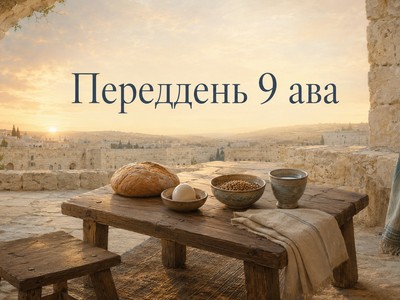
Forerunner 9 ava
Community
From the series "The Book of Our Heritage"Laws and customs of the day before Lent 9 AvOn the eve of the 9th of Av, shortly before sunset, that is, before the beginning of fasting, they arrangeseuda mafseket— "final" meal (literally — "interrupting meal").During this meal, it is forbidden to eat two cooked dishes, even if they are similar to each other, such as pasta and vermicelli. Even a product that is usually eaten raw, if cooked, is considered a cooked dish and excludes any other.Therefore, according to the custom, during this meal they eat a boiled egg or lentil, which, because of their round shape, are symbols of mourning. This exhausts the allowed number of boiled dishes. Nothing else cooked or fried is eaten, and hunger is satisfied with bread, milk or fruit.There is a custom to soak a piece of bread in ashes and eat it with such a "seasoning".The "final meal" is eaten sitting on the ground or on the floor. However, be sure to put something under yourself, such as clothes, so as not to sit directly on the bare ground. It is also allowed to sit on a low donkey less than three tefahs high.This custom is not a direct manifestation of grief, but indicates that the meal is not festive, but quite ordinary. Shoes should not be removed during it.If the "final meal" is over before sunset, it is still allowed to eat after it — provided that the person has not made a decision to start fasting, even mentally, and has not announced it aloud. Anyone who has not made such a decision, but only decided that he is already full and will no longer eat before the fast, can change his mind and eat something else.On the 9th of Av it is forbidden to study the Torah, because the Scripture says:“G-d's orders are just, they rejoice the heart.”(Tegilim, 19:9).The study of the Torah undoubtedly brings joy, and everything that pleases a person is forbidden on this day. Therefore, on the 9th of Av, when the laws of complaint apply to us, one cannot study the Torah.It is customary to extend this prohibition also to the afternoon of the eve of the 9th of Av. At the same time, there are topics and sections that are not covered by this ban, since their study does not bring joy.On the eve of the 9th of Av, it is customary to arrange a hearty and full meal in the middle of the day, which, however, does not include meat and wine. It can be even more abundant than usual so that future fasting does not harm health. A similar meal is customary on the eve of Yom Kippur.This custom reminds us that during the time of the Second Temple, both the eve of 9 Av and the day of 9 Av itself were holidays. In general, during that period, all four days of fasting established as a sign of mourning for the destroyed Temple were holidays. Even directly on the 9th of Av, they arranged rich meals, during which they drank wine.We have not yet received this great joy — rebuilding the Temple and turning the days of mourning into holidays. Therefore, so far we are arranging only a meal on the eve of the 9th of Av — as a memory of past times and a sign that the Temple will soon be rebuilt. This meal expresses confidence that the Almighty will send us final deliverance.It is customary to arrange the "final meal" after the Minha prayer. The penitential passage is not recited during this prayerApaim nephilate, since 9 ava is namedmydome— a festive day. And in the festive prayers, as well as during the Minha on the eve of the holiday, this passage is not read.On the eve of the 9th of Av, you should not go for a walk to crowded public places or to the market, because this can bring fun.They try to arrange a "final meal" so that three adult men do not participate in it. If three men still take part in it, they readbirkat hamazonnot together, but separately.After all, if three men participate in a joint meal and read this blessing together, they add a special formula to it —zymoon. But on the eve of the 9th of Av, they do not say it.On the eve of the 9th of Av, it is allowed to eat vegetables and fruits without restrictions. Even after the end of the “final meal”, you are allowed to drink tea or coffee.There is also a custom not to eat a vegetable salad during the “final meal”.A dish consisting of two or more components, which are usually cooked together, is considered one rather than two cooked dishes. Therefore, it is allowed to eat it during the "final meal".However, people who especially carefully follow the commandments eat only dry bread with salt during this meal and drink only water.Here is what the Talmud says about this:“So did Rabbi Yehuda bar Eli: on the eve of the 9th of Av they brought him dry bread with salt. He sat near the oven, that is, in the least attractive place in the house, and there he ate it, washed down with water. He behaved as if the body of a deceased relative were in the house.”Source:toldot.com
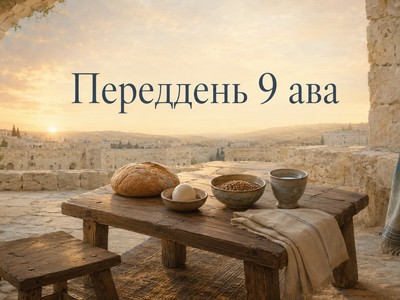
Forerunner 9 ava
Community
From the series "The Book of Our Heritage"Laws and customs of the day before Lent 9 AvOn the eve of the 9th of Av, shortly before sunset, that is, before the beginning of fasting, they arrangeseuda mafseket— "final" meal (literally — "interrupting meal").During this meal, it is forbidden to eat two cooked dishes, even if they are similar to each other, such as pasta and vermicelli. Even a product that is usually eaten raw, if cooked, is considered a cooked dish and excludes any other.Therefore, according to custom, a boiled egg or lentils are eaten during this meal, which, due to their round shape, are symbols of mourning. This exhausts the allowed number of cooked dishes. Nothing else boiled or fried is eaten, and hunger is satisfied with bread, milk or fruit.There is a custom to dip a piece of bread in ashes and eat it with this "seasoning".It is customary to eat the "final meal" while sitting on the ground or on the floor. However, you definitely need to put something under you, such as clothes, so that you are not sitting directly on the bare ground. It is also permissible to sit on a low donkey less than three tefahs high.This custom is not a direct manifestation of mourning, but indicates that the meal is not festive, but quite ordinary. You should not take off your shoes during it.If the "final meal" ended before sunset, it is still allowed to eat after it - provided that a person has not made a decision to start fasting, even mentally, and has not announced it out loud. The one who did not make such a decision, but only decided that he was already full and would not eat again until the beginning of the fast, can change his mind and eat something else.9 ava it is forbidden to study the Torah, because the Scripture says:"G-d's commands are just, they make the heart rejoice"(Tehillim, 19:9).Studying the Torah certainly brings joy, and anything that brings joy to a person is forbidden on this day. Therefore, on the 9th of Av, when the laws of mourning apply to us, one cannot study the Torah.There is a custom to extend this ban also to the afternoon on the eve of the 9th of Ava. At the same time, there are topics and sections to which this ban does not apply, as their study does not bring joy.On the eve of the 9th of Ava, it is customary to arrange a hearty and complete meal in the middle of the day, which, however, does not include meat and wine. It can be even more abundant than usual, so that the upcoming fast does not harm health. It is customary to arrange a similar meal on the eve of Yom Kippur.This custom reminds us that during the time of the Second Temple, both the eve of the 9th of Ava and the day of the 9th of Ava were holidays. In general, during that period, all four days of fasting, established as a sign of mourning for the destroyed Temple, were holidays. Even directly, the 9 avas arranged rich meals during which wine was drunk.We have not yet received this great joy - the rebuilding of the Temple and the transformation of mourning days into festive days. Therefore, for now, we only arrange a meal on the eve of the 9th of Av — as a memory of the past and a sign that the Temple will soon be rebuilt. This meal expresses confidence that the Almighty will send us final deliverance.It is customary to arrange the "final meal" after the Mingha prayer. During this prayer, the penitential passage is not readNephilat apaim, since 9 ava is namedby means of— a holiday. And in holiday prayers, as well as during Minha on the eve of the holiday, this passage is not read.On the eve of 9 ava, you should not go for a walk to crowded public places or to the market, because it can bring fun.They are trying to arrange a "final meal" so that three grown men do not take part in it. If three men still take part in it, they readbirkat hamazonnot together, but each separately.After all, if three men take part in a joint meal and read this blessing together, they add a special formula to it -zimun. But on the eve of the 9th of Ava, it is not said.On the eve of the 9th of Ava, it is allowed to eat vegetables and fruits without restrictions. Even after finishing the "final meal" it is allowed to drink tea or coffee.There is also a custom not to eat a vegetable salad during the "final meal".A dish consisting of two or more components that are usually cooked together is considered one, not two, cooked dishes. Therefore, it is allowed to eat it during the "final meal".However, people who follow the commandments especially carefully eat only dry bread with salt and drink only water during this meal.Here is what the Talmud says about it:"This is what Rabbi Yehuda bar Ilai used to do: on the eve of the 9th of Av, dry bread with salt was brought to him. He would sit by the stove, that is, in the least attractive place in the house, and there he would eat it, washing it down with water. He behaved as if the body of a deceased relative was in the house."Source:toldot.com
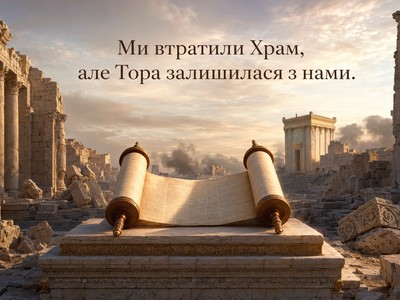
We lost the Temple, but the Torah stayed with us
Community
With the destruction of the Temple, our people lost their highest soul — the Shekhinah, the Divine Presence among us. Gaon of Vilna wrote that it was like the death of a people.After all, the inner essence of the Jewish people is life in unity with the Creator. We were a people of prophecy, a people of living connection with the Almighty and His Torah.Exile is a state of distance from the Almighty and His Torah. And it gets deeper every day. The worst thing is that sometimes we almost do not feel this pain...That is why it is so important for all who hold fast to the Almighty and His Torah to strengthen themselves and their families, to pass the Torah on to children, so that they grow in an inseparable connection with the Creator. To have a direct spiritual connection with the forefathers and great sages of our people in our families.We have lost the Temple, many of the commandments associated with it, lost the prophecy. But the Torah stayed with us.Therefore, today our task is to deepen and strengthen the connectionof the entire Jewish people with the Almighty and His Torah.source: ttps://www.beerot.