
Jewish Holidays: TheFifteenth of Ava
Community
TheFifteenthof Av (July 29 in 2026) is undoubtedly the most mysterious day of the Jewish calendar. If we look at the Shulchan Aruch — the code of Jewish laws — we will not find any mention of any special rituals of this day. It is only noted that in prayers they do not say Tahanun — a penitential prayer, as well as on other holidays. And also that, starting from the fifteenth Ava, more time should be devoted to studying the Torah, because the nights become longer, and "the night is created for learning."In addition, the Talmud says that many years ago, on the fifteenth of Ava, “Jerusalem girls went out to dance in the vineyards,” and “everyone who was not married went there” to choose a bride.And it is this day that the Talmud calls the greatest holiday of the year along with Yom Kippur, giving the latter an honorable second place!In fact, the fifteenth ABA cannot but be mysterious. Falling on the full moon of the tragic month of Av, it is a holiday of the coming Liberation, and therefore — a day, the essence of which, by definition, remains incomprehensible to us until we are liberated...source: chabad.org

Lubavitcher calendar: 14 Menachem Ava
Community
Today is 14 Menachem Ava 5786📌5543 (1783)— the Great Debate between the Alter Rebbe and the most prominent authorities of the mitnagdim took place in Minsk. As a result, hundreds of young scholars joined Chabad Hasidism.📌5561 (1801)— Alter Rebbe settled in the city of Lyady, opening a new page in the leadership of the Hasidic movement.Iom-yomDuring the prayer, Minha Tahanun is not spoken.14 Menachem-Ava 5701 marked fifty years since my father, teacher, and Rebbe [Rashab] ordered me to begin recording the stories he told me.When Tsemakh Tzedek began to write works on the open part of the Torah and Hasidism, Alter Rebbe told him: "And get yourself a friend" —"u-kne lekha haver". The word “acquire” (kne) is spelled in the same way asCanetFeatherMy father, teacher and Rebbe explained: it was aboutheart featherThis means that everything you learn must not only be understood, but also lived.Source:Lubavitcher calendar

Jewish Holidays: TheFifteenth of Ava
Community
TheFifteenthof Av (July 29 in 2026) is undoubtedly the most mysterious day of the Jewish calendar. If we look at the Shulchan Aruch — the code of Jewish laws — we will not find any mention of any special rituals of this day. It is only noted that in prayers they do not say Tahanun — a penitential prayer, as well as on other holidays. And also that, starting from the fifteenth Ava, more time should be devoted to studying the Torah, because the nights become longer, and "the night is created for learning."In addition, the Talmud says that many years ago, on the fifteenth of Ava, “Jerusalem girls went out to dance in the vineyards,” and “everyone who was not married went there” to choose a bride.And it is this day that the Talmud calls the greatest holiday of the year along with Yom Kippur, giving the latter an honorable second place!In fact, the fifteenth ABA cannot but be mysterious. Falling on the full moon of the tragic month of Av, it is a holiday of the coming Liberation, and therefore — a day, the essence of which, by definition, remains incomprehensible to us until we are liberated...Source:chabad.org

Day 15 Ava — Tu B'Av
Community
“There were no such feasts among the people of Israel as 15 Ava and Yom Kippur.”15 Ava — a holiday of love?In the Mishnah, in the treatise Taanit, it is said: “There were no such feasts among the people of Israel as the Fifteenthof Av and Yom Kippur.”❓What is this day — the Fifteenthof Av — and why is it compared to Yom Kippur?📌Our sages explain: Yom Kippur symbolizes the forgiveness of the sin of the golden calf. This forgiveness was granted by the Almighty on this very day, and it was then that Moshe Rabbeinu descended from Sinai with the new Tablets of the Covenant.Thefifteenthof Av also symbolizes the redemption of sin — the sin of the scouts who were sent to the Land of Israel and who slandered it. On thefifteenth of Av, it stopped taking the lives of those who left Egypt, and was the execution of the death sentence pronounced by the Almighty to the whole generation, which committed two grave sins: created a golden calf and did not want to go to Eretz Israel.📖Events that occurred on 15 ABASix joyful events took place on the fifteenth of Av.1. Those who left Egypt stopped dyingThere were 600,000 of them — men over the age of twenty. Every year, 15,000 people died on the Ninth of Av.In the fortieth year of wandering through the wilderness, when the people of Israel were already standing on the threshold of Eretz Yisrael, the last fifteen thousand people were waiting for theNinth of Av for their fate.However, the Almighty, mindfulof the many trials that our ancestors endured in the desert, had mercy on them and decided to keep them alive. Seeing that they were still alive, people thought that they had made a mistake in the calculations and the Ninth of Av had not yet come. But when the 15th of Av — the day of the full moon — came, doubts disappeared. It became quite clear that now it is really a month ago, the Ninth of Av has already passed — and no one has died.Therefore, the Fifteenthof Av forever remained a day of joy: the Almighty gave them life, and the sin of the scouts was finally atoned for.Now the words of the Mishnah become clear: there were no holidays in Israel like the Fifteenthof Av and Yom Kippur. For there is no greater joy than to be cleansed of sins: of the sin of the golden calf on Yom Kippur, and of the sin of the scouts on theFifteenth of Av.2–3. Two bans on marriages were liftedOn this day, the ban on marriages between men and women from different tribes of Israel was lifted, as well as the ban on the sons of the Benjamin tribe to marry girls from other tribes.As you know, in connection with the appeal of the daughters of Clofhad, which is described in the book Bemidbar, the Almighty forbade a girl who inherited her father's property to marry a man from the other tribe of Israel, so that land ownership would not pass from one tribe to another.Many years later, the tragic story of a concubine in Givi, described in the book of Shoftim, resulted in the other tribes of Israel recklessly swearing, “None of us will give our daughter in marriage to the knee of Benjamin.” Because of this, there was a danger that Benjamin's knee would disappear.Both of these prohibitions were lifted on the Fifteenth of Av. The people realized that the knee of Benjamin could not withstand this prohibition, and repented of the deed: "Today one knee is cut off from Israel!"But the question arose: “What can we do for them — we who have sworn by the nameof G-d that we will not give our daughters to them as wives?”The way out was found: the oath taken by the Jews then was not eternal and did not extend to future generations. A similar solution was found for the abolition of the ban on marriages between representatives of different tribes: it turned out that this ban was valid only for the generation that conquered the Land of Israel.І15 Awa sons of Benjamin were allowed to take wives of girls from the city of Shiloh, who went to the vineyards to drive round dances.Thus was preserved the existence of the whole tribe of Israel. At the same time, the ban on female heirs from one knee to marry men from the other knee has ceased to apply.This was the first unification of the clans of the nation of Israel in Jewish history, and the book of Shoftim calls it “a feast in thename of G-d.” Subsequently, according to the Mishna, it became customary to start matchmaking on this very day in order to create new Jewish families.4. Roads to Jerusalem were openedOn the fifteenth of Av, the Israelite king Hoshea ben Elah abolished the outposts on the roads leading to Judea.When the Jewish kingdom was divided into two — Judah and Israel — the first king of Israel, Jeroboam ben Nevat, feared that if his subjects came to Jerusalem three times a year for the holidays, their hearts would gradually return to the reign of the house of David. Therefore, he forbade them to go to Jerusalem, and to ensure the fulfillment of his order, he blocked the roads that led to Judah.Instead of the Jerusalem Temple, he established in two cities - Dana and Beit Eli - idols in the form of bodies and ordered to worship them. This is how the once unified state finally disintegrated: in Judea, the only God continued to be served, and idolatry spread in the kingdom of Jeroboam.However, the last king of Israel, Hosea ben Ela, removed roadblocks, allowing the people to make a pilgrimage to Jerusalem. So he tried to reduce the gulf that separated the two kingdoms.5. The gathering of firewood for the temple altar was coming to an endOn the fifteenth of Av, they finished gathering wood for the altar in the Temple, about which the Torah says: "The constant fire lit on the altar must not go out."At the beginning of the Second Temple period, most of the Land of Israel was devastated, so gathering firewood for the altar was an extremely difficult task. However, the people took up this work with great zeal, which was often associated with mortal danger.Those who delivered the collected firewood to the Temple were honored with the opportunity to bring a special sacrifice of thanks to the Most High - "korban etzim", that is, "sacrifice of firewood".The last day to gather firewood for the altar was the 15th of Ava, as the heat began to subside from then on.The fact is that only firewood that did not contain worms could be used for the altar. After 15 Ava, the probability of their appearance in wood increased as humidity increased and nights became colder. Therefore, the Fifteenth of Ava was also a temple holiday.6. The martyrs of Beitar were buriedThe martyrs of Beitar were buried on the fifteenth of Av. In memory of this, the sages added the last, fourth blessing to the Birkat ha-Mazon, the blessing after the meal.The Romans forbade burying the bodies of Beitar's defenders. But on the 15th of Ava, a year after the fall of the fortress, this ban was lifted.This event was a double miracle. First, the Almighty softened the hearts of the ruthless Romans. Secondly, it appeared that, despite the long time during which the bodies remained in the open air, accessible to wild animals and birds, they did not undergo decomposition.Therefore, the words that became his name were added to the fourth blessing: "Good and He who does good." "Good" - because the Almighty saved the body from decomposition; "He who does good" - because He provided for their burial.And to this day we celebrate the Fifteenth of Ava as a joyful day. On this day they do not recite Tahanun and do not indulge in sorrow.The circle closesFrom the Fifteenth of Av begins the spiritual preparation for the month of Elul and the Terrible Days.The length of the day is gradually decreasing, and the nights are getting longer. The time for summing up is approaching. Nature itself contributes to this: field work ends, the heat subsides, and it becomes easier for a person to focus on thoughts.Starting with the Fifteenth of Av, it is customary to wish each other a good year. The gematria of the wish: "May G-d grant that you will be recorded for a happy year in the Book of Life and that this record will be sealed!" - is equal to the gematria of the words "Fifteenth Ava" - 928.We find another hint of the approaching Terrible Days in the 29th chapter of the book of Dvarim:"You all stand today before your G-d: the heads of your tribes, your elders and those in charge of order, all the men of Israel, your children and your wives, as well as the proselytes who live in your land - from the woodcutter to the water-carrier - to enter into an alliance with your G-d, in the sworn alliance that G-d makes with you today."The mention of the woodcutter is an allusion to the 15th of Av, when the gathering of wood for the altar in the Temple was completed. The mention of the water-carrier is an allusion to the day of Oshan Rab, when water was poured on the altar. And during all this time - from the 15th of Av until Oshan Rab - "you all stand together before your G-dThe atmosphere of the days of reading slikhots and pleas for mercy, the atmosphere of the days of judgment is returning. We are again facing the new year - with all its holidays and fasts, days of spiritual joy and days of sorrow. It's almost time to take stock of the past year.The annual circle ends — and a new one begins. A new year is coming with its blessings.source: https://toldot.com

The meaning of the holiday and spiritual work from the 15th of Av to Yom Kippur
Community
The common thread of all the events of 15 Ava is the restoration of integrity: the people, the family, the connection with the Creator, the natural and spiritual cycle. The holiday is perceived as a moment of harmony and the completion of the circle, when what was broken becomes complete again.The 15th of Av begins a special period of preparation for Rosh Hashanah and Yom Kippur. The power of the yetzer ha-ra weakens, and it becomes easier for a person to approach the Most High.Tradition hints at the connection of the 15th of Av with the future construction of the Third Temple and the final Deliverance.

15 Ava: from tragedy to recovery and joy
Community
15 Ava is a day that combines historical memory, correction of the consequences of tragedies, and joy at the completion of the commandments.It reveals the Jewish understanding of the holiday as a moment of harmony, when the connection between man, people and the Most High is restored.The special atmosphere of this day makes it an auspicious time for shidukhs, family strengthening and increased Torah study. The period from the 15th of Ava to Yom Kippur is an opportunity for conscious preparation for the Judgment Days and deepening spiritual closeness to the Creator.

"The yoke of commandments"
Community
Commandments yokeRabbi Ishaya GisserLet me remind you of Tori's words:“And it shall come to pass, that, because ye will hearken unto these laws, and keep them, and do them, the Lord thy G-d shall keep for thee the covenant and the mercy which he sware unto thy fathers.”Lubavitsky Rebbe in his conversation explained that, according to the teachings of Hasidism, in the formulation of this verse — in the wordEkev— you can see a hint of the difficult period of history in which we all now live: the time before the arrival of the Messiah, named in the Talmud²ikvot Mashiach— "by the heels of the Messiah." Just like theheel —Ekevhebrew is the end of the body, and this time is the completion of the expulsion.I can not deny myself the pleasure of quoting this quote more fully — it is so eloquent:"Before the coming of the Messiah — literally:beikwot Meshikha— audacity will grow… the authorities will become godless, and there will be no instruction… The wisdom of Torah scholars will become impoverished, those who fear sin will be despised, the truth will be hidden, the young will disgrace the elders, and the elders will stand before the children. The son will despise the father, the daughter will rebel against the mother, the daughter-in-law against the mother-in-law, and the enemies of the person will become her home. The face of a generation will be like a dog's face, and the son will not be ashamed of his father. Who will you be able to rely on? Only on our Heavenly Father. ”So, if we understand these lines of the Torah as a hint of the time before the coming of the Messiah, then they contain a promise that these days we will faithfully observe the commandments of the Almighty. This is also stated by the Torah itself in the Nitzavim section:“And you will return to the Lord your G-d.”³It should be noted that such an understanding is fully consistent with Rashi's explanation to this verse of Scripture — about “light commandments that a person despises and tramples on his heels.”During exile, especially in our dark times before its completion, the fulfillment of the commandments is often accompanied by neither special feelings nor an understanding of their meaning and level of holiness. And then discipline and a sense of duty come to the fore, the general acceptance of the entire system of commandments as a yoke of service —cabalat olSuch service may not be accompanied by spiritual exaltation, inner peace, or a sense of personal need to fulfill the commandments.It would seem that there is nothing good in this. It is not in vain that these days it is so difficult for many to understand the feelings and experiences associated with the fulfillment of the commandments.All this is true, but even in such a ministry, devoid of vivid spiritual experience, there is an advantage. Observance of the commandments without a strong personal need, without a lively sense of involvement is characterized by a low level of personal interest. And, paradoxically, this may indicate a high level of self-denial —bitulac74(97A29.4'Our generation is not in vain compared to the fifth — the coarsest and lowest part of the body, which, however, holds all its weight.This is our goal:“And it will be: because you will listen to these laws…”It is necessary to obey and fulfill all the commandments — even those that “a person usually tramples with his heels” — bringing himself to a state of completebitula: Submission and self-denial of the soul to the Creator.NotesDvirim, 7:12.Sota, 49b.Dvirim, 30:2.Source:https://chabad.org/
Chabad history: Man-energy📢: how one Chassid became the voice and embodiment of the Rebbe's plans for millions
Community
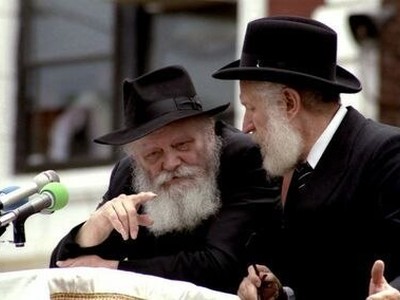
🎙️A voice everyone knewIf you were in Brooklyn in the 1970s and 1980s for the famous children's parade at Lag ba Omer or the massive gathering at Synagogue 770, the first thing you'd hear is a loud, charismatic, and incredibly lively voice. It was the voice of Rabbi Jacob Yehuda Echt, known simply as “J.J.”He wasn't just an organizer or host. Rav Echt had a unique talent: just during many hours of dyeing, he simultaneously interpreted the Rebbe's speeches from Yiddish into English. Moreover, he was able to retell deep Hasidic ideas so simply and fascinatingly that, with bated breath, he was listened to by both young children and people who came to the synagogue for the first time.🏛️From the ordinary student — to the most important projectsYakov Yehuda was born in 1923. In his youth, he, along with five brothers, discovered Chabad Hasidism and joined the central yeshiva. After his marriage, he was appointed rabbi of the East Flatbush community. In those years, even before the Rebbe officially led the movement, the young rabbi often turned to him for advice. The Rebbe was literally teaching him what and how to talk to people during sermons.Subsequently, the Rebbe began to entrust him with the most important and large-scale initiatives. Rav Echt headed the Shla organization, an after-school Jewish education program for children from ordinary public schools, founded the first Mahane Emuna summer camp for girls, led the Adar HaTorah yeshiva for those who returned to their Jewish roots, and also regularly conducted educational programs on the radio.The Rebbe once said amazing things about him:“I have a Hasid who does exactly what I want.”✨Caring, discouragement and special treatmentRav Echt gave his all to the work without a trace. But from such a colossal load, even the strongest people are sometimes exhausted. In 1987, immediately after the completion of another grand parade, the Rebbe approached him and asked with parental care:“How's your frustration?”Rav Echt replied:“Rebbe, you got me out of it!”To this, the Rebbe smiled, raised his hands and said:“I lifted you out of it!”His connectionto the Rebbe was truly deep. In the autumn of 1989, during the holiday of Simhat Torah, an amazing episode occurred. Turning the Torah scroll, the Rebbe made a special, extremely warm hand gesture towards Rabbi Echt, as if sending him an air kiss. Subsequently, Rabbi Echt confessed to his son that the day before he fell asleep in a bough and saw in a dream how much he wanted to kiss the Rebbe.🕯️A legacy that lives onWhen Rabbi Echt passed away in 1990, on the 15th day of Menachem Av, it was a huge loss for the entire community. The Rebbe was personally present at the cemetery and stayed at his grave for a very long time.Later in his speech, the Rebbe noted that the numerical meaning — gematria — of the name "Jacob Yehuda" coincides with the word "Rebbe", because this person devoted his whole life to fulfilling the tasks of the head of the generation and raising Jewish children.Today, the case of Rabbi Jay Jay Echt is continued by his children and grandchildren. They serve as Rebbe envoys around the world, from New York to South Africa. And the yeshiva "Adar HaTorah", which he led for many years, now bears his name — "Kol Yakov Yehuda".💡The main conclusion of this storyThe story of Rabbi Echt is a vivid example of how one person with inexhaustible energy can become a bridge between a great leader and hundreds of thousands of people.No matter how difficult the task before you: if you take it with sincere love, inspiration and willingness to act, you can light the hearts of an entire generation.📖Lubavitcher calendar

📖 Lubavitcher calendar: Today is 15 Menachem-Ava 5786
Community
📌 5586 (1825/1826) — Rebbetzin Khaya Sarah Alexandrov (Zaslavskaya), daughter of Miteler Rebbe — the Second Lubavitcher Rebbe, — married Rabbi Aaron Alexandrov from Shklov.📌 5706 (1946) — a freight train ("echelon") with hundreds of Hasidim left the Soviet Union as part of the "Great Escape" — Exit from Russia in 5706📌 5730 (1970) — At the direction of the Rebbe of Tuvia, Ples launched an operation to support and strengthen the spirit of the soldiers of the Israel Defense Forces (IDF) after the end of the War of Attrition.📌 5746 (1986) — based on the results of the Rebbe's Farbrand, the "Committee for the Execution of the Instructions of His Holiness the Admiral — May the Almighty continue his days" was founded.📌 5750 (1990) — left this world by Rabbi Yakov Yehuda Echt — the founder of the children's camp "Mahane Emuna", the host of the famous children's meetings in the presence of the Rebbe and the general director of the organization "SHELAH".Iom-yomTahanun is not spoken.My master, father, teacher, and mentor writes:The advantage of 15 ABA (Tu B'Av) over the other fifteenths of the month is that in the remaining months it is only the fullness of disclosure, but still it remains only the level of the recipient (bhinat mekabel). However, 15 Ava light is constantly in it, since the elevation corresponds to the depth and strength of the fall of 9 Ava (Tisha be Av)...This is the meaning of "weakening the power of the sun" (tashash kokha shel hama): idolaters count the sun — "solar chronology", and 15 Ava this power weakens. And if it was so in the days of the Temple, when they obeyed King Shlomo, then all the more so in the future, when they "reach out to him" in complete self-annulment (bitumen) and "the spirit of impurity I will remove from the earth...".Something similar happens on 15 Ava — "the strength of the sun is weakening...".source 📖 Lubavitcher calendarhttps://t.me/+8KbDy9dQVqAxZWE8

What work is prohibited on Saturday?
Community
In the Jewish tradition, the Sabbath rest is not just a rest from physical fatigue. In the Torah, the activity prohibited on Shabbat is called a special word — melakha (in the plural — melakhot), which is only conditionally translated as "work".The word melakha is associated with the concept of malach ("messenger"). The Creator sent man into the world to master and order him. For six days, we have been transforming nature, putting its resources at its service. On the seventh day, a person stops mastering the world and does not interfere with the natural course of things. Therefore, Saturday's ban does not concern the difficulty of work, but the very fact of creative influence on matter.There is no detailed list of prohibitions in the Written Torah — only a general requirement and a mention of fire. The detailed system is revealed in the Oral Torah through the connection between the passages of Scripture: the commandment on Shabbat is given immediately before the command to erect the Mishkan — the Portable Temple.The Creator's warning gave a clear formula:shabbat cannot be broken even for the sake of building the Temple.A key principle was derived from this: melakha is any action necessary for the construction and arrangement of the Mishkan.Analyzing the process of creating the Mishkanu, the sages of the Talmud identified 39 main categories of creative activity — avot melakhot, or "parental categories":Farming & Cooking:plowing, sowing, harvesting, sheaf harvesting, threshing, blowing, sorting, grinding, sifting, kneading dough, cooking.Tissue making and leather processing:wool spinning, washing, dyeing, spinning, weaving, sewing, hunting, leatherworking.Construction and everyday life:construction, destruction, ignition and extinguishing of fire, marking, transfer of objects from one possession to another.These 39 activities are the main prototypes. Any other actions similar to them in their purpose are called toladot — "children", or derivatives. For example, if grain sowing is the main category — ab, then plant watering or weeding are its derivatives — toladote, since they also promote growth.source: toldot.com

SUNFLOWER. EYES TO THE SUN 🌻
Community
There are flowers that grace the eye. And there are those that become symbols of an entire people.For Ukrainians, sunflower is not only the gold of summer fields. This is the memory of the native land, hard work, indestructibility and the belief that even after the darkest night, the sun will certainly rise. He always reaches for the light, reminding: strength is born of hope, and the future belongs to those who do not stop looking forward.On August 6, at 18:00, the Fiddler on the Roof gallery invites you to the opening of the Eyes on the Sun exhibition, an art project in which the sunflower appears not only as an image of nature, but also as a symbol of Ukraine, its culture, dignity and indestructible spirit.In the works of artists, a flower comes to life, which has become an integral part of the Ukrainian landscape, history and our common memory. It unites generations, recalls the value of peace and gives faith in the light to which our eyes are turned today.We invite you to share with us this evening of art that speaks the language of the sun, freedom and love for Ukraine.August 📅 6, 202618.00Fiddler on the Roof 📍 Gallery13 Shota Rustaveli Str., Kyiv (entrance from Esplanadnaya, 24)Let's look at the sun with our eyes. Together.
Ayom-yom: 20 Menachem-Ava
Community
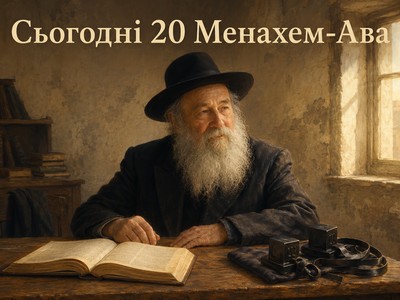
Yorzeit Rabbi Levi-Itzhak Schneerson, may his memory, the Rebbe's father, be blessed.“He was arrested and exiled for activities to strengthen Judaism and died in exile on the twentieth day of the month of Menachem-Aba…”(The inscription on the tombstone of Rebbetzin Hana, may her memory be blessed, Rebbe's mother.)To fulfill the Tefillin commandment, there is a place defined by law — on the head and on the forearm. At the same time, a person feels the weight of the tefillin placed on the head and the pressure of the tefillin strap applied to the hand.The same applies to the commandments of love and fear of the Almighty. The Rambam writes (Ysodei ha-Torah, 2:1): “To love and fear the great and formidable G-d are two commandments of the Torah, as it is said: 'Love the Most High, your G-d,' and 'Fear the Most High, your G-d.'”They should be performed in such a way that both love and fear can be physically felt by the heart. For example, having met a beloved friend, a person not only feels joy, forgetting all his troubles, but also experiences the awakening in the soul of a new vitality and inspiration, the source of which is his joyful state of mind.The same goes for fear of G-d. Seized with great trepidation and fear, a person remembers everything bad and unworthy that was in his thoughts, words and actions. Her heart physically feels the pain of a God-fearing fear of punishment.¹ Sometimes a person experiencesyirat Boshet(“fear generated by shame”)² oryirat Garomut("trembling before the majesty of the Almighty").³source: chabad.org