
Another hard night.........
Community
Kyiv did not just stay awake last night — it shuddered at the explosions that broke the silence. Air raids, smoke, pain, and the unknown have once again become part of the night for thousands of people.During these hours, everyone was looking for salvation: someone rushed to shelter, someone hugged their relatives more tightly, and someone, holding their breath, waited for the message: "I am alive." In the darkness of cellars and shelters, people shared not only space, but also hope — silent, but so necessary.Today, our hearts are with the families of the dead, the wounded, those who have lost their homes, and the rescuers who are relentlessly clearing the rubble, hoping to find those who are still waiting for help.We pray that the Almighty will give comfort to those who mourn their loved ones, healing to the wounded, strength to all who save lives, and bring peace to Ukraine as soon as possible.

Bein HaMetsarim 🗓 Days (Three Weeks) — An Inside Look
Community
Bein HaMetsarimis the 21-day period of grief between fasting17 Tammuza(the day when the walls of Jerusalem were broken) and9 Ava(the day of the destruction of the First and Second Temples). Historically, this time is considered a period of mourning and severe Heavenly judgment. However, the Lubavitcher Rebbe reveals a completely different, deeper look at these days.🕯Inner Content: The Path to the Third TempleThe Rebbe explains that the very name of this period isThree weeks, not just "21 days", contains a hint of the futureThird Temple (Beit HaMikdash HaShlishi). The spiritual goal of each descent and destruction is to lead to even greater exaltation.In our generation, this inner light is revealed even before the beginning of mourning: the month of Tammuz opens with the holiday of Liberation12–13 TammuzaIt reminds every Jew that the ultimate goal of all difficult events isGeula (Liberation). Therefore, strictly observing the laws of mourning, we are at the same time looking for ways allowed by the Torah to add holy joy to these days.🚫Laws and customs (from 17 Tammuz to Rosh Chodesh Av)In the first part of this period, we refrain from manifestations of excessive joy:Music.They do not listen to music or attend concerts.TravellingIt is not customary to go on entertaining trips or on vacation, as this time is considered unfavorable.Wedding.Wedding celebrations are not held during this period.Haircut.Men don't cut or shave, and women don't cut their hair either.New things.Don't say a blessing"Shegeheyan"for new fruits or important purchases (even on Shabbat).🌒"Nine days" (from 1 to 9 ABA)With the onset of the month of Av, the level of grief increases. In Chabad, they adhere to the Ashkenazi custom, according to which all stricter restrictions begin to operate fromRosh Chodesh Avc74(97A29.4'Meat and wine.They are not used (except for Shabbat or a meal on the occasion of the completion of the study of the Torah treatise —Siyum Masekhet) is properly prepared and signed by appropriate authority.Laundry and clothing.Do not wash or put on clothes that have just been washed or ironed.💡Practical tip:It is customary to wear clean clothes (shirts, pants, etc.) for a short time before the onset of Rosh Chodesh Av, so that they lose the status of "completely new" clothes.Rebbe's custom.On the eve of Rosh Chodesh, the Lubavitcher Rebbe took turns wearing the prepared shirts for a few moments and removed them so that the sleeve turned inside out. It was a sign that the thing was already considered worn.📜Special Instructions to the Rebbe: How to Turn Darkness into LightTo spiritually confront the forces of destruction and hasten the coming of the Messiah, the Rebbe gave some important instructions:Study the laws of the Temple.The Rebbe called for active study of the structure of the Holy Temple (according to Rambam, the treatise "Midot" or the book of the prophet Ehezkel). The Almighty said:“If you study the structure of My House, I count it to you as if you were building it.”Multiply the study of Torah and tzedakah.It is worth devoting more time to learning and increasing charity, rememberingthe words:“Zion will be redeemed by justice (Torah), and those who return to her will be redeemed by tzedakah.”Daily Siyum Masekhet.Continuing"Nine Days"(and before15 Avainclusive) The Rebbe recommended to spend or visit dailySiyum Masekhet— celebrating the completion of the study of the Talmud. On weekdays, such completions must necessarily be accompanied by the distribution of tzedaka.📖Lubavitcher calendar

When words are lacking, prayer remains
Community
We usually try to share interesting materials, stories, facts, translations, news of our community with you every day. It is important to us that this site is a place where you can find knowledge, inspiration and light.But today there are almost no words. And not just because the night was again sleepless, filled with explosions, sirens and anxiety.Today it just hurts. It hurts somewhere very deeply, where fatigue, pain from losses and anxiety for each life have long accumulated.Therefore, today, instead of another publication, there is only silence, prayer and a request to the Almighty to protect Ukraine, our defenders and everyone who is going through these terrible days.May the Almighty send comfort to those who have lost relatives, healing to the wounded and strength to all who continue to hold on.We willdefinitely return to our usual publications. But today the heart is simply silent.Thank you for your understanding!

💔 Kyiv is in mourning
Community
🕯️ In Kyiv, the number of deaths as a result of an enemy strike increased to 19 people, according to the State Emergency Service.In Darnytsia district, rescuers unblocked the body of another person from under the rubble.Today, the Day of Mourning for those killed as a result of this attack has been declared in Kyiv and Kyiv region.💔 By dry numbers — someone's life, someone's family, someone's pain, which will never be less.Bright memoryto the dead. Condolences to family and friends.

📜 Rabbi Eliyahu Baal Shem of Worms: At the Origins of Hasidism
Community
The history of Jewish mysticism is full of prominent figures, but Rabbi Eliyahu Baal Shem occupies a special place in it. It was he who laid the spiritual foundation on which the mighty tree of Hasidism subsequently grew.Here are some important and inspiring facts about his life. ✨Miraculous Birth Rabi Eliyahu was born in Krakow (Poland) in 1537. His father, Rabbi Joseph Jospa (“Saint Sephard”), came from a family of Spanish maranas. According to the "Memoirs" of Lubavitsky Rebbe Rajac, his parents' marriage was foretold in a dream: the first husband of Eliyahu's mother was allowed to appear to her and ask her to marry Rabbi Yosef, predicting that they would have a son who "will illumine the whole world." 🌙The Early Years and the Path of MysticismEven from an early age, his father took little Eliyahu with him to Tikun Hatsot — a night prayer for the destroyed Temple. At the age of thirteen, he was orphaned and began his wanderings. Subsequently, in 1590, he settled in the German city of Worms (Wormaisa), where he founded a special yeshiva for the study of the Cabal. 🛡️Secret Society of the Righteous (Nistarim) The main cause of Rabbi Eliyahu's life was the creation in 1621 of the "Mahane ha-Nistarim" ("Camp of the Hidden Righteous"). It was a society of great sages and cabalists who secretly traveled in Europe, supported the Jews materially and spiritually and prepared the ground for the future spread of the teachings of Baal Shem Tov. Chain of spiritual continuity: Rabbi Eliyahu Baal Shem passed on his knowledge to the best student —Rabbi Joel Baal Shem, who became a teacherRabbi Adam Baal Shema, who gave the sacred scrolls and secretsglorious Rabbi Yisrael Baal Shem Tov - the founder of Hasidism. Long life and spiritual legacyRabbi Eliyahu Baal Shem lived to be over 118 years old. Among his famous students were the prominent commentator Mishna Tosafot Yom-Tov, as well as Rabbi Baruch Batlan — the great-grandfather of Alter Rebbe, the founder of Chabad. His life became an important link in the transmission of the spiritual tradition, which was later revealed through the teachings of Baal Shem Tov and gave rise to the Hasidic movement. 📚 Source: Lubavitcher Calendar. The material was prepared based on the "Sefer ha-Zikhronot" ("Book of Memories") of the sixth Lubavitcher Rebbe, Rabbi Joseph Yitzchak Schneerson (Rajac).


Psychologist Page: Why Does Opinion Addiction Make Us Unhappy?
Community
If the craving for recognition is a perfectly natural desire, how does it become a problem? After all, we are all social creatures and somehow depend on someone else's opinion.The fact is that the pleasure of obtaining someone else's recognition is not endless. And if this is the only way for a person to feel happy, then he will be unhappy exactly until he receives another “dose”.And here the question arises: why does what is natural begin to destroy us?Because there is a difference between “I am pleased when I am recognized” and “I exist only when I am recognized.”In the first case, it's about living interaction. The second one is about addiction.When “I feel good” is completely tied to others, then self-reliance is lost.Today you have been approved and you are OK. Tomorrow you are not, and you are already doubting yourself, shrinking, adjusting.And so on in a circle.Where is the line?The norm is when you can withstand the lack of approval and not collapse.When the opinion of others is important, but not decisive.Destructive - when you don't feel well without it. When you live, focusing not on yourself, but on the reaction from the outside.Such dependence did not appear just like that.It was once a way to be accepted without losing important people.Therefore, she does not disappear from the advice "be yourself". It changes only where it arose - in interaction with others.That is why the therapeutic group is not just conversations. This is where you start to notice yourself among others,you stop automatically adjusting and gradually regain your support.Source:InstitutPsihoterapiiResurs


🏖️ Vacations that... don't exist. Lubavitsky Rebbe's Revolutionary View of Summer and Bein a-manim
Community
Summer is in full swing, and while the whole world is feverishly looking for where to "take a vacation", the Lubavitcher Rebbe offers a completely different view of rest.❓Is it even possible to take a vacation… from life itself?The Rebbe asks a profound question: if the Torah is “our life and the length of our days,” how can we take a break from life? After all, we do not take a break from breathing.According to the Rebbe, completely stopping studies, closing yeshivas or schools for the summer is a spiritual analogue of cardiac arrest. That is why in the yeshiva "Tomhey Timimim" in Lubavitches the concept of "holidays" (bane a-zmanim) in the usual sense simply did not exist.Here are the five main principles of the “correct Hasidic summer” according to the teachings of the Rebbe:️1. Rest is not an end, but a meansThe Rebbe did not deny the person's need for rest. But the approach itself changed: a change of scenery, walks or trips to nature are necessary first of all in order to restore strength and strengthen the spirit, and then return to studying the Torah with new energy.️2? The best test of sincerityWhen a person is no longer subject to the strict order of a yeshiva or school, his true essence is manifested. Do you keep learning when no one is forcing you to? Summer becomes a test of personal, free choice.️3. Strengthen the body — strengthen the soulThe Rebbe quotes the words of Rambam: “A healthy body is one of the ways of serving the Almighty.” If in the summer we care more about physical health — we eat right, swim, spend more time outdoors — then we should also care about the health of the soul, increasing the time spent studying the Torah. Otherwise, the body will become stronger and the soul will become weaker.️4? Summer temptationsHeat is not an excuse for permissiveness. The Rebbe reminded that the laws of modesty (zniyut) set forth inShulchan Aruch, apply equally to both men and women. No time of year changes that.5️ᐈ Time for schlichutteInstead of aimlessly idling, summer is a great opportunity to influence others. The Rebbe encouraged students to use their free time to bring Jewish youth closer to the Torah, the commandments, and Jewish tradition.⭐️ An impressive story about the "product of America"One summer, a yeshiva student went out of town to perform summer dressing. He was born in America and spoke English without the slightest accent.On a hot day, he walked down the street without a hat — due to the intense heat — and enthusiastically told local Jews about the highest spiritual worlds and the concept of "Ikhuda Elaa".One of the locals was impressed and asked:“Where is this guy from? Poland?” Or maybe from Galicia?He was told:“No, he was born in Boston.” This is a real American product.This person understood almost nothing from the complex Hasidic concepts. But it was the fact that a young American who speaks fluent English, openly wears peeises and tzitsit and talks about the Almighty that turned his worldview upside down.After this meeting, he began to donate large sums in the tzedakah, and later came to the observance of Shabbat and kashrut.The most amazing thing is that the student himself did not even guess how much his usual behavior changed someone's life.🌿 Remember: in nature — among green onions and flowering trees — the Divine presence is felt especially close. The main thing is to direct this energy in the right direction.We wish everyone a healthy, meaningful and spiritually rich summer!Source:Lubavitcher calendar

📜 What was the Temple Mount like?
Community
🏛 Temple Mount (Ar HaBait)At the time of King Shlomo, the Temple Mount was small in size500 × 500 elbows. There were five entrances to its territory:on the south sideDoublehuldi Gatethat benefit/prefer/promote specific political parties or politicianson the west side—kifonus Gatethat benefit/prefer/promote specific political parties or politicianson the north side—tadi Gatethat benefit/prefer/promote specific political parties or politicianson the east side—shushan Gatec74(97A29.4'Later, King Herod, expanding the area of the Temple Mount, added anotherthree gatesfrom the west side.The main part of the Temple Mount wascentral courtyard, in which stood the building of the Holy Temple. Various structures and premises were located on the rest of the territory, including:📖House of Doctrine (Beit HaMidrash), where the laws of the Torah and Talmud were studied and discussed.🏛 Hall for Temple employees.🛡 Armoury — in case of an enemy attack.🛠 Premises where tools for repair work were stored.📯Place of trumpeting— a special platform from where they trumpeted the shofar (lamb's horn) before the Sabbath, informing the people about the time to stop working and prepare for the holy day.source: chabad.org

🏛 Earthly and Celestial Temple Part 1
Community
“You will bring them and plant them on the mountain of Your inheritance, in the place that You have prepared for Your dwelling, Lord, in the Holy Place, which Your hands have established.”(Shmot 15:17).This is a verse from a song that Moshe and the people of Israel sang after crossing the divided sea.Hebrew wordMakhonWhat’s the meaning on"prepared place", can also be read asMekhuvan—"directed". The sages explain that here we are talking abouttwo Temples— earthly and heavenly, which are directed towards each other and correspond to each other.There is an inextricable link between them. The earthly Temple should be built in the image of the Heavenly, and the Heavenly Temple fully fulfills its purpose only when there is a corresponding earthly Temple in which service is performed.At the same time, in the material world, one shrine replaced another. Initially, it was builtMishkan— a portable Tabernacle, which was transferred from place to place. Subsequently, Jerusalem erectedFirst Templethat was destroyed. After that, they builtSecond Templebut it was destroyed as well.For almost two thousand years, the Jewish people have been waiting for the construction ofThe Third Templec74(97A29.4'Despite the fact that the basic principles of the Temple's structure remained unchanged, each of these shrines was a separate structure, and therefore they could not fully correspond to one and the same Heavenly Temple.📚Source:Meir Shlepakov. "Earthly and Heavenly Temple" (according to Chabad.org).
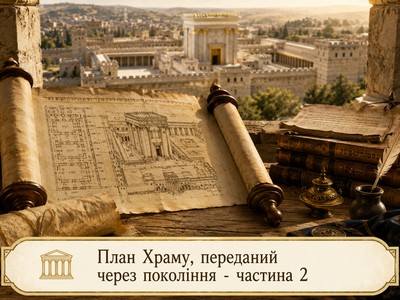
Temple 🏛 Plan Generationally Handed Down Part 2
Community
While crossing the sea, Moses and the people of Israel saw in a prophetic vision the Temple prepared by the Most High.According to Midrash,it was on Mount Sinai that Moshe received the exact plan of the corresponding earthly Temple in the form of a separate scroll — "Megilat Beit ha-Mikdash" ("Scroll of the Temple"). It was according to this plan that the Jewish people were to build the Shrine in the Land of Israel.Moses gave this scroll to Joshua, Joshua to the elders, the elders to the prophets, the prophets to King David, and David to his son Shlomo. This plan is also mentioned in the Tanakh:“And David gave Shlomo, his son, a plan of the porch, its rooms, vaults, upper rooms, inner chambers, and a place for the Ark… And a plan of all that was revealed to him by the spirit of prophecy… All this was written down by the hand of the Lord, who gave him an understanding of all the details of this work” (Deuteronomy ha-Yamim I, 28:11–19). 📖The Jerusalem Talmud explains:"Everything was recorded" means that the plan of the Temple was passed down from generation to generation;“by the hand of the Lord” — that is, it was revealed through prophecy;"gave understanding" means that it must be understood and interpreted with the help of the human mind.It was according to this plan that King Shlomo built the First Earthly Temple.After the destruction of the First Temple, a vision of the future Temple, which already existed in the spiritual worlds, was revealed to the prophet Yechezkel. He saw its structure, plan, and dimensions.This new plan was significantly different from the previous one.However, during the construction of the Second Temple, the old plan was still taken as a basis, and only some of its elements were changed in accordance with the prophecy of Yehezkel.✍About this, Rambam writes:“Although the prophet Yehezkel described the structure of the Temple to be built in the future, many details of his description remain unclear. Therefore, the builders of the Second Temple in the time of Ezra erected it on the model of the Temple of Shlomo, taking into account only those features that were clearly explained in the book of Yechezkel.”That is why the Second Earthly Temple no longer fully corresponded to the Heavenly Temple. 📚 Source: Meir Shlepakov, Earth and Heaven Temple, Chabad.org.