
Book "Ayom-yom" , today 29 Menachem-Ava
Community
In the book "Ayom-yom" on 29 Menachem-Av, the instruction is given that a person should serve the Almighty with his own strength. Personal work and overcoming difficulties are more valuable than the spiritual heights that a person reaches when he is “led by the hand”. [1, 2]📌Meaning of the wordA person must make his or her own efforts in the service of G-d.Help from above or mentoring is important, but real growth comes through personal work on oneself.Independent overcoming of obstacles reveals the inner potential of the soul.📖“Man is required to serve the Supreme in his own strength. Of course, if you are led by the hand, you can reach unprecedented heights, but your own achievements are much more valuable. "source: chabad.org

Ayom-yom: 30 Menachem-Ava, Rosh Chodesh Yelul
Community
Ayom-yom (day by day) is a book with short thoughts and guidelines for each day of the year, compiled by the Lubavitcher Rebbe. 30 Menachem-Ava also falls on the first day of Rosh Khodesh of the month of Elul.❓What is said in "Ayom-yom" on 30 Menachem-AvaFrom the first day of Rosh Hodush Elul, they begin to read a special chapter from the book of Tehilim — the 27th Psalm.Guidance is given on internal growth and verification 📎of one's own good deeds.📎The wise words of the Hasidic teachers of the Chabad movement are given.📖Ayom-yom: 30 Menachem-Ava, Rosh Chodesh Yelul"The 27th Psalm begins to be read: " ThePsalm of David. The Almighty is my light...".It is the Rebbe's custom to practice the shofar trumpet this day. From the second day, Rosh Khodesh is trumpeted into the shofar after the morning prayer.At first, Alter Rebbe uttered short, concise maamarim. For example, the maamar "Zeher rav tuvha" and its explanations, printed in Sidur, were pronounced as a cycle of six consecutive maamarim, somewhat more extensive than the published version."source: chabad.org
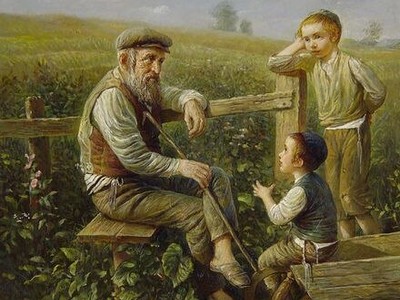
📚 About Sipurei Tzadikim and Hasidic Stories: Answering Questions
Community
Recently, we are often asked a variety of questions about the Sipurei tzadikim — stories about the righteous, especially those related to Baal Shem Tov. People are interested in how to treat such stories, whether everything described actually happened in our material world and why read them today, when there is so much worry and bustle around.These topics are of great interest, because stories about the righteous have always been an important part of Jewish life. They were passed down from generation to generation as a living example of true devotion to the Almighty. To make all this clear, let's consider the main questions in simple words — relying on our holy sources and the instructions of the Rebbe.❓Is everything written in these stories true?One of the most common questions is: Is every story true?There is a well-known rule: the one who believes absolutely everything is a simpleton, and the one who does not believe in anything at all is a heretic.How is this?It is not at all necessary that every single event take place in the material world in exactly the same way, to the smallest detail. However, the deeper meaning of these stories is much more important. The main thing is to understand how great the righteous themselves were. These spiritual giants truly had a special power bestowed upon the Almighty, which enabled them to change reality and do extraordinary things.Even if a story sounds amazing, it equally faithfully conveys the spiritual level, deeds, and thoughts of the righteous, showing us what a person's true relationship with God should be. The righteous lived with such a strong sense of the presence of the Almighty that for them the boundaries between the usual material world and the higher spiritual reality were blurred.🌿Why talk about miracles at all?Someone might think: why should children and adults listen to miracles, if in ordinary life we live according to the laws of nature?Our great teachers explained it quite differently. When we read about how the tzaddiks overcame the laws of nature, we strengthen deep faith and hope in the Almighty in our hearts and in the souls of our children.Our mind is a beautiful gift, but it often sets limits for us: “It's impossible”, “There is no way out”, “There is no money”, “There is no solution”. And the miracles in these stories expand our thinking and remind us that there are no hopeless situations for G-d. What seems miraculous to us is the natural order of things to Him.The Rebbe always stressed that such stories awaken a living faith that goes far beyond ordinary logic and helps us overcome daily difficulties.💧Soul HealingCan Hasidic stories really heal the soul?Undoubtedly! Alter Rebe called such a story "the dew of light" —hoist hoistc74(97A29.4'Heavy rain can break fragile sprouts, and the soft morning dew quietly and imperceptibly nourishes each plant, giving it life and strength. Similarly, a good story about the righteous does not put pressure on a person with boring instructions and does not plunge him into sadness.It gently enters the heart, relieves burdens, fears and anxiety, straightens out what is twisted in our souls, and returns the joy of life and service to G-d to a person, filling his inner world with quiet light and peace.🧠How to listen and read such stories correctly?One more important question: how exactly do you need to read these stories to get the most out of them?Our teachers taught that just listening to them with one ear for fun is not enough. Rebbe Rajac gave a clear guideline: after we have read or heard such a story, three simple steps should be taken:To understand what it was about and what the main idea of this story is.Ask yourself: what does this have to do with me personally? In what life situation can I apply this lesson today?To make a practical conclusion: what kind of character trait or habit do I want to improve due to what I have learned?This approach turns ordinary reading of Hasidic stories into a real impetus for spiritual growth.Source:(https://t.me/+8KbDy9dQVqAxZWE8)

Question of the day: Who are the angels?
Community
Who are the angels? Aren't they the same manifestations of God's will? Why is it possible to refer to the Names of the Almighty, but not to the angels?To understand this, it is important to distinguish between two things: what we call the Almighty and whom we address.When a person prays and says different Names — for example, the four-letter Name, Elokim, Zwaot, and others — he does not turn to different “forces”. She appeals to the One Creator, but calls Him according to the quality that is revealed in a particular situation. As the sages explain, the Almighty is “called according to His deeds.” Names are human language, an attempt to describe how the Creator reveals Himself in the world while remaining absolutely One.It's different with angels.An angel is not a “name” or an “aspect”, but a created being, a separate reality created by the Almighty to perform a certain task. An angel is not a source of strength. It does not choose, decide, or act on its own. He is a messenger, an instrument of the Creator's will. Even if the angel completely obeys the Almighty, he still remains not the Creator, but the creation.This is where the fundamental limit passes. Prayer in Judaism is not just asking for help. It is the act of connecting and acknowledging: “You are the source of everything.” Therefore, one can pray only to the One Who is this source.Turning to the angel, even with the words "pass, help, do", translates a person into the plane of mediation — as if there is a certain "service", which is more convenient to address directly. This is already dangerously reminiscent of a religious error that the Torah calls serving alien forces.This view is clearly articulated in the Jerusalem Talmud: if disaster befell, neither Michael nor Gabriel should be addressed — only the Almighty. Not because angels are “bad”, but because even a real messenger has no right to take the place of the One to whom the prayer is actually addressed.To give a simple example, the king allows his subjects to address him as “wise,” “merciful,” or “just.” This does not violate loyalty to the king. But if the subject begins to make requests to the minister — even the most loyal and appointed by the king himself — he will violate the main rule: you need to appeal to the king, not to his servant.Thus, the Names of the Almighty are ways of addressing the One Creator through His manifestations. Angels, on the other hand, are created beings who carry out errands. Therefore, prayer to angels in Judaism is impossible: it destroys the very basis of faith — the direct connectionof man with the Creator, without intermediaries.source: toldot.com
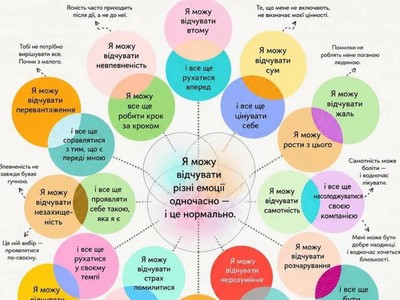
Psychologist page:
Community
Sometimes it seems to us that we should feel one thing: either joy, or sadness; or confidence, or fear. But the human soul is much deeper. 🌿You can get tired and still move forward.Grieve — and at the same time appreciate yourself. 🤍Feel fear — and dare to try.Want to give up — and afford to rest instead of defeat. 🕊️Contradictory feelings do not make us weak or ungrateful. They only remind us that we are alive. 💛It is important not to deny your emotions, but to hear them — and carefully continue on the path, step by step. ✨
"Ayom-yom" Segodnya 4 Elula
Community
"Ayom-yom"on 4 Elul is a daily Hasidic excerpt from the book "Ayom-yom", concluded according to the instructions of the Lubavitcher Rebbe. On this day, four concepts are considered that characterize the spiritual qualities of a person: **Adam, Ish, Enosh and Gever**, as well as serving the Almighty through the mind, feelings and overcoming internal obstacles.** 4 Elul Highlights*** * *Adam is a human:** a level that symbolizes the high dignity of the mind and the intellectual comprehension of the Divine.* **Ish is a man:** a level that indicates the dignity of the heart, feelings, and emotional love for the Creator.* **Enosh is a weak person:** a level associated with weakness in the sphere of mind, feelings, or both.* **Hever is a strong person:** A person who overcomes inner flaws and removes obstacles that impede spiritual growth.All these levels should be involved in daily spiritual work, especially in the month of preparation for Rosh Hashanah.---The order that must be observed by the one who is summoned to the Torah scroll: the edge of the talit gadol touches the beginning of the passage to be read and its completion; kiss the place on the talit touched by the Torah scroll; close the scroll, turn a little to the right and say proper blessings. After that, the scroll is unfolded and the reading begins. When describing human qualities, four concepts are used:1. **Adam** — indicates the high dignity of reason and intelligence.2. **Ish** — indicates the high dignity of the heart and feelings.3. **Enosh * * — indicates weakness in intelligence, feelings, or both.4. ** Hever** — indicates the overcoming of internal shortcomings and the elimination of all obstacles and obstacles that stand in the way of acquiring intellectual or emotional qualities. Thus, ** Hever helps Enosh to rise to the level of Ish or Adam**.Since it is possible to “transform” Enosh into Ish or Adam, it is obvious that Enosh already has all the qualities inherent in Ish and Adam. Source: Chabad.org
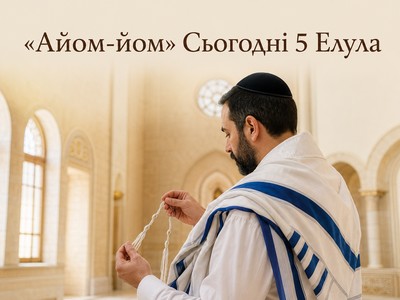
"Ayom-yom" Today 5 Elul
Community
"During the talit wrapping, the folded talit is placed on the right shoulder, the tits are checked, saying: " Borchinafshi " — "Bless, my soul...".Then the talit is removed from the shoulder, unfolded, kissed on the upper edge and thrown behind the back. After that, they begin to say the blessing "Leitatef bacicitus" — "...Who commanded us to wrap ourselves in tzitsit..." — and complete it, throwing the two right corners of the talit gadol over the left shoulder.(See Sheerit Yehuda, Orach Chaim, 1; Divrei Nehemiah, Orach Chaim, 9.)" 📖In the book "Ayom-yom" on 5 Elulimportant guidelines for daily Hasidic practice are given: the order of wrapping with a large talit, checking the tits of the tits and pronouncing the words "Borkhi nafshi".📌Habits of the dayWhen wrapping with talit, put the folded talit on the right shoulder.Check the tassels for cicitis.Say the words "Borhi nafshi" — "Bless, my soul...".source: chabad.org

"Ayom-yom": today 6 Elul
Community
Tsemakh Tzedek said that Baal Shem Tov was very fond of light and explained:"The words op — "light" — and once — "mystery" — have the same numerical meaning. He who knows the mystery hidden in every thing brings light.”📖In the book "Ayom-yom" on 6 Elul, it is said that the words "op" — light — and "one" — mystery — have the same numerical meaning, or gematria. With this statement, Baal Shem Tov reveals the deep connection between mystery and light.📌The essence of the phraseThe connection between the concepts of light — "op" — and mystery — "one" is revealed.The one who sees the hidden meaning of each thing is able to bring light.Tsemakh Tzedek's words about Baal Shem Tov's love for the light are quoted.Note! Tikuney Zohar, 19; Zohar, III, p. 28b.Source: Chabad.org
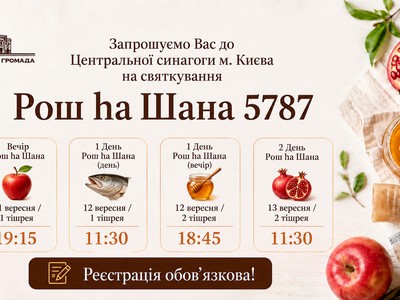
Pre-registration for Rosh Hashanah is now 📢 open!
Community
🍎🍯 We invite you to celebrate the year 5787 together!Please indicate exactly when you plan to join the celebration with the Community:September 📅 11 — at 19:15September 📅 12 — at 11:30September 📅 12 — at 18:45September 📅 13 — at 11:30We will be glad to celebrate the New Year together — in a warm, festive atmosphere, in the community. ❤️❗ Pre-registration isrequired.Please register at:https://forms.gle/osXa5ze1rgD8qdiq6
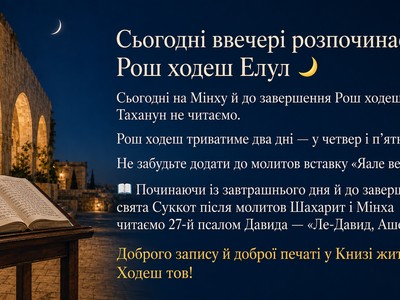
Rosh Khodush Elul starts tonight. 🌙
Community
Today, we do not read Tahanun at the Minkhu and until the end of Rosh Khodesh.Rosh Hosh will last two days — on Thursday and Friday.Do not forget to add the insert "Yaale ve-javo" to the prayers.📖 From tomorrow until the end of the holiday of Sukkot, after the prayers of Shacharit and Minha, we read the 27th Psalm of David — "Le David, Ashem Ori".Good entry and good seal in the Book of Life!You go tov!

Question to the Rabbi: Is it possible to ask the Almighty to punish enemies?
Community
Questions:Is it possible to ask the Almighty for the fastest and most obvious punishment of the enemies of the Jewish people, in particular terrorists? Is it possible that in this way we are telling the Creator how to rule the world and what His actions should be hidden and what should be obvious?Answer:Undoubtedly, this can be done. We know that King David asked for this:“Pour out your wrath upon the nations that do not know you, and upon the kingdoms that do not call upon your name.”(Tehilim, 79:6).Elsewhere, King David said:“Remember, O Lord, the day of the destruction of Jerusalem to the children of Edom, when they said, 'Destroy it, destroy it to the very foundation!“ Daughter of Babylon, doomed to destruction! Happy is the one who will repay you for what you have done to us. ”(Tehilim, 137:7–8).As long as the enemies of our people are not punished, the world reigns supremehilul HaShem— desecration of the Name of the Creator. After all, the enemies of the Jewish people are the enemies of the Almighty, because our people are the people of God.By our prayers, we must show that this condition hurts us and that we seek an end to the desecration of His Name. Therefore, such prayers are not considered to be an instruction to the Almighty how to act.At the same time, it is important to remember the words of the Zohar: for sinners — both from the Jewish people and from among other peoples — we should pray that they repent of their actions, stop sinning and not be destroyed.Sinners are also creatures of the Most High, and He is hurt when His creatures perish. This is evident from the story described in the Book of Jonah. So say our sages:"The Almighty does not rejoice at the fall of sinners"(Megila, 10b).That is why, as the Talmud says, the Almighty did not allow the angels to sing a song of praise to Him during the cutting of the sea:“The works of My hands are drowning in the sea, and you are singing a song?”We are talking about the Egyptians who drowned when the waters of the sea closed.Source:Imrey Noam

Our dates: 3 elul
Community
3 elul 5695 (September 1, 1935) — Yorzeit (anniversary of the departure from this world) Rabbi Avraham-Itzhak Ha-Kogen Kuk.Rav Avrađam-Yitzhak Kook was born in Latvia, in the city of Daugavpils (then Hryva), and studied at the famous Volozhyn yeshiva, after which he was the rabbi of the cities of Zeymialis (Lithuania) and Bauska (Latvia). Arriving in Eretz Israel, he headed the Jaffa community, and during the First World War, which found him in England, Rabbi Kook became the rabbi of one of the London communities. After returning to Eretz Israel during the British mandate of the country, he became the head of the religious Zionists of the Holy Land, and in 1920 he became the first Ashkenazi chief rabbi of Eretz Israel.The Peruvian eminent philosopher and mystic Rabbi Cook owns many books and articles, and he is considered the founding father of the movement of religious Zionism.source: chabad.odessa