
Our dates: 3 sowings
Community
3 Sivan 2448 (1313 BC) — The beginning of the preparation for the Gift of the Torah.On this day, preparations for the Gift of the Torah began. The Jews received the "commandment of the border" — the Almighty forbade them to approach the mountain and indicated exactly which line near Mount Sinai they should not cross. Anyone who crossed that line and approached the mountain would be subject to death.Jews also received commandments about sanctification. They were barred from marital intimacy and had to cleanse their bodies and clothes.3 Sivan 5589 (June 4, 1829) — Adoption of the leadership of the Chabad Hasidim by Rabbi Tsemakh-Tzedek.After his departure from this world, Miteler Rabbi Tsemakh-Tzedek, despite the decisions of the older Hasidim, refused to lead Chabad. He considered the sons of Alter Rebbe — Rabbi Chaim-Avraham and Rabbi Nahum or the grandson of Alter Rebbe — Rabbi Aaron from Kremenchug — to be more worthy candidates. And only after prolonged persuasion did he agree to take up this position, provided that he would not be burdened with issues related to material things.


Our dates: 6 sivan
Community
*6 sivan2448 (1313 BC) — Giving the Jews the Torah on Mount Sinai.Seven weeks after the Exodus from Egypt, the Most High revealed himself to the Jewish people on Mount Sinai. Here 600 thousand Jews (and at that moment near Mount Sinai there were also the souls of Jews who were destined to be born in all future generations) heard the first two of the ten commandments, but they were afraid of what was happening, so the remaining eight commandments were transmitted through Moshe-Rabein. Then Moshe climbed to the top of the Sinai and spent 40 days there, receiving the rest of the Torah.*6 sivan2854 (906 BC) is the birthday of the great sage and righteous king David.The Midrash tells us that the Almighty, in creating the first man, Adam, held all future generations before his inner sight, and Adam saw an infant who was destined for a great future, but who was to die immediately after birth. And Adam, who was given 1,000 years to live, sacrificed 70 of them for this baby. This infant was David, the youngest son of the head of the tribe of Judah Ishai and the great-grandson of the famous righteous Ruth.*6 sivan2924 (836 BC) — Yorzeit (the anniversary of the departure from this world) of King David.One of the greatest kings and sages in Jewish history, the righteous and singer of Israel, David ben Yishai, lived exactly 70 years, departing from this world on the very day he came into it. The Midrash says that the Angel of Death could not take away King David for a long time, because he was constantly immersed in the study of the Torah. And then he broke a branch of the tree. David was distracted by the sound, and the angel did his job.David's father, Yishai, was the reincarnation of the head of the tribe of Yehuda Nahshon ben Aminadab (who was the first to enter the water during the crossing of the Red Sea). The prophet Shmuel anointed David's kingdom, and later his descendants were recognized as legitimate Jewish kings (Moshiach also comes from the line of King David).King David was a great warrior who defeated the giant Goliath and recaptured Jerusalem from the Jebusites and then made it his capital. King David bought the Temple Mount from the last Jebusite king Aravra (he bought it from an already defeated enemy, and not just captured it as a winner), on which his son Shlomo (Solomon) later built the Temple. David himself intended to begin the construction of the Temple, but the Almighty forbade him because he, being a warrior, shed a lot of blood.King David was also the author of many psalms collected in the book of Tehilim.King David is buried in Jerusalem. When in the 16th century the Turkish Sultan Suleiman decided to surround Jerusalem with a new city wall, the grave of the righteous was outside the city because of the oversight of the architects. An angry sultan, who hoped that the grave of the righteous would protect the city no worse than strong walls, executed the architect.*6 sivan5520 (May 21, 1760) — Yorzeit (the anniversary of the departure from this world) of the founder of Hasidism, Rabbi Israel ben Eliezer Baal Shem-Tov (Rabbi Besht).Rabbi Israel was born in 1698 in the small Ukrainian town of Okup on the border with Poland and Wallachia to pious, but poor and elderly parents. Orphaned early, he served as an assistant to the melamed, and later as a watchman in the synagogue; at the age of 18 he got married, soon became a widower and began to travel through the Jewish towns of Eastern Galicia. Two years later, he married a second time - to the daughter of the merchant Ephraim Kutover, and after some time he retired to the Carpathian Mountains, where he spent several years earning a living by hard physical labor. In 1730, Rabbi Israel settled in Tlust, and in 1740, Rabbi Israel ben Eliezer, already known as the Baal Shem-Tov, moved to Medzhibozh (Khmelnytskyi region), which became the center of his activities.For many years, Baal Shem-Tov was going to make a trip to Eretz Yisrael and, it seems, even went on the road (they say that he reached Istanbul), but for some unknown reason he returned back.Israel's slave had a son, Zvi Hirsch, and a daughter, Godl (Adel), whose sons, Rabbi Moshe-Haim-Ephraim of Sudilkov and Boruch of Medzhybizh, as well as Rabbi Nachman's grandson from Bratslav, became the leaders of the Hasidic movements.Rabbi Israel passed away at the age of 61 years, 8 months and 18 days. Before his death, he said that he had the opportunity to be like the prophet Elijah (Elijah), who was taken alive to heaven, but he did not want to lose what was said: “For you are dust, and you will return to dust.”Rabbi Besht is buried in the city of Medzhybizh. After his departure, the Hasidic movement was led by Rabbi Dov-Ber from Mezherich.source: chabad.odessa

Our dates: 5 sivan
Community
*5 sivanas2448 (1313 BC) — Naase ve nishma.On this day, at the foot of Mount Sinai, Moshe made a covenant with the people, during which "And he [Moshe] took the book of the covenant and read aloud to the people, and they said: Everything that the Lord has spoken, we will do and we will listen" (Mishpatim 24:7). By putting the words "naase" (we will fulfill) before "nishma" (we will listen), the Jews confirmed their unconditional trust in the Most High and their readiness to fulfill any commandments, even if their meaning is still hidden from our understanding (that's why "we will fulfill" comes before "we will listen").

Our dates: 7 sivan
Community
7 Sivan 5509 (May 24, 1749) — Yorzeit (anniversary of the departure from this world) Rabbi Avraham ben Avraham Pototsky (her-zedek).Ger-zedek (“righteous proselyte”, that is, a righteous person who converted to Judaism) lived during the time of the Vilna Gaon to Rabbi Eliyahu ben Shlomo-Zalman. He was born in one of the most famous Polish families — Potocki and was known as Count Valentyn Potocki.Having gone to study in Paris, Count Potocki befriended another Polish aristocrat, Mr. Zaremba. Once the friends saw an old Jew immersed in the study of the Talmud, and asked him to familiarize them with the basics of Judaism, swearing that they would accept him if they were convinced of the falsity of the Christian faith. Zaremba forgot about the vow, and Pototsky, after studying for some time at the Papal Academy in Rome, went to Amsterdam and there he accepted Judaism, taking the name Abraham. Zaremba learned about Pototsky's disappearance and remembered the oath. He went with his family from Lithuania to Amsterdam, also converted to Judaism and later settled in Eretz Israel. Potocki returned to Lithuania and settled near Vilno.One day, Abraham scolded a boy who was disturbing prayer in the synagogue, and his father reported the proselyte to the authorities. The conversion of a Christian to Judaism was punishable by death, so Abraham was arrested and put on trial. Despite the persuasion, he did not renounce Judaism and was burned at the stake near the wall of the Vilna fortress, saying before his death a blessing for those who accept martyrdom (kiddush ha-Shem). One of the local Jews, Eliezer Ziskes, sneaking into the place of execution under the guise of a Christian, collected some of the ashes and the surviving finger of the executed and buried them in the Jewish cemetery. A large tree grew on his grave, but it was destroyed by Catholics at the beginning of the 20th century. After the Second World War, the Jews of Vilnius reburied Potocki, the Vilnius Gaon, his wife and son in the new Jewish cemetery and built a common crypt over their graves.7 Sivan 5521 (June 9, 1761) — Rabbi Dov-Ber (Magid) from Mezherich led the Hasidic movement.After the departure of Rabbi Yisrael Baal Shem-Tov, his son, Rabbi Zvi, was elected head of the Hasidic movement. A year later, the students of Besht — the Holy Brotherhood (Hebra Kadisha) saw that his forces were weak, and the movement needed a strong leader in those conditions.On the festive meal of the second day of the feast of Schwues, after the first anniversary of Besht's departure, Rabbi Zvi sat at the head of the table, dressed in his father's clothes, and the "Hevra Kadisha" sat around him. After Rabbi Tzvi had completed the Torah recitation, he stood up and said:— Today my holy father came to me and told me: "The entourage from above, together with their servants who were usually with him, today passed to the holy and formidable Rabbi Berenya, the son of Rabbi Abraham (that is, to Ber — Mezheritsky Magid). Therefore, my son, give him the leadership in the presence of the whole “Hebrus Kaddish”, and he will sit in my place at the head of the table, and you will sit in his place. And know that luck and double spiritual power will be with you.”Having said this, Rabbi Zvi turned to the Magid with the blessing "Mazl tov!", took off his outer garment and handed it to Rabbi Dov-Ber, and he put on his outfit and sat in its place.source: chabad.odessa
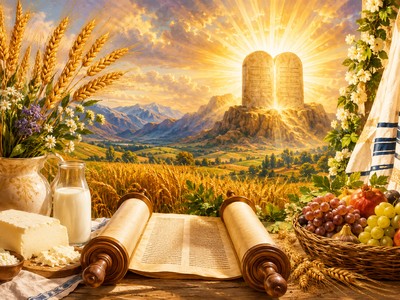
JEWISH INSTRUCTIONS: THE FEAST OF SHAVUOT
Community
Свято Шавуот (українські євреї кажуть Швуес) — свято Дарування Тори, яке відзначається на п’ятдесятий день після Песаха. Наші мудреці пояснюють, чому цей день називається днем дарування, а не, скажімо, отримання чи прийняття Тори. «Отримання» передбачає, що ви перебуваєте на одному рівні з тим, хто дає, і цілком заслужили ту річ, яку погоджуєтеся прийняти. «Дарування» ж означає, що той, хто дарує, і той, хто отримує, перебувають на різних рівнях, і подарунок явно перевищує заслуги отримувача. Тора, на основі якої побудований цей світ, — безцінна, і немає нічого, що зробило б нас рівними та гідними її прийняття, тому її Дарування можна пояснити лише милістю з боку Всевишнього. Але й до такого отримання дару потрібно як слід підготуватися, тому перші сім тижнів перебування в пустелі після виходу з Єгипту євреї духовно очищалися і підносилися, поки на п’ятдесятий день вони нарешті не досягли рівня, на якому ТАКИЙ ПОДАРУНОК можна було б отримати без шкоди для духовного і фізичного здоров’я. Хоча зазвичай ми називаємо це свято — Швуес (у крайньому разі кажемо «Свято Дарування Тори») — воно має 4 назви. Перша з них — «Свято жнив», оскільки свято припадає на час жнив пшениці, яка достигає пізніше за всі інші злаки. Це свято відзначається принесенням у Храмі нового хлібного приношення Всевишньому. Друга назва — «свято Шавуот», тобто «свято тижнів» або «сімок», дана тому, що перед настанням свята ми відраховуємо сім тижнів. Третя назва — «День бікурім, перших плодів», пов’язана з тим, що в цей день починається «сезон перших плодів». Кожен єврей бере певну кількість плодів, народжених землею, з числа видів, якими славиться Ерец-Ісраель, кладе їх у кошик і приносить у Храм, де коѓен приймає кошик з його рук і кладе на храмовий жертовник. Четверта назва — Ацерет («Зібрання»). Ця назва не згадується в Танаху і була введена єврейськими мудрецями, які часто її використовували. «Зібранням» воно назване тому, що є ніби восьмим днем, який завершує сім днів Песаха, і тісно пов’язане з ними. Дні лічби омера між Песахом і Швуесом не розділяють свята, а з’єднують їх, і тому Швуес отримав назву Ацерет Песах. Швуес також названий Ацеретом тому, що з цим святом не пов’язана жодна особлива заповідь, яка не виконується в інші дні року. Його святковий характер виражається в тому, що в цей день утримуються (неецарим на івриті) від виконання роботи. У ніч напередодні Швуеса прийнято не спати всю ніч і вивчати Тору. Робиться це для виправлення помилки, допущеної нами 3335 років тому, коли народ стояв біля підніжжя гори Синай. Тоді, готуючись до отримання Тори, євреї настільки втомилися, що проспали початок. Ну не зовсім проспали, але замість того, щоб зі сходом сонця вже бути на ногах, вони спокійно спали ще кілька годин, ніби їх це зовсім не хвилювало. Мудреці пояснюють, що цей сон зовсім не був проявом байдужості, а осмисленою лінією поведінки. Людина, що спить, не пов’язана тривогами і турботами навколишнього світу, не занурена в побут, не зайнята задоволенням реальних і уявних потреб. Її душа підноситься над тлінним тілом, і євреї вирішили, що саме цей стан, стан сну, буде найбільш придатним для прийняття Тори. Вони не відмовлялися від служіння Творцеві, але вважали, що ідеали Тори будуть так краще сприйняті. Але вранці, прокинувшись від гучних звуків шофара, євреї з жахом зрозуміли, що помилилися. Для того, щоб виправити це прикре непорозуміння, відтоді заведено, що з року в рік у ніч перед Швуесом євреї не сплять, вивчаючи спеціальну книгу «Тікун лейл Швуес» («Виправлення ночі Швуеса»), де зібрані уривки з усіх книг і розділів Танаху та інших єврейських книг, так що протягом ночі людина ніби прочитує всю Тору. У день свята, під час ранкової молитви, уголос читають 10 заповідей, причому прийнято, щоб їх читання слухали всі, навіть новонароджені немовлята (при цьому слід розуміти, що Тора не обмежується 10 заповідями, і на горі Синай ми отримали саме ВСЮ Тору, а не якусь кількість заповідей). На свято Швуес прийнято читати одну з книг Танаху — книгу Рут, де розповідається про велику прабабусю царя Давида. У дні свята категорично заборонено постити, і прийнято їсти молочну їжу. Чому саме молочну? Одразу після Дарування Тори і введення законів кашруту у євреїв не було кошерного м’яса, і перший час їм доводилося їсти лише молочні продукти.source: chabad.odessa
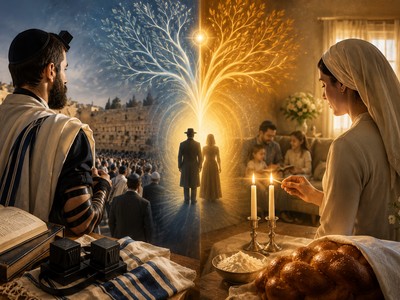
Question to the rabbi: Why do only men wear a kippah?
Community
According to the foundational work of Kabbalah - the Book of Zohar - any thing, event or phenomenon in our world has two components: an external form ("vessel") and an internal content ("filling"). Man is arranged in a similar way: he has a body (external manifestation) and a soul (inner essence).This very principle of duality was laid down by the Creator in the male and female principle. Originally created as one, man and woman were separated to become independent guides of the Divine Will, but with completely different dynamics of service.The man's mission is more focused on the external, social and public structure. His spiritual path moves from the outer to the inner—through action and well-defined attributes to spiritual awareness. That is why men's duties include many public commandments and external signs, such as wearing tefillin, tzitzit, or the custom of covering the head with a kippah. For a man, the kippah is a constant reminder that there is a Higher Power over him, helping to discipline his outer nature.A woman's mission has the opposite dynamic — from deep inner to outer. A woman is endowed by nature with finer spiritual and emotional "receptors" that connect her with the Creator. She does not need artificial external attributes to remember the Almighty, because her connection with the Divine is deeply rooted within.It is through the mother that Jewishness (an internal characteristic of the soul) is defined, and it is the woman who is exempted from most of the commandments related to time, so as not to violate her main task - to be the inner core of the home and the Keeper of Tradition.Instead of external signs such as a kippah, the purpose of a woman is expressed in three main commandments, symbolizing the filling of the material world with spiritual light:• The separation of challah — the consecration of physical food and the creation of a blessed atmosphere in the home.• Purity of family life — protection of the sanctity and depth of marital relations.• Lighting Shabbat candles is the revelation of Divine light, because the candle symbolizes the human soul.Therefore, the laws of modesty for a Jewish woman are not an analogue of a man's kippah, but a manifestation of her inner awareness of herself as a "daughter of the King." A woman does not need to cover her head with a veil, because her service is not based on external attributes, but on a subtle manifestation of spiritual warmth, modesty, and the transformation of everyday life into a space of holiness.

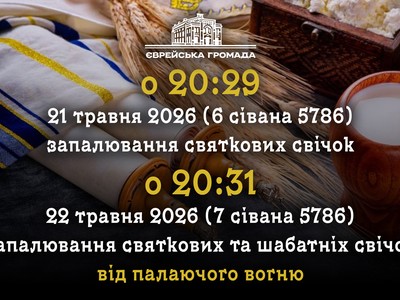
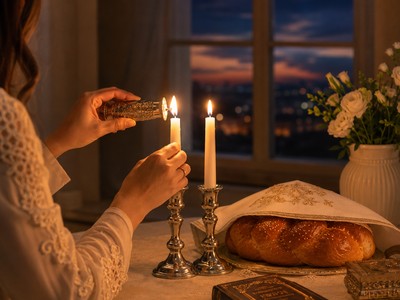
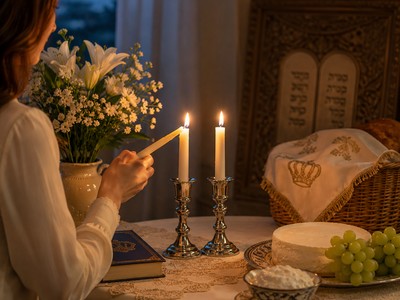
📖 Procedure for lighting holiday candles
Community
❗Usually candles on Shavuot are lit 18 minutes before sunset. If the holiday falls on a Friday evening (and passes into Shabbat), the lighting is done at the same time, but the blessing is said twice: on the holiday and Shabbat candles.📌 Procedure:First, light the candles (from the burning fire), and then close your eyes with your hands before saying the blessing. This is because after the lighting blessing you accept the holiness of the day ahead.🙌Say the blessing:📌In Hebrew:בָּרוּךְ אַתָּה יְיָ, אֱלֹהֵינוּ מֶלֶךְ הָעוֹלָם, אֲשֶׁר קִדְּשָׁנוּ בְּמִצְוֹתָיו וְצִוָּנוּ לְהַדְלִיק נֵר שֶׁל יוֹם תוֹב📌Transliteration:Baruch ata Adonai, Elogain Melech ha-olam, asher kidshanu be-mitzvotav, ve-tsivanu legadlik ner shel Shabbat ve-shel Yom Tov.📌Translation:"Blessed are You, God, our God, King of the Universe, who sanctified us with His commandments and commanded us to light Shabbat and festive candles!"
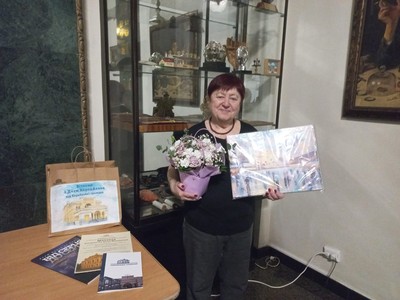
Congratulations to the anniversaries, Mazal Tov!
Community
🌷 The Jewish community sincerely congratulated the May jubilarians - people whose years have become a real wealth of wisdom, strength and vital warmth.💐 Venzhega Svitlana Stepanivna celebrated her 85th birthday.💐 Iryna Mykhailivna Spitkovska — her 80th birthday.The representatives of the community congratulated the birthday girls with warm words, flowers and gifts, enveloping them with attention, care and a festive mood on this special day.May the Almighty grant the jubilarians good health, peace, joy from their relatives and many bright and blessed years! ✨