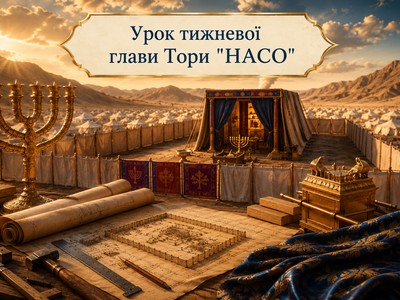
Lesson of the weekly chapter of the Torah "Naso" - Moshe Temple
Community
In the weekly chapter of the Torah "Naso", the story of the consecration of the Temple begins with the words: "The day when Moshe completed the construction of the Sanctuary..." And an attentive reader with a keen sense of justice, these words can be touched: after all, before this, it was described in detail how the whole people generously donated to the construction of the Sanctuary, and then many people "wise of heart" under the leadership of Bezalel and Ogoliab diligently built it. And now all the credit goes to Moshe!It is clear that this is not an exaggeration for the sake of diminishing the role of the numerous builders of the Sanctuary. The Torah uses this expression to emphasize Moshe's special merit. After all, as the sages of the Talmud explain, he devoted himself completely to the construction of the Temple, making sure that each element of the Sanctuary corresponded to the plan of the Almighty, and gave detailed instructions to the masters.Similarly, the First Temple is called the Temple of David, and the Second is called the Temple of Solomon. Not because they were built with their money, but because they put their heart and soul into their construction. It is for this reason that the original Sanctuary is called the Temple that Moshe built.Such an attitude towards a beloved child does not mean excessive control. When a large project manager knows the price of each cog, it is not necessarily micromanagement. Of course, if he does not try to tighten these screws with his own hands, pushing employees away or filling them with unnecessary advice. There is an important balance here: to be able to delegate, respecting the performers and their possible initiative, not to stand over your soul and not to look over your shoulder — but at the same time to be able to ask for the result.And this art is important not only during the construction of the Temple, construction or business, but also in the family and in life in general. You need to be able to delegate functions and work. But it is the work, not the responsibility for the final result. Otherwise, it will be irresponsible.Source:Chabad.org
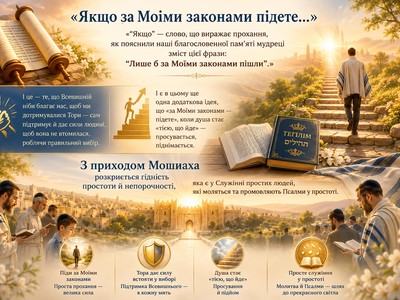
“If you follow My laws…”
Community
“If” is a word expressing a request, as our blessed memory sages explained the meaning of this phrase:“If only they would follow My laws.”And this is the fact that the Almighty seems to beg us to adhere to the Torah - he supports and gives strength to a person so that he does not get tired of making the right choice.And there is another additional idea in this that "according to My laws, you will go", when the soul becomes "the one who goes" — it advances, rises.With the coming of Moshiach, the dignity of simplicity and purity will be revealed, which is in the Ministry of Ordinary People who pray and pronounce the Psalms in simplicity.Follow My laws. A simple request is a great powerThe Torah gives strength to stand in the choice of the Support of the Almighty - at every momentThe soul becomes “the one that goes.” Advancement and upliftmentSimple service in simplicity. Prayer and Psalms are the way to the beautiful light!source: moshiach.ru

Historical essay: 📜 The community of Chabad in Eretz Israel during the riots of 1834:
Community
The period of pogroms of 1834 was a turning point in the history of the Jewish Yishuv in Eretz Yisrael and, in particular, in the history of the Hasidic community of Chabad. The political instability that arose as a result of the Egyptian conquest of the region by Muhammad Ali led to the complete destruction of the security system of the Jewish communities.Safed Community 🏚️ CrisisSafed at that time was the central spiritual and administrative center of the Chabad Hasidim in Israel. The events of those years caused irreparable damage to the community. The destruction of Israel Bak's printing press, which played a key role in the provision of the community and the development of book printing, deprived many members of the community of their livelihoods.Attempts by the head of the Kolel Hasidim to provide security through negotiations with the local Qadi were unsuccessful; after a short shelter, hundreds of families were forced to leave safe places and seek salvation in caves and ruins. The combination of pogroms and the devastating earthquake of 1837 led to the actual disintegration of the Chabad community in Safed. The bulk of the community decided to move to Jerusalem, which laid the foundation for the creation of a new large Chabad Hasidic center there.🏗️ Restoration of the community in HebronUnlike Safed, the Chabad community in Hebron has demonstrated a high level of resilience. After the city suffered looting by both rebels and government troops, the community was in danger of disappearing.Thanks to a large-scale fundraising organized among the Chabad Hasidim in Russia, the Ashkenazi countries and Italy, it was possible to mobilize the necessary resources. Financial support made it possible to restore infrastructure, repair synagogues and community institutions, thereby ensuring the continuity of the Jewish presence in the city.🧭 Historical significanceThe period of unrest in 1834 demonstrates two opposite processes: the loss of old centers and the formation of new organizational structures. The ability of the Chabad community to quickly mobilize resources and redeploy forces allowed it not only to survive the crisis, but also to strengthen its position, turning Jerusalem into the central Chabad cell, which determined the vector of development of the movement in Eretz Israel for decades to come.📖 Lubavitcher calendar

Our dates:13 sivan
Community
📌13 Sivan 5660 (10 June 1900) — Wedding of the Rebbe's parents, Rabbi Levi-Itzhak and Rebbetzin Hana Schneerson.When Levi-Yitzchak reached the appropriate age, the then head of Chabad, the fifth Lubavitsky Rebbe, Rabbi Sholom-Dov-Ber (Rebbe Rashab) introduced him (as the Jews say - "arranged a shiduh") with Hana, the daughter of the chief rabbi of Mykolaiv, the sage and righteous Rabbi Meir-Shlomo Yanovsky. However, after the wedding date was set, on the Saturday evening after the end of the Shvues holiday, the bride fell ill and her parents decided to postpone the wedding. A special envoy was sent to Rebbe Rashab to seek his approval, but the Rebbe disagreed and recommended that the ceremony be held at the appointed time, giving his blessing for a successful outcome.source: chabad.odessa

Our dates:14 sivan
Community
Sivan 14, 5581 (June 14, 1821) - Yortzeit (anniversary of departure from this world) of Rabbi Chaim ben Yitzchak of Volozhin (Wolozhiner). Rabbi Chaim was the best student of the famous Rabbi Eliyahu ben Shlomo-Zalman (Gaon of Vilna). He belonged to the number of opponents of Hasidism (misnagdim), but compared to the teacher he was quite moderate and even almost benevolent towards the Hasids, recognizing the value of the ideas of Hasidic teachings. At the beginning of the 19th century, Rabbi Chaim founded a famous yeshiva in his native Volozhin, which existed for almost a hundred years and shaped the religious and spiritual image of Lithuanian Jewry. The Volozhyn yeshiva became the model and prototype of large Talmudic educational institutions that existed first in Eastern Europe, and then moved to Israel, the USA and other places (yeshivas in Slobodka (now a part of Kaunas, Lithuania), Miri (Belarus), Kelme, Kielce (both Poland) and Telza (Telsiai, Lithuania)).source: /chabad.odessa

🗓 Yemeni Tashlumin Extension Days
Community
Yemei Tashloumin is the six days immediately following the holiday of Shavuot, from 7 to 12 Sevan. These days, there is an opportunity to supplement what was not done or sacrificed on the holiday itself.🏛 Historical Aspect and the TempleIn the time of the Temple, those who, for various reasons, did not have time to bring a festive sacrifice to Shavuot had the opportunity to do so for the next six days. The Rebbe emphasized that even in our time, in anticipation of the rapid rebuilding of the Temple, this period retains its significance as the time set for the completion of the festive service. If the Temple had been built these days, we would have been obliged to make festive sacrifices.🧳 Spiritual content: baggage packingAlter Rebbe explained the essence of these days through the parable of the merchant. A merchant who bought goods at a large fair is in no hurry to go immediately. He remains for a few more days to carefully pack the goods so that they are not damaged on the way. So are we: after the great revelation of the Torah light on Shavuot, we were granted the days of Tashlumin to "pack up" and consolidate the inspiration received, so that it would remain with us throughout the year and not get lost in the hustle and bustle of everyday life.Rebbe's 💡 guidelines before the end of the periodThe Rebbe called for the use of the final day, 12 Sivan, to make firm decisions. This includes reinforcement in Torah study, continuity in Hitas and Rambam classes, and deepening in the mysteries of Torah — that is, in Hasidut. It is also important to increase the spread of the sources of Torah wisdom outside, to strengthen the unity of the Jewish people through love for one's neighbor, and to increase the size of donations by doing so with a benevolent expression.Chabad 📜 traditions and customsIn the days of Tashlumin, the Tahanun repentance prayer is not recited. It has become a tradition to hold meetings dedicated to the study of the Torah, called Kinus Torah, as well as to organize children's events. In memory of the events of 1991, when the Rebbe held a special meeting at the end of this period, Hasidim around the world arrange daisies to summarize the festive time and inspire further service.📖 Lubavitcher calendar

The Fiddler on the Roof Gallery invites you to the opening of the exhibition
Community
The Fiddler on the Roof Gallery invites you to the opening of the exhibition of student graphic design "Judaica in the Ukrainian Poster" ✨The exhibition is dedicated to the dialogue of cultures, memory and artistic continuity of generations. It recalls prominent Jewish artists associated with Ukraine, whose work has enriched Ukrainian, European and world culture.But the legacy lives only when it continues. That is why the project combines the experience of masters and the energy of young designers who, through a modern poster, rethink the topic of Judaica in the Ukrainian cultural space.📍 Opening of the exhibition: May 28 at 18.00🗓️ The exhibition will last: 28.05 — 23.06 (free admission)🕛 Opening hours: Sun-Thu | 12:00–19:0013 Shota Rustaveli Str., 📌 Kyiv(entrance from Esplanadna street)Curators of the project:— Albert-Leiser Feldman— Andriy Budnyk

Today is 10 Sivan 5786.
Community
📌 5625 (1865): Rebbe Rashab (Rabbi Sholem Dov-Ber) became engaged to Sterna-Sara Schneerson.📌 5692 (1932): Rabbi Menachem-Mendel Ornstein married Sheina, daughter of Rabbi Rajac (Rabbi Yosef-Yitzchak Schneerson).Iom-yomAlter Rebbe said to one of those who entered his yehidut:“… the children of Israel are like candles. The candle consists of a vessel, a yoke, oil and the fire itself. But for the candle to start shining, it needs to be lit. Your soul is a candle full of inner good, but it lacks someone who would give it a flame. And know this: only through decisive struggle and overcoming your animal soul, like the blow of a flint on a flint, a spark is carved that lights the Divine fire in you.”Source:📖 Lubavitcher calendar
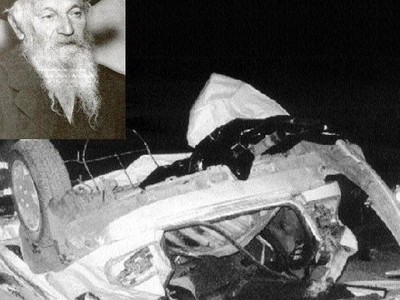
LESSON OF RESILIENCE FROM LIUBAVITSKY REBE: PAIN THAT CANNOT BE JUSTIFIED
Community
Recent days have brought us news of tragic events that make each of us ask the question: "Why?". When misfortune comes suddenly, taking lives, attempts to find a logical justification for the tragedy often seem pointless and only exacerbate the suffering.Events ChronicleMore than 50 years ago, on the night after the holiday of Shavuot, a terrible car accident occurred, in which four people were killed, among them a prominent rabbi of Kfar Chabad, the river Schneur-Zalman Gorelik. This event shook the entire community. Witnesses of those days spoke of moments of horror when a holiday trip turned into an unspeakable loss in an instant.🧠 REBE'S WORDS: "THERE IS NO OBLIGATION TO JUSTIFY THE ALMIGHTY"When the news of the accident reached the Rebbe's secretariat in 770, he was deeply impressed. However, seeing that the Hasidim continued to sing without yet knowing what had happened, the Rebbe went out to them and encouraged singing so as not to interrupt the joy of the feast for others.On Shabbat, 11 Sivan, the Rebbe dedicated a deep conversation to this event. He explained that there are things that are incomprehensible to the human mind.Truth above all: The Rebbe quoted the words of the Gemara, explaining that when we see events that seem to us wrong or cruel, there is no obligation to “justify” the Almighty.Right to pain: The Rebbe taught that faith in G-d does not contradict the “cry” of the heart. On the contrary, it is because of the depth of his faith that a person has the right to express his pain and his "claims" to Heaven, because he knows: G-d is the Truth, and He does not need to lie in order to justify the incomprehensible.Call to actionThe Rebbe stressed that even when the cause of what happened remains a mystery, the response to the pain must be actionable. He called for the strengthening of “mivtseim” (campaigns), support for yeshivas and schools and the manifestation of unconditional love for one's neighbor (Agawat Israel). The Rebbe saw this as a way to add light to the world, turning unbearable sadness into concrete steps of help and creation.🙏 CONCLUSIONS FOR US TODAYThe lesson that the Rebbe has left us is that in moments of irreparable loss, we are not obligated to engage in self-deception or seek false consolation. We can acknowledge our pain, our cry, and our misunderstanding, but at the same time direct our energies to strengthening the good, turning grief into actions that will bring light to where there was darkness.📖 Lubavitcher calendar https://t.me/+8KbDy9dQVqAxZWE8

🇺🇦🇮🇱 Ukrainian students received a unique opportunity to study at one of the most prestigious universities in Israel
Community
Ukrainian students received a unique opportunity to study at one of the most prestigious universities in Israel, Tel Aviv University, under an exclusive scholarship program.TAU International opens a special scholarship fund for Ukrainians, which allows you to get an education in English at Lowy International School with full tuition coverage.The scholarship is available for:bachelor's Degree Programsmaster's programsWhat is important?training takes place in Englishfund covers tuition feethe program is designed specifically for Ukrainian studentsTo participate, you should:have Ukrainian citizenship and a confirmed place of residenceapply and be accepted into one of TAU International's programsParticipation in the Student Ambassador Club Lowy International School is also one of the conditions.Today, education is not just a diploma. These are new opportunities, international contacts, the experience of living in another country and a chance to build a future even in the most difficult times.Tel Aviv University is among the most renowned universities in Israel and cooperates with leading international academic programs.Details and application via TAU Intern's official websiteReferenceshttps://international.m.tau.ac.il/scholarship_programs...

📖 Lubavitcher Calendar: 11 sivan
Community
Today is 11 Sivan 5786.5660 (1900) — (according to the records of Rebbetzin Hana) the wedding of Rabbi Levi-Itzhak and Rebbetzin Hana, the Rebbetzin's parents, took place.5681 (1921) — RabbiShmarjahu Gurarya (Rashag) married Rebbe Rajaca's daughter.Ayom YomFrom the conversations of Rabbi Rashab: in the service of the Almighty according to the path of Hasidism, there are various levels... The level of the "dead" does not require long explanations. But there is — G-d's glory — a “resurrection from the dead” in spiritual work.Dead is cold; there is nothing colder than the natural, purely human mind. And when this natural intelligence comprehends the Divine truth, and the feelings contained in the mind begin to tremble and admire the intellectual pleasure of comprehending the Divine — this is the real “resurrection from the dead”.Lubavitcher Calendar

In the person of Chabad: Rabbi Abraham Schneerson: a standard of modesty and truth in the history of Chabad
Community
Rabbi Abraham Schneerson, born on 11 Sivan 1860 in the town of Lyubavichy, is one of the prominent figures in the history of the Hasidic movement. As the son of Rabbi Israel Noah Schneerson, known as “Maarin” — the Chabad Hasidic leader in Nezhin — he left his mark on history primarily as the father-in-law of the Sixth Lubavitcher Rebbe, Rabbi Yosef Yitzchak Schneerson (Rebbe of Rajac). His personality still serves as an example of deep spirituality and rare modesty.📖 Life path and spiritual developmentIn 1875, he married Rebbetzin Yocheved, daughter of Rabbi Yehoshua Fallik Sheinberg, after which he moved to Chisinau. There he devoted his life to the deep study of Torah, maintaining a close spiritual connection with the chief rabbi of Bessarabia, his childhood friend, Rabbi Yehuda-Leib Tsirelson. In Chisinau, Rabbi Avraham was highly respected as a Torah scholar, but avoided publicity and honors. The words of the Fifth Lubavitch Rebbe (Rebbe Rashab), who instructed his son, Rebbe Rayatz, to learn the principles of true humility from his father-in-law, Rabbi Avraham, are a vivid testimony of his greatness. Even when after the death of Nizhin's Hasidic father, Rabbi Avraham was asked to take up the position of admor, he categorically refused, remaining true to his ideal of modesty.🕊 Recent years and memoryof generationsRabbi Abraham Schneerson took an active part in the most important events of the Schneerson family; in particular, he attended the wedding of the Seventh Lubavitcher Rebbe, taking pride of place at the table next to Rebbe Rajac. He died on 2 Hashvan 1937 and was buried in a Jewish cemetery in Chisinau next to his wife, Rebbetzin Yocheved, who died in 1919.For decades, the place of his burial remained forgotten, but around 2002 the grave was found. On the eve of the anniversary of his death in 2011, the resting place was completely restored by the efforts of Hevr Kadish and the Chief Rabbinate of Moldova under the leadership of Rabbi Zalman Abelsky's envoy under the coordination of his grandson, Rabbi Menachem-Mendel Zalmanov.👨👩👧👦 Family & HeritageRabbi Avraham and Rebbetzin Yocheved raised children who continued their path. Among them was Nechama Dina, the wife of the Sixth Lubavitch Rebbe. The family experienced many trials, including the loss of children at an early age, among them Israel Noah, Ephraim Fishel and Sheindl. Among their other children who left their mark in the family history are Malka-Sasya, Bracha-Liza, Bat-Sheva and Rabbi Ben-Zion Schneerson of Tel Aviv. Their lives and ministry remain an important page in the annals of the Schneerson dynasty, continuing to inspire new generations.source: 📖 Lubavitcher Calendar