
Lubavitcher calendar: 12 sivan
Community
Today is 12 Sivan 5786.While walking with his father, Rebbe Rashab, on 12 Sivan 5655 (1895), Rebbe Rajac heard from him words about the spiritual significance of 12 Sivan. Rebbe Rashab said that this is the seventh day after the feast of Shavuot, just as Oshana Rabba is the seventh day of the feast of Sukkot, and the seventh day of Passover is the seventh day of the feast of Passover.The Rebbe asks the question: at first glance, it is not entirely clear what this similarity is?Oshana Rabah is the completion of the process of final approval of the verdict ("gmar khatima") and the time of pronouncing numerous prayers "Oshanot". Similarly, the seventh day of Passover is not just a holiday that differs from the weekdays of the holiday week (khol a-moed), and even more so not an ordinary weekday, but a day endowed with a special power associated with the Cutting of the Red Sea.At the same time, 12 sivan is an ordinary weekday, which looks no different from other weekdays.However, from the words of Rebbe Rashab about the equality between the 12th of Sivan, Oshan Rab and the seventh day of Passover, it becomes clear that the 12th of Sivan has the advantage of the principle "all seven are beloved" ("kol ha-shviin haviin"). This means that on the seventh day of any period, the light of the holiday is revealed with special intensity ("assault") due to the power of "reverse light" ("or hozer").Iom-yomIn the blessing "Sheakol Ni[is] Bidvaro" ("All that is according to His word"), the word "No[is]" (נהי'[ה]) is written with the vowel "kamats" under the letter "yud", and not with "segol".My master, father, teacher and mentor (Rebbe Rashab) writes in one of his letters:“Love criticism, for it will lift you to your true height.”📖 Lubavitcher calendar
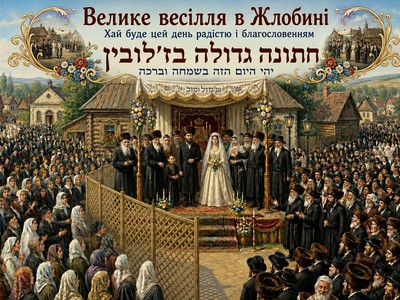
Lubavitcher calendar:📜 Big wedding in Zhlobin
Community
Imagine 13 Sivan 5567 (1807). In the town of Zhlobin, lost among the Belarusian forests, something incredible is happening. Thousands of Hasidim, great righteous and rabbis from all over the country came to this modest town. The air was full of awe: it combined two of the most prominent spiritual houses of the time — the dynasty of the founder of Chabad, Alter Rebbe, and the family of the legendary Rabbi Levi-Itzhak from Berdychiv.It was the wedding of the granddaughter of Alter Rebbe and the grandson of the "Defender of Israel" — Rabbi Levi-Itzhak.📍Why Zhlobin?Interestingly, the Tna 'im (prenuptial agreement), signed three years earlier, recorded: “The wedding will take place in Jerusalem.” But life made its adjustments: the distance between Lyady (where Alter Rebbe lived) and Berdychiv (where Rabbi Levi-Itzhak lived) was too great for that time. Therefore, the choice fell on Zhlobin — the ideal "golden mean", a large Hasidic center located at the crossroads of important roads.⚡️“Did you see him with your own eyes?” — a dispute between the giantsAt the wedding, there was not only joy, but also serious spiritual tension. Miteler Rebe (son of Alter Rebe) was already famous for his deep lessons of the Cabal, explaining the most complex concepts such as “Atik” and “Arich”.Rabbi Levi-Itzhak, known for his directness, did not hide his concern:— Is it possible to talk about such heights? After all, Baal Shem Tov taught that these secrets are revealed only to those who saw his face!Miteler Rebe, feeling uncomfortable under the criticism of the great tsadik, hurried to his father:— Why do you allow me to be mocked like that?Then Alter Rebbe approached Rabbi Levi-Itzhak. There was a conversation between them, which the Hasidim retold for many generations. The Rabbi from Berdychiv repeated his question:— Who gave the right to say such things if a person did not see Baal Shem Tov?Alter Rebbe calmly replied, but with such force that the dispute immediately subsided:“I saw him. And not in a dream, but in reality.” There, in St. Petersburg, when he was in the fortress.This answer put everything in its place.🕊R' Benjamin Klecker 's MiracleAmong the guests was R'Binyamin Kletsker. He was terminally ill. His family begged him to stay home, but he repeated:“Alter Rebbe sent an invitation, and I haveto be there.”He was brought to Zhlobin in critical condition. Upon learning of this, Alter Rebbe ordered to bring him just to himself. The patient was so weak that he could not even walk. He was taken on a cart and put in front of the Rebbe.Alter Rebbe gave him a mug of beer. Then the second. Then the third. After the third mug, he said:“Now go dance!”And the incredible thing happened: r 'Binyamin, who just a minute ago could not move, stood up — cheerful and healthy — and went dancing with everyone!✨It was only the starting point. This wedding became a symbol of the union of two great spiritual pillars. And exactly one year later, in 5568, another historic wedding took place in Lyady: Ryekutiel-Zalman married Rebbetzin Bayla, daughter of Miteler Rebbe.The events in Zhlobyn are still remembered as an example of how faith and unity can turn an ordinary wedding into an event, the echo of which can be heard even centuries later. source: 📖 Lubavitcher calendar.

Today is 13 Sivan 5786 - the day of the Great Wedding
Community
Today is 13 Sivan 5786 - the day of the Great Wedding in Zhlobin5567 (1807) — the day of the wedding of Rebbetzin Sarah, daughter of Miteler Rebbe, with Rabbi Eliezer Derbermediker, the grandson of Rabbi Levi-Itzhak from Berdychiv.Ayom Yom"Tzemach Tzedek composed several niguns. He studied aloud and with singing, and sometimes interrupted studying, writing Hasidic works or responds (" Sheelotu-Tshuvot ") to sing some nigga.My grandfather (Maarash) told me that the singing of Tsemakh Tzedek could determine what he was doing at that moment."Source:Lubavitcher calendar

Lubavitcher calendar: 🏕️ "Hahn Isroel": a garden in which the souls of our children blossom
Community
As summer approaches its warmest days, in all corners of the Jewish world a special flame of anticipation is lit in the hearts of children and their parents for the start of the Han Yisroel camp season. This story began back in 1956, when the idea of creating a unique summer space was born on the initiative of "Merkaz le-Inyanei Hinuch" and with the Rebbe's personal active blessing. The Rebbe not only supported this idea, but also took a direct financial and organizational part in it. It was he who gave the camp its name in honor of the great founder of Hasidism, the Baal Shem Tov. The Rebbe explained that the word "Gan" ("garden") is related to the fifty-five levels of understanding of the Torah mentioned in the holy book of Zohar, and that every Jewish child, having his own letter in the Torah, rightfully belongs to this holy garden.📜The idea laid down by the Rebbe: more than just a holidayFrom the very beginning, the Rebbe stressed that the purpose of the camp was to create an atmosphere in which the children lived for a long time outside the walls of their homes and outside the usual school environment, being under the immediate spiritual protection of the Rebbe. He called the camp "a kind of anvil on which Hasidim are forged", and noted that achievements in such an environment can surpass the results of months of training in normal conditions. In the camp, the child breathes the air of Torah and commandments twenty-four hours a day — from morning prayer to evening rest. This continuous chain of holiness, where life, recreation, and entertainment are inextricably linked with Jewish tradition, turns the summer months into more than just a vacation, but a powerful impetus for spiritual growth that transforms the children and, through them, the entire home from which they came.🌟Personal presence and blessing of the RebbeThe uniqueness of this project was so great in the eyes of the Rebbe that, despite his habit of never leaving the borders of New York, he personally visited Camp Han Yisroel three times, calling it part of the holy center of 770. During these visits, the Rebbe conducted farbrenghen, shared invaluable instructions and even gave the children siddurs, emphasizing that the physical health that a child strengthens in the camp becomes the foundation of its future service to the Almighty. One day, while talking to the director of the camp, the Rebbe said with a smile the words that have become legendary: he heard that Shabbat at the camp felt as uplifting and joyful as the Simchat Torah holiday. This was evidence of the special atmosphere created by educators and counselors.🎶A spirit of unity and commitmentToday, decades later, Han Yisroel camps continue to operate and grow around the world, uniting children through music, deep Hasidic melodies, and carefully crafted educational programs. Each song that children sing in a circle of friends carries a message of love for every Jew, the approach of the Final Liberation and a strong connection with the Rebbe, turning every minute of rest into a manifestation of devotion. As we prepare for the opening of the new season, we must remember that we are sending our children not just to summer camp, but to a special space where their souls are carefully formed, where they gather strength and inspiration for the entire coming year, and where each of them can feel truly at home — in the garden planted for us by the Baal Shem Tov and blessed by our Rebbe.✨Getting ready for summerMay the coming summer be a time of great victories for all our children, a time when their hearts will be filled with the light of Hasidism, and each day will bring new discoveries in the service of the Almighty and the preparation of the world for the coming of Moshiach. source: 📖 Lubavitcher Calendar

💡 Siha Rebbe for the Beaalotha Weekly Chapter | The Real Place
Community
📖IntroductionOur weekly chapter deals with the commandment “Passover of Sheni” (Second Passover). Anyone who, for good reason, could not make a pasachal sacrifice at the established time — 14 Nisan — gets the opportunity to correct this in a month, 14 Iyar.The Torah says, “If a person is unclean… or on a long journey” (בדרך רחוקה).🤔QuestionWhy does the Torah use the expression “on a distant journey” and not “in a distant place”? After all, this law applies to every Jew who is far from the Temple, even if he simply lives in another city, and is not literally on the road!💡ResponseThis teaches us a fundamental truth: the real “home” of the Jew is the Temple (Beit HaMikdash). Any other place we are is just the road to it.Our Galut (exile) is not a natural state, but only a temporary path. All the hardships we go through — both material and spiritual — are the road to complete Liberation (Geula) and the rebuilding of the Temple, where we Jews really should be.📌LessonEven in the “darkness” of exile, we don't just stand still — we move forward. Each of our actions during this period is an important step on the way to the true Home, to the eternal and complete Geula.(Based on the conversation at Passover Shen, 5740) source: 📖 Lubavitcher Calendar

💙💛 Congratulations on the Day of Kyiv!
Community
For each of us, Kyiv is something special. It is the city in which we live, work, raise children, celebrate holidays, support each other in difficult times, and rejoice in good events.The last few years have been a difficult test for Kyiv. Our city is experiencing anxiety, shelling, loss and pain. We are pained by every destroyed life, every family that was touched by the war. But at the same time, we see the courage, strength and indomitability of Kyiv residents who continue to live, work, help their neighbors and believe in the future.It is people who fill Kyiv with life, give it strength, warmth and a special character. Therefore, today we congratulate not only our city, but also everyone who loves it, cares about it and calls it home.We believe that peaceful days, reconstruction, development and prosperity await Kyiv ahead. May the Almighty protect our city and its inhabitants, and peace will reign over Kyiv as soon as possible. Let there be peace in every home, well-being in every family, and confidence in the future in the hearts.Happy Kyiv Day!Best regards,Jewish Community of Kyiv

Mazal tov! A holiday for birthday people in May
Community
There is a special good tradition in our Jewish community — to hold Birthday Day every month for our dear believers of respectable age.For us, this is an opportunity to bring together people who are a real blessing and a great value of the community. We give them attention, warm words, good mood, communicate sincerely, treat them with goodies and just spend time in a family way.It is especially touching to see our birthday people who have lived a long and difficult life. And may the Almighty give them many more years of health, joy and well-being!Despite the war, constant anxiety and shelling, we try to do everything possible so that on this day they feel warmth, care and love, so that for at least a few hours they forget about anxiety and feel the joy of meeting friends.Unfortunately, many of them are lonely. Sometimes such meetings become for them a real sip of light, a reminder of peaceful life, human warmth and sincere communication. They give strength, help not to lose hope and feel that they are remembered, appreciated and waited for.And every time you look into the eyes of these people, full of joy and gratitude, you realize especially keenly how important simple human attention, care and kindness are.Mazal tov!
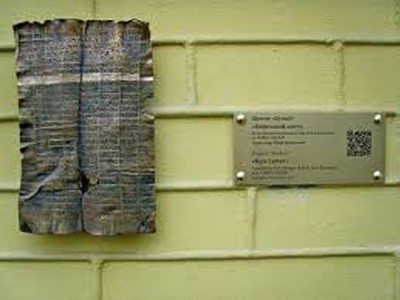
📜 The Kyiv letter is a witness to the thousand-year history of our city
Community
On the building of the Central Synagogue of Kyiv there is a copy of a unique document known as the "Kyiv Letter". This document, created in the 10th century, is one of the oldest written references to Kyiv that have survived to the present day.The story he has preserved impresses with its humanity and mutual responsibility.The Kiev letter was issued by the Jewish community of Kiev to Mar Yaakov ben Hanukkah. He vouched for his brother, who had borrowed money from Gentiles. Later, the brother was killed by robbers, and the debt remained unpaid. The responsibility was placed on Yaakov, and he was imprisoned.The community did not leave him alone with trouble. Together, they managed to collect 60 coins for his ransom, but another 40 were missing for his final release. That is why this letter was drawn up — an appeal to the Jewish communities of other cities with a request to help complete the liberation of a person in distress.More than a thousand years have passed, but the words of this document still remind us today of the values on which the Jewish community was based: mutual assistance, mercy, responsibility for each other, and a willingness to extend a hand to those in need of support.Of particular importance is the fact that the letter contains one of the oldest mentions of Kyiv. So this is not only a monumentof Jewish history, but also an important part of the history of our city.When you are near the Central Synagogue of Kyiv, pay attention to this sign. She recalls that more than a thousand years ago, a community already lived here, for which human dignity, mutual support and mercy were not just words, but a matter of life.Kyiv Central Synagogue"Kyiv Letter", 10th centuryHappy Kyiv Day!

Our dates: 16 sivan
Community
16 Sivan 5573 (June 14, 1813) — Yorzeit (the anniversary of the departure from this world) of the daughter of Alter Rebbe — the Rebbetzin of Freud.Rebbetzin Freud was a wonderful and very intelligent woman. Alter Rebbe loved his daughter very much, gave her lessons in Hasidut (Hasidic philosophy) and often said that her soul belonged to the "Alma Deduhra" (male world), but for some reason the Almighty decided to put her in the body of a woman. Even Freud's brother, the future head of the Hasidim, Rabbi Dov-Ber (Miteler Rebbe), when he wanted to find out something about Hasidism, turned to her, and she already asked the teachers.Rebbetzin Freud was born in 1763 and left this world half a year after her father's death, surrounded by love and respect. Rebbetzin Freud was buried next to Alter Rebbe in the Jewish cemetery in Hadiach (Poltava region).16 Sivan 5669 (June 5, 1909) was the birthday of Rabbi Israel-Arieh-Leib Schneerson, the Rebbe's younger brother.Rabbi Israel was also born in Mykolaiv and from childhood was distinguished by a great love for learning, and in order to feed him, the mother (Rebbetzin Hani) had to, in the literal sense of the word, forcefully pull her son away from books.source: chabad.odessa

Our dates: 17 sivan
Community
📌17 Sivan 1656 (2105 BC) — Noah's Ark docks at Mount Ararat.Seven months after the beginning of the Flood and 17 days after the water covering the earth began to subside, the ark with Noah, his family and all the animals that were there approached the top of Mount Ararat.📌17 Sivan about 3620 (140 BC) — Victory of the Maccabi brothers' army.On this day, troops led by the Maccabi brothers recaptured the fortress of Migdal-Zur from the Greeks. The Talmud (treatise "Taanit") says that this day was declared a holiday.📌17 Sivan 5632 (23 June 1872) — Yorzeit (anniversary of the departure from this world) to Rabbi Aaron ben Asher (Aaron II) of Carlin.Rabbi Aaron was the grandson of Rabbi Aaron the Great of Karlin, the first Karlin rabbi, and the son of Rabbi Asher, the second Karlin rabbi. At the age of 26, he became a Karlin rabbi, going down in history under the nameof Rabbi Aaron II. It was for him that Karlin's Hasidism reached its heyday, and at the same time the most famous Karlin chants and songs appeared.In 1867, Rabbi Aaron moved to the town of Stolin, and from that moment the movement was called "Karlin-Stolin Hasidism".Like his father, Rabbi Asher, Rabbi Aaron strongly supported the Hasidim who settled in Eretz Israel. Today, Carlin-Stolin Hasidism is a rather influential and dynamic Hasidic movement, the main centers of which are in Jerusalem and Tiberias (Israel), Brooklyn (USA). There are also Karlin-Stolin Hasidim in Ukraine (in Kyiv).source: chabad.odessaOur dates:📌17 Sivan 1656 (2105 BC) — Noah's Ark docks at Mount Ararat.Seven months after the beginning of the Flood and 17 days after the water covering the earth began to subside, the ark with Noah, his family and all the animals that were there approached the top of Mount Ararat.📌17 Sivan about 3620 (140 BC) — Victory of the Maccabi brothers' army.On this day, troops led by the Maccabi brothers recaptured the fortress of Migdal-Zur from the Greeks. The Talmud (treatise "Taanit") says that this day was declared a holiday.📌17 Sivan 5632 (23 June 1872) — Yorzeit (anniversary of the departure from this world) to Rabbi Aaron ben Asher (Aaron II) of Carlin.Rabbi Aaron was the grandson of Rabbi Aaron the Great of Karlin, the first Karlin rabbi, and the son of Rabbi Asher, the second Karlin rabbi. At the age of 26, he became a Karlin rabbi, going down in history under the nameof Rabbi Aaron II. It was for him that Karlin's Hasidism reached its heyday, and at the same time the most famous Karlin chants and songs appeared.In 1867, Rabbi Aaron moved to the town of Stolin, and from that moment the movement was called "Karlin-Stolin Hasidism".Like his father, Rabbi Asher, Rabbi Aaron strongly supported the Hasidim who settled in Eretz Israel. Today, Carlin-Stolin Hasidism is a rather influential and dynamic Hasidic movement, the main centers of which are in Jerusalem and Tiberias (Israel), Brooklyn (USA). There are also Karlin-Stolin Hasidim in Ukraine (in Kyiv).source: chabad.odessa

Our dates: 20 sivan
Community
📌20 Sivan 4931 (May 26, 1171) — Blood libel in Blois (France).Rabbi Yosef Ha-Cogen recorded in his book Emek Ha-Baha the history of the Jewish pogroms during the Crusades, beginning in 4846 (1096), where he told about the terrible fate of the Jewish community of the city of Blois. Here's what he writes:"A man, a Jew, led his horse to a watering hole and met there another man, a non-Jew. The Jew was frightened because he saw a non-Jew drowning a non-Jewish youth. The Gentile also became frightened and came to his master and said to him: "I saw a Jew throw into the water a little boy who was causing trouble to the Jews - and I am telling you about it." By order of the evil master, Rabbi Yehiel ben David and Rabbi Yekutiel bar Yehuda, cogens, students of Rabbi Shmuel, as well as Rabbi Yehuda ben Aharon, were arrested. The villains then lit a fire, stabbed the bound Jews with their swords, and threw their bodies into the fire—but they did not burn! Other Jews were killed and arrested together with them, thirty-one people in all, their souls left their bodies, but the bodies did not burn in the fire! These Jews died at the stake with the words "Aleynu leshabeyah" ("Our duty is to praise the Lord of the world") on their lips, and their souls ascended to heaven.These people were faced with a choice: convert to Christianity or go to the hearth, but they all remained faithful to the Almighty. They were brutally tortured, hoping thus to incline them to apostasy. They refused the offers of the enemies and supported each other in every possible way.Their bodies were thrown into the fire, but they did not burn, although the souls left them. When the uncircumcised saw that their bodies were not burning, they were amazed and said to each other, “Undoubtedly, these people are saints, and all that has happened is the finger of the Most High.”In memoryof the victims of slander, Rabbi Yaakov ben Meir (Rabbeinu Tam) and the most prominent of the Jewish sages of France proclaimed the 20th of Sivan a day of fasting.📌20 Sivan 5409 (May 31, 1649) — The beginning of the non-Myriv pogrom.In 1648–1649, the gangs of Bohdan Khmelnytskyi, cursed be their names, destroyed hundreds of communities and many tens of thousands of Jews in Ukraine. The following year, rabbis and public figures who were part of the highest Jewish legislative body in Poland - the "Council of the Four Lands" - gathered during the Lublin fair and declared the 20th of Sivan a day of mourning for the fallen Jewish communities, as well as a day of remembrance for two martyrs - Rabbi Yechiel Michl from Nemyrów and Rabbi Shimshon ben Pesach from Ostropol, who were killed on this very day.It has been found that all men aged eighteen years and over, as well as all women aged fifteen years and over, are required to fast on this day as they fast on public fasting days. The resolution concerned only Jews in Poland, but the Council of Lithuanian Communities, which governed the Jewish communities of that part of Lithuania that was not part of the Polish kingdom, also agreed with this decision and banned Lithuanian Jews from wearing rich clothes for three years.📌20 Sivan 5662 (June 25, 1902) — The "Tomhei Tmimim" yeshiva located in Lyubavichy was closed by order of the authorities.Founded in 1897, the yeshiva served as a reliable barrier to a new trend — assimilation and "enlightenment", which spread among Jews, which aroused the hatred of supporters of these trends — the maskilim. It was they who made significant efforts to achieve its closure.In 1902, their efforts were crowned with success, but Rabbi Yosef-Yitzhak (Rebbe Rayats), who led the yeshiva, did not give up, and soon in one or another city in Russia, Poland, and then around the world, new yeshivas began to open, which were also called "Tomhei Tmimim".source: chabad.odessa