
🌿 Soon we will have one of the most joyful holidays - Sukhoth! 🍋🌿
Community
And in order to fully feel the atmosphere of the holiday and fulfill the commandment, it is important that everyone has their own Lulav and Etrog.We have already opened a pre-order for Arba Minim - several sets are available for different budgets and quality levels.We advise you not to postpone the order!The number of sets is limited, so it is better to arrange it as soon as possible so that on the eve of the holiday you will not be left without your Arba Minim.You can place an order using the link below or by phone: https://forms.gle/jzEzF54mUSrcThSx9097 121 11 33 Adam

A moment of silence.
Community
Every day at 9:00, Ukraine stops for a minute.In this silence, we honor the memoryof the military and civilians, adults and children — all who were taken by the Russian war.This is a moment of our common pain, honor and promise to remember.Let's stop together. Let's bow our heads.We remember everyone.

Iyom-yom: 24 Elul
Community
In the book,"Ayom-yom"on 24 Elul it is written:“There were times when every utterance was taken as a guideline, and everything seen as a guide to ministry and a guide to action.”These words remind us that spiritual knowledge should not remain just a good thought. Hearing should touch the heart, what is seen should become a lesson, and the conscious should be embodied in a specific act. Wisdom becomes truly valuable only when it changes our lives. This guideline is especially profound at the end of the month of Elul — in the days of spiritual completion and preparation for Rosh Hashanah. This is a time to ask myself: what have I heard and understood over the course of the year — and what has been my action from that?About the book "Ayom-yom"“Ayom-yom” is a daily Hasidic calendar whose name means “Today is a day.” In the winter of 1942, the Sixth Lubavitcher Rebbe, Rabbi Yosef-Itzhak Schneerson, commissioned his son-in-law, the future Seventh Lubavitcher Rebbe, Rabbi Menachem-Mendel Schneerson, to compile a collection of Hasidic expressions, teachings, and customs arranged according to the days of the Jewish year. Each entry in it is a short spiritual guideline for the day. "Ayom-yom" not only gives knowledge, but helps to see how the teachings of Hasidism should be manifested in prayer, service to the Almighty, attitude to people and daily actions.After all, the real guideline is not the one that we just remembered, but the one after which we began to live a little differently.
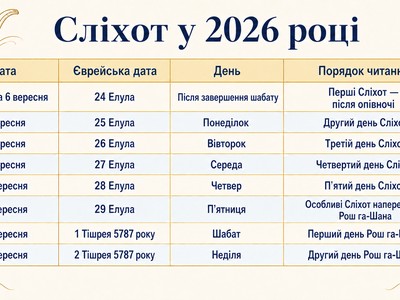
Schedule of slippers for 2026
Community
When is Slichot read in 2026?S'lichotare special prayers for forgiveness and mercy that help prepare for Rosh Hashanah and Yom Kippur.According to Ashkenazi custom:The first Slichot is always read on the night after the Sabbath.Rosh Hashanah must be at least four days away from Slichot reading. Therefore, if the first day of the holiday falls on a Monday or Tuesday, they begin to be read a week earlier.The first Slihot is read after the halakhanic north. In the following days, they are usually read in the early morning, before the morning prayer.On Shabbat, Slihot is not read.On the eve of Rosh Hashanah, special Slichot is read, designed specifically for this day.

Today — 22 Elul 5786
Community
The eve of the Sabbath. Weekly section of the Torah "Nitsavim-Wayelekh", Shabbat Mevarkhim and Shabbat SlikhotAbout Shabbat Mevarhim — herehttps://jewishukraine.info/post/1533/Three additional psalms per month Elul: 64–66Ayom YomHasidism requires that before making remarks or reproaching someone, they first "cut their nails" — that is, they do not stab or hurt them with a word. After all, "unclean klipot clings to the nails," and each injection or sharpness is a manifestation of the "clip" — the shell — and the "achra" — the dark side.And after cutting your nails, you need to wash your hands. The inner content of this ablution, according to the secret teachings of the Torah, is explained in detail as the ascent and spread of the light of the mind — mohin — into the realm of emotional qualities — medot.Lubavitcher calendar

Psychologist's page: Humor is not an escape, but a support
Community
The source of the psychologist: In difficult times, we are looking for something that will help us not to break. For many, humor becomes such a pillar. Jokes are not frivolity, not avoidance of seriousness, but a way for the psyche to withstand excessive tension.When we joke, we don't deny the pain — we give it a form that can be sustained. Laughter releases tension, returns a sense of control, allows you to see the situation from a different angle. And even if it is difficult around, for a few seconds the areas responsible for joy, relief, hope are activated in the brain.Humor is part of our psychological immune system. It does not solve problems, but it helps us to live to the point where we again have the strength to solve them.So we laugh where we can. Because it's not an escape. It's a pillar.And remember: if you are still able to joke — you are still able to fight.source: InstitutPsihoterapiiResurs

This week is Shabbat Slikhot!
Community
A special time is approaching when the air is literally full of awe, expectation and deep inner light — the period of Laughter, which in Hasidism opens with the majestic Sabbath of Laughter.🕯️What is Slihot in Hasidism?Slichot is not just the usual words of repentance, but a powerful impetus to awaken the soul on the eve of the New Year — Rosh Hashanah. In Hasidism, this period is lived with extraordinary depth.As Tzemach Zedek explained, before Rosh Hashanah, our service to the Almighty is expressed through speech — sincere prayer and asking for forgiveness. Instead, in Rosh Hashanah and Yom Kippur, the main emphasis shifts to the level of thought and inner contemplation.Interesting detail:Rebbe Chabad, like the Hasidim, did not read Slichot during the Ten Days of Repentance, because after Rosh Hashanah comes the time for concrete deeds and practical correction. However, the previous week was full of intense spiritual work.🍷Farbrengen before Slichot: the fire of joy and preparationA special part of this evening is the Hasidic farbrangen before the first Slichot, which is recited in Motsay Shabbat — after the end of Shabbat.The Hasidim gathered at a common table before nightfall to light their hearts. In Lyubavichy, it was said that after the farbrängen, the Hasidim came to the night Slikhot literally wiggling, overflowing with holy inspiration, which remained after the fierce Hasidic meeting and the sincere "Lechaim!".This joy does not contradict awe — on the contrary, Hasidic joy destroys all obstacles, turning the fear of the Judgment into deep trust and love for the Creator.🔥The atmosphere of the Lubavitchers: how it was in the pastFrom the entries in the "Likutey Diburim" and "Sefer ha-Sihot", live pictures of those days have come down to us.Anticipation in the air.Already on the night of Friday before Shabbat, Slichot was running away from his eyes. Thoughts about the Judgment and the infinite mercy of the Almighty did not give rest, prompting the soul to seek support.Early Mikvah.Even before dawn on Saturday, everyone rushed to the mikva. The immersion turned into a harsh inner judgment over itself: does this water really wash away former mistakes along with sincere remorse — does the person remain as he was?Tegilim from the depths of the heart.On the way to the synagogue, the voices of ordinary Jews and artisans were heard reading the psalms with such an inner fire that you would not hear any other day of the year.A short Saturday meal.At the table of Rebbe Rashab, the meal of this Sabbath was noticeably shorter than usual: every minute was permeated with anticipation of the Days of Awe.📜Traditions and laws of Slichot who live todayStart timeThe first Slichots begin to be recited in the mozzaei Sabbath, just after midnight. In the synagogue of the Lubavitsky Rebbe, in 770, it happened at 1 a.m.The Triple Alliance is learning, tsedakah, and prayer.Before the beginning of Slichot, they study a passage from the Torah, for example, the Hasidic Maamar Alter Rebbe "Leha HaShem HaTzaka", and also give tzedakah.ClothingThe Rebbe went out to Slichot in a Saturday festive outfit.Niguns.The first night Slichot is opened by the legendary nigun "Arba Bavot" — "Four stanzas", and ends with the cheerful and warm chant of "Rahman de Aney", the rhythm of which the Rebbe invariably supported with applause.May this week bring each of us spiritual renewal, a good and sweet year and the final good entry in the Book of Life!📖Lubavitcher calendar
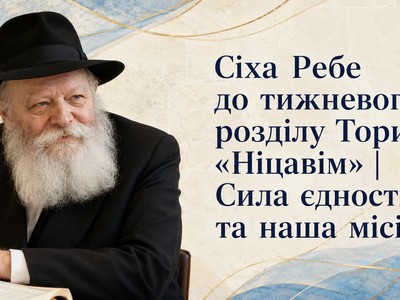
Siha Rebe for the week-long section of the Torah "Nitzavim" | The Power of Unity and Our Mission
Community
📖Introductio nOn the Sabbath before Rosh Hashanah, we read the section of the Torah "Nitzavim", in which the Almighty makes an alliance with the entire Jewish people without exception — from the highest leaders ("your heads") to the simplest workers ("those who draw your water").And the paradox immediately catches the eye: on the one hand, the text speaks of absolute, monolithic unity — everyone stands as if one person. And on the other hand — here he lists in detail all the social stages and differences.🤔QuestionHow to combine the urgent need to become part of a common unity, in which any boundaries are erased, while preserving the personal uniqueness and individual role of each?💡ResponseThe whole secret is contained in the words: “before G-d your Almighty.” When unity is based on a connection with the Almighty, who permeates the whole essence of man, personal differences do not divide, but, on the contrary, merge into a harmonious whole.And most importantly: the words "You stand" are not just a beautiful call, but an unshakable reality! There are enormous forces in each of us, sometimes hidden even from ourselves, to withstand any difficulties and fulfill our purpose.📌LessonWe will enter the new year with a firm decision: to reveal our hidden forces, to persevere in our own mission and, most importantly, to walk side by side in true unity. This is how we bring the long-awaited Liberation closer!Based on the materials of Likutey Sikhot, vol. 9, p. 462.📖Lubavitcher calendar

Our dates: 25 Elul
Community
Our dates:25 Elul before the creation of the world (3761 BC) — The First Day of Creation.In fact, this is a conditional 25th number. At that time, there was not a single Elul (that is, it was, but purely theoretically, in the plans of the Almighty). However, since the chronology begins on the 1st day of the month of Tishrei, and this day was the sixth day of Creation, it is possible to risk assigning the corresponding day of the month to the first day.On this day, reality, time, matter, light, and darkness were created. Not so little for the first day...25 elul 3426 (335 BC) — The walls of Jerusalem were rebuilt.Кріпосні стіни, що оточували місто, лежали в руїнах 88 років, з моменту руйнування Єрусалима і Першого Храму вавилонянами. Їхнє відновлення було справою рук Нехемії — одного з лідерів євреїв, які повернулися з вавилонського вигнання. Нехемія обіймав важливу і почесну посаду при дворі перського царя Артахшасти, однак добровільно повернувся до Ерец-Ісраель відроджувати країну. Під його керівництвом стіна, що оточувала Єрусалим, була відбудована менш ніж за два місяці, всього за 52 дні (при тому, що єрусалимці працювали через день, почергово виконуючи ролі будівельників і охоронців, що відбивали набіги сусідніх народів).25 Elul 3862 (August 27, 102) — Yorzeit (anniversary of the departure from this world) Rabbi Elazar ben Shimon.Рабі Елазар бен Шимон був сином найбільшого кабаліста, рабі Шимона бар Йохая. Разом із батьком рабі Елазар 13 років переховувався від римлян у печері, разом із ним вивчав Тору і осягав таємниці Кабали. Рабі Шимон одного разу сказав, що якщо покласти на одну шальку терезів усіх мудреців світу, а на другу — його сина Елазара, то Елазар переважить усіх. Агада розповідає, що Моше мав пророчий дар, і йому було відомо, що в далекому майбутньому, через тисячу років, у великого мудреця на ім'я Шимон буде син Елазар. І от одного зі своїх синів Моше назвав Елазаром, на честь ще не народженого мудреця.25 Elul 5546 (September 18, 1786) — Yorzeit (the anniversary of the departure from this world) to Rabbi Ihiel-Mikhl from Zlochev.Як часто траплялося, батько Іхіела-Міхла, рабі Іцхак із Дрогобича, був завзятим противником хасидизму (був, поки не зустрівся з рабі Баал Шем-Товом). Рабі Іхіель-Міхл був одним із відданих учнів засновника хасидизму рабі Ісраеля Баал Шем-Това, а потім і Межиріцького магіда, і героєм багатьох чудесних історій про нього та його вчителів. Йому належить авторство відомого нігуна, який так і зветься «Реб Міхл зі Злочева». Сам реб Міхл одного разу сказав, що якщо людина, яка потрапила в біду, співатиме цю пісню, то він докладе всіх зусиль, щоб врятувати її. Хоча, додавав реб Міхл, це не скасовує обов'язку просити про порятунок Б-га.Among the disciples of Rabbi Michal, the most famous were Rabbi Abraham-Yegoshua Heshel from Apta (Apter Rebbe) and Rabbi Mordechai from Nesvizh.25 Elul 5505 (September 22, 1745) — The union of Abraham-Avin Schneur-Zalman Schneerson.The future founder of the Chabad movement entered the union of Abraham-Avin (that is, he was circumcised) on the eighth day, as it should be according to the laws of the Torah. That's when he got his name — Schneur-Zalman.source: chabad.odessa

Our dates: 26 Elul
Community
26 Elul before the creation of the world (3761 BC) — The Second Day of Creation.On the second day of Creation, the Most High separated the waters of heaven from the waters of the earth, creating an airspace between them, where we are with you. And on this day, a vault was created, which the Almighty called "heaven".source: chabad.odessa

Our dates: 27 Elul
Community
27 Elul before the creation of the world (3761 BC) — The Third Day of Creation.On this day, the lower waters were collected into the sea-oceans and separated from the land. On the same day, grass and fruit trees appeared on the surface of the earth. On this day, the Almighty, looking at his actions, twice said "This is good", which he did not say on the first or second day (then there was still what is called "in the process", and now quite visible and tangible fruits have become visible, and the fruits in the literal sense of the word).The third day of Creation was Tuesday, and since G-d said “This is good” twice on this day, Tuesday is considered a lucky day for the Jews. But for the British, Wednesday is considered a good day for some reason. Apparently, it was too late for them...27 Elul 5615 (September 10, 1855) — Yorzeit (anniversary of the departure from this world) Rabbi Shalom Rokeah (Belzer Rebbe).Рабі Шалом Рокеах був нащадком великого гаона (генія, мудреця найвищого рівня) рабі Еліезера з Амстердама, автора книги «Маасе Рокеах». Рано осиротівши, він навчався в домі свого дядька, скулянського рабина рабі Іссахара-Бера. Його вчителями хасидизму були рабі Авраѓам-Єгошуа Ѓешель з Апти (Аптер ребе), рабі Ісраель із Кожниці (Кожницький магід), рабі Урі зі Стреліска, але головним учителем юнака був знаменитий сліпий мудрець Яаков-Іцхак ѓа-Хозе мі-Люблін («Провидець із Любліна»). Розповідають, що при народженні «Провидець» отримав дар бачити всю землю від краю до краю, однак, поглянувши на цей світ, вблагав Всевишнього обмежити його дар 400 верстами. За рекомендацією Хозе, рабі Шалом був призначений рабином у Белзі (місто у Львівській області. Не плутайте з містом Бєлц (Бєльці), яке в Молдові). Тут рабі Рокеах прожив усе своє життя, заснувавши свою гілку хасидизму — белзьский хасидизм, і поклавши початок династії Белзьских ребе.source: chabad.odessa

Our dates: 28 Elul
Community
28 Elul before the creation of the world (3761 BC) — The Fourth Day of Creation.On this day, the Almighty created the heavenly bodies and stars. Initially, two equally large luminaries were created — night and day, however, according to legends, the moon was outraged and stated that two equal luminaries were impossible — one must necessarily be larger. His wish was granted and his size was reduced.source: chabad.odessa