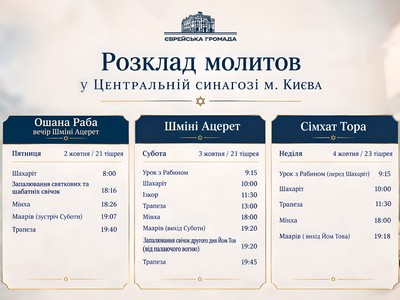
Central Synagogue Holiday Prayer Schedule
Community
🌿Oshana Rabah / evening Shmini Atzeret📅Friday, October 2/ 21 Tishrei📖 Shaharit — 8:00🕯 Ignition of festive and sabbatical candles — 18:16🙏 Minha — 18:26🌙 Maariv — Saturday meeting — 19:07🍽 Meal — 19:40 Shmini Atzeret📅Saturday, October 3/ 22 Tishrei📖 Lesson with Rabin — 9:15🙏 Shaharit — 10:00🕯 Izkor — 11:30🍽 Meal — 13:00🙏 Minha — 18:00🌙 Maariv — Sabbath Exit — 19:20🕯 Ignition of candles of the second day Yom Tov from a burning fire — 19:20🍽 Meal — 19:45 🎉Simchat Torah📅Sunday, October 4/ 23 Tishrei📖 Lesson with Rabbi before Shaharit — 9:15🙏 Shaharit — 10:00🍽 Meal — 13:00🙏 Minha — 18:00🌙 Maariv — Yom Tov Exodus — 19:18

The time of lighting festive and Sabbath candles in Kyiv
Community
🌿Oshana Rabah / evening Shmini Atzeret📅2 October / 21 Tishrei🕯 Ignition of festive and Sabbath candles —18:16 ✨Shmini Atzeret📅3 October / 22 Tishrei🕯 Ignition of festive candles from burning fire —19:20🎉Simchat Torah📅4 October / 23 Tishrei🌙 The end of the holiday —19/18

🌿 Today 24 Tishrei
Community
Iom-yom:Today in "Ayom-yom" is dedicated to a special topic — Hasidic painters.Farbrengen is not just a meeting at a table. This is a warm Hasidic gathering where they talk about the Torah, serving the Almighty, loving their neighbor, singing niguns and inspiring each other to become better.Ayom-yom emphasizes that the dye-breaker, especially on Shabbat or at the end of the holiday, is one of the foundations of Hasidic life. It opens the way to the fulfillment of an important commandment — love for one's neighbor.During such meetings, it is customary to talk not only about high things, but also about practical steps: how to improve your behavior, how to devote more time to studying the Torah and Hasidic philosophy, how to make knowledge part of everyday life.But the main rule of the farbrängen is to instruct with love. Words should not humiliate a person, but raise him up. Not to inject, but to awaken. Not to embarrass, but to help you get closer to G-d.Farbrengen is when a soul hears another soul.And it is with such sincerity that real change begins.

The Night of Oshan the Slave: A Time of Prayer, Mercy and Spiritual Awakening 🌿📖
Community
The night from 20 to 21 Tishrei is the night of Oshan Rab, the seventh day of Sukhoth.Since the Jewish day begins in the evening, it is on this night that they traditionally remain vigorous, read the book of Tegilim — the Psalms of King David, pray and ask the Almighty for mercy, blessing and a good year.Oshana Rabah has a special spiritual significance. In Jewish tradition, this day is considered the end of the period that began with Rosh Hashanah and Yom Kippur: the time when the heavenly sentence for the next year is finally approved.📖 Why is Tegilim being read on this particular night?According to the Kabbalistic tradition, the night of Oshan Rab is a special exception: at this time, the light of mercy overcomes the harshness of judgment. Therefore, reading the Psalms is considered a great spiritual power, protection, and a plea for good fortune.As is customary, the book of Tegilim is read in its entirety — from beginning to end. In many communities, after each of the five parts of Tegilim, special prayers "Yehi Ratson" are said — with a request for forgiveness, blessing, life and peace.🌿 The main customs of the night of Oshan Rab:✨ stay invigorated overnight;📖 read Tehilim or study the special collection "Tikun Oshana Rabah";🌿 if possible, read prayers in the festive hut;💧 before dawn in some communities, men are immersed in the mikvah.📍 In the Central Synagogue of Kyiv, the reading of Tehilim will take place from 00:00 to 5:00 in the morning.May our prayers be received this night with mercy, and may the Almighty grant us all a good, peaceful and blessed year.Oshana Rabah Samaah!🌿✨

October 1 — Day of Defenders of Ukraine 💙💛
Community
Today we remember with deep gratitude all those who defend our country, our homes, our children and our future.Every quiet morning, every opportunity to live, work, pray and be close to loved ones is someone's courage, someone's fatigue, someone's feat and, unfortunately, someone's highest sacrifice.🕯️ Eternal memoryto the fallen heroes.🙏 Shana and gratitude to everyone who is defending Ukraine today.May the Almighty protect our defenders and defenders, give them strength, endurance and return home alive.Glory to Ukraine, Glory to the Heroes!

We invite you to Akafot in the Central Synagogue of Kyiv!
Community
Akafot are festive rounds with Torah scrolls in the Simhat Torah, a time of joy, unity and love for the Torah.📅Friday, October 2/21 Tishrei🌙 Akafot — after Maar📅Saturday, October 3/ 22 Tishrei🌙 Akafot — after Maar📅Sunday, October 4/ 23 Tishrei🎉 Akafot — at 11:30Kyiv 📍 Central SynagogueCome and share the joy of the Torah with the community!Hag Samah!

Our dates: 25 Tishrei
Community
📌25 Tishrei 5600 (October 3, 1839) — Yorzeit (anniversary of the departure from this world) Rabbi Moshe Sofer (Khatam Sofer) from Pressburg.Rabbi Moshe was a renowned halakhic authority and leader of orthodox Jewry, known in the Jewish world as Hatam Sofer, after the title of one of his books.Hatam Sofer held the posts of rabbi in the Moravian city of Dreznica and the Prussian Mattersdorf, and from 1806 became rabbi of Presburg (Bratislava, now Slovakia, then Hungary), where at that time there was the largest Jewish community in Hungary. Rabbi Moshe held this position for the rest of his life, founding the famous yeshiva in Pressburg, the largest since the Babylonian academies.Although Rabbi Moshe was opposed to the new teaching methods proposed by reformist leaders, he did not object to the study of secular sciences, as long as it did not interfere with the traditional way of life and served to earn a living. In his struggle with reformist leaders, Rabbi Moshe used rather unusual methods for that time — caustic witty epigrams and bright slogans, such as: “It takes more courage to increase severity, not facilitate.”Also, Hatam Sofer put an end to the heated debate over whether the Shulchan Aruch could be considered the ultimate authoritative body of law, and since then full submission to the Shulchan Aruch guidelines has become one of the fundamental doctrines of orthodox Judaism.source: chabad.odessa

Our dates: 26 Tishrei
Community
📌26 Tishrei 5589 (October 4, 1828) — Yorzeit (anniversary of the departure from this world) Rabbi Asher ben Aharon Perlov of Stolin.Rabbi Asher was the son of the famous Rabbi Aharon "the Great" (Aharon ha-Hadol) of Karlin, the founder of the Karlin Hasidic dynasty. After his father's passing, the movement was headed by Rabbi Aharon's disciple, Rabbi Shlomo ben Meir ha-Levi, who was the spiritual mentor of many Hasidic tzaddiks, including Rabbi Asher. Rabbi Asher settled in the town of Stolini (near Karlin), and since then the Karlin Hasids became known also as Stolin (Karlin-Stolin). As the "head of the sect" he was arrested in 1798, and after his release he settled again in Carlin.source: chabad.odessa

Our dates: 27 Tishrei
Community
📌27 Tishrei 5502 (October 25, 1742) — Yorzeit (anniversary of the departure from this world) Rabbi Elazar ben Shmuel Rokeah.Rabbi Elazar was born in Krakow, to a family descended from King David. His father was Rabbi Shmuel-Shmelke Margaliot, who headed the communities of the Polish towns of Liska and Makov, and the boy was named after his great-grandfather — the famous Kabbalist Rabbi Elazar ben Yehuda ben Clonimus from Worms.Rabbi Elazar led the communities of Makov and Tarnów and then moved to Brody. It is said that in Rabbi Elazar's 20 years here, not a single woman in the city had a miscarriage and none of them had problems during childbirth.From Broad, Rabbi Elazar went to Amsterdam, where (they say, at the request of the king of the Netherlands), together with the rabbi from Belz, he helped the Dutch get rid of the epidemic that threatened the country. After the prayer of Rabbi Elazar, the danger receded, and the Dutch government issued a commemorative coin with the profile of Rabbi Elazar and the text of the psalms as a token of gratitude.Rabbi Elazar led the Amsterdam community forfive years, fighting here with the followers of the false messiah Shabtai Zvi. In Amsterdam, he published his main book, Maase Rokeach, with cabalistic commentaries on the Torah and Talmud. He borrowed the name from the book of the great cabalist Rabbi Elazar Rokeah to emphasize the continuity of the tradition of knowledge transfer.Then Rabbi Elazar went to Eretz Israel, where he headed the Jewish community of the Holy Land. On his way to Eretz Yisrael, Rabbi Elazar hoped to meet one of the Baal Shem Tov's greatest disciples, Rabbi Nachman of Horodenka, in order to bring Moshiach into the world with him. However, upon arriving in the country, he learned that Rabbi Nachman had urgently left for Europe. In turn, Rabbi Nachman, hearing that Rabbi Elazar had arrived in Eretz Yisrael, urgently returned, but unfortunately, by the time he reached the Holy Land, Rabbi Elazar, having lived in Eretz Yisrael for one year, had passed away.The descendant of Rabbi Elazar was Rabbi Sar-Shalom from Belz, the founder of Belz Hasidism.source: chabad.odessa

Today — 24 Tishrei 5787
Community
**Isra Haq**📌5542/13.10.1781 ** — Rabbi Yakov Yosef of Polonne, the author of the book "Toldot Yakov Yosef", left this world.📌5556/18.10.1995 ** — Reb Chaim Zalman (Zanuil) Abramovich, Rybnitsky Rebbe left this world.📌 5559/04.10.1798 ** — Alter Rebe was sent to his first imprisonment in St. Petersburg.📌5561/13.10.1800 ** — Alter Rebbe went to the second imprisonment in St. Petersburg.📌 5688/20.10.1927 ** — Rebbe Rajac left Russia and settled in the city of Riga, Latvia, at the invitation of the Jewish community.**Ayom Yom**Farbrengen — with the participation of many people in general, and especially on Shabbat or at the end of Shabbat — is one of the foundations of the Hasidic path and Hasidism. It is also the gateway and introduction to the fundamental commandment of loving one's neighbor.Usually, in such a color-breaking, the main speakers call on those present to improve their behavior and actions, to establish a constant time for studying Hasidism, to strictly adhere to this schedule, namely, to direct the training to practical implementation.The essence and form of this attitude are explained in detail in the Hasidic maamar, which begins with the words "Im ruach ha-moshel". Each of the shlomain ansha should study it well and apply it to themselves.At the same time, the attitude during the farbrangen should concern only those things and issues that in no way can lead to public shame. This is how it has been established for a long time: people instructed each other in an atmosphere of great love and spiritual warmth.source: 📖 Lubavitcher Calendar

What to do with the four plant species after Sukhothu?
Community
Four types of plants — etrog, lulav, myrtle (adas) and willow (araba), including oshanot from the holiday of Oshana Rabah — are forbidden to be used for ordinary household needs, while the commandment is fulfilled with their help. During this period, they should be treated with special respect and trepidation.When the holiday of Sukhoth comes to an end, the plants lose their sacred status and are formally allowed to be used in everyday life. However, since they served to fulfill the commandment, it is still impossible to treat them disrespectfully.That is why they should not be thrown openly into the trash or simply left on the street under the feet of passers-by. According to Halacha, it is enough to wrap the plants tightly and completely in an opaque bag and only then put them in a garbage can — in this form this is not considered a manifestation of neglect.A separate rule applies to etrogs that have the sanctity of the seventh year — schmites. Such a fruit cannot be thrown away immediately: you need to wait until it is completely dry and completely unfit for food.In Judaism, there is a beautiful principle: an object that served to fulfill one commandment should be used for another. Popular folk customs of using festive plants after Sukhoth are based on this rule:🌿Before the feast of PassoverThe branches and leaves are stored until spring and thrown into the fire during the burning of kvass — hamets, or used as fuel during the baking of festive matzah.🌿At the end of the SabbathMyrtle twigs, if they have retained a pleasant aroma, are used as incense during Awdala — the rite of separation of the Sabbath from everyday life.🌿To the holiday of Tu BiShvatFrom the fruits of the etrog, fragrant jam is boiled or candied fruits are made, which are served to the table for the New Year of trees.There is also a special gathering: in folk tradition, it is believed that the etrog that was in the hands at the time of the fulfillment of the commandment, as well as the dishes prepared from it, can be a good sign and a blessing for women during pregnancy and childbirth.source: https://toldot.com/
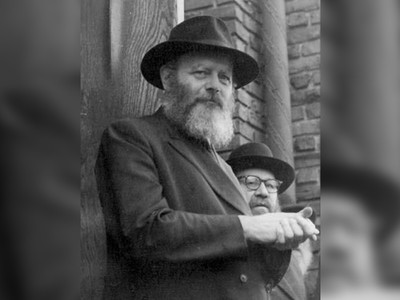
And Jacob went his way" — when Tishrei comes to an end
Community
More recently, the whole Jewish world lived in a special atmosphere of the month of Tishrei: Rosh Hashanah, Yom Kippur, Sukhoth, Simhat Torah… Someone spent these days next to the Rebbe, someone in his yeshiva, synagogue or at home with his family.And now the holidays are over.And the words sound:"וְיַעֲקֹב הָלַךְ לְדַרְכּוֹ" — "And Jacob went his own way."🌅What do we bring with us from Tishrei?In Lyubavicha, after the Simhat Torah, these words were proclaimed as a special parting word.In Tishrei, the Jew receives great spiritual powers. But the Almighty does not give them so that they remain only a memory of holy days.Now you need to take them with you — into ordinary life.🔥“Open your packages!”Rebbe Rajac gave the example of a merchant who comes to the fair, buys goods and carefully packs them. But when he gets home, he doesn't leave the bundles closed. He opens them and begins to use what he has acquired.Likewise with Tishrei.We received "goods" for the whole year: strength, inspiration, solutions and new spiritual opportunities.Now it's time to open your packages.Do not wait for the next holiday, but start using all this today.🚌"Zeithem le Shalom" — and the road continuesOnce, the Rebbe personally escorted guests who returned home after Tishrei. Today, many return from 770, with yeshivas, from trips to the Rebbe or just after holidays spent with their community and family.But there is only one content:time to move on.The holiday is over — but what it has given us should remain.While the holidays last, it is easy to feel a special spiritual upliftment. But then comes Mar-Kheshvan. Ordinary days. Study, work, business, care.And that's when it checks that we took from Tishrei.Will we continue to study the Torah? Will we become more attentive to prayer? Shall we add another mitzvah? Will we help another Jew? Will we bring more light into our home?<bx id="1"/>“Here’s what that means. “And Jacob went his way.”🏠Everyone is on their wayIt doesn't matter where you spent Tishrei:at 770 or at home,in a yeshiva or in your community,whether you're on a trip or with your family.The main thing is where you are going now.Because Tishrei shouldn't be left behind. It should continue in each of our days.Yes, the holidays are over. It may be a little sad to go back to everyday life. But this tightness can become a force.Let's open our Tishrei packages.Let's take his light, solutions and inspiration with us.And let's turn them into real actions.Let us meet the next Tishrei in a completely different reality — together with the Rebbe, in the Third Temple, in Jerusalem."וְיַעֲקֹב הָלַךְ לְדַרְכּוֹ" — "And Jacob went his own way."And our road leads simply to one goal:before the coming of Moshiach now!📸Client Name:Rebbe at the farewell ceremony for guests returning home after a trip of up to 770 per month to Tishrei. 5721 / 1960.