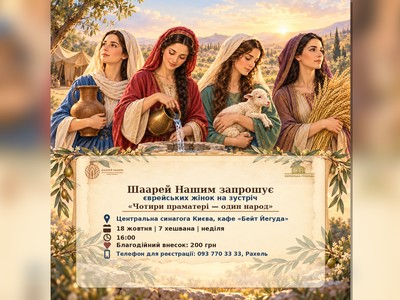
Shaare Nashim invites Jewish women to a meeting
Community
Women's Community"Shaare Nashim"invites Jewish women to a meeting ✨"Four foremothers — one people"📍Location: Kyiv Central Synagogue, Beit Yehuda Cafe📅on theOctober 18 | 7 hash | Sunday🕓Timing:16:00💛Charitable contribution:UAH 200📱Registration phone:093 770 33 33, RachelWe will be glad to see you at a warm women's meeting in an atmosphere of unity, inspiration and communication.

Hyur — Acceptance of Judaism,Part 2.
Community
Everything you wanted to know about hyury, but didn't dare to askPart 2: Essence of Gyuru🔹 How did the sages treat the hyur?The sages' approach to hyury is often misunderstood. In particular, because of the well-known story from the Babylonian Talmud (Shabbat 31a), which tells of three people who wanted to accept Judaism: Shammai rejected them, and Hillel accepted them.Because of this, it is sometimes mistakenly believed that there was a fundamental dispute between Shammai and Hillel about the essence of the hyur. But the words of the wise must always be understood in context.📖 What does Rashi explain?Rashi explains: Hillel accepted these people because he felt that in time they would become sincere heroes, that is, people who truly accept Judaism.Shammai rejected them because he doubted their sincerity and saw that their intentions were not serious enough.That is, both wise men agreed on the main point:✨ one who sincerely aspires to become part of the Jewish people for purely spiritual reasons must be brought closer;⚠️ and those whose intentions are in doubt should not be taken lightly.🔹 Judaism is not missionaryHillel, of course, did not encourage missionary work. Jewish tradition does not seek to convert people to Judaism.The sages often use the expression: ger she-ba leitgayer — “a stranger who comes to accept Judaism.” The very word "comes" emphasizes an important principle: a person must come to this decision himself, according to his own desire and inner call.But if a person really decided and proved the sincerity of his desire — to bring him closer is mitzvah, a good and important commandment. As the midrash says:“I brought Ytro closer and did not reject him. So are you: when a person comes to you to become a Jew solely for the sake of Heaven, bring him closer and do not push him away.”(Yalkut Shimoni, Ytro 268).🔹 Whom does the Almighty bring to the Jewish people?The Talmud explains that the Almighty sees among the nations of the world individuals with high spiritual aspirations and can lead them to the Jewish people.This does not contradict the fact that Judaism does not engage in missionary work. There are two different levels here:🌿 Jewish tradition does not deal with conversion. But if a person comes with a sincere desire to accept Judaism, this is taken seriously and with respect.on the part 🌿 of the Almighty — He can awaken in an individual the desire to join the people of Israel.After the gift of the Torah at Sinai, Judaism does not appeal to entire nations to accept Judaism. Each nation has its own spiritual mission. And Giyur is the path of an individual who sincerely seeks to become part of the Jewish people.🔹 Gyuru conditionsHyur means more than just embracing faith. It is a deep process that includes:📌 joining the Jewish people;📌 acceptance of the yoke of the commandments.📌 willingness to live according to the Torah;📌 entering the life of the Jewish community.These stages are related to each other. A person cannot fully accept the Torah, leaving aside the Jewish community.🔹 Unity of the people and the gift of the TorahRashi explains that the Torah was given to the Jewish people only when they became one.The Torah says:"And he stood by mount Sinai" (Exodus 19:2).Although it refers to the whole nation, the verb is in the singular. Rashi explains that near the Son, the Jews were “as one man with one heart.”That's when the Almighty said, this is the time to give the Torah.🔹 Why is the community so important?The Jewish people are the bearers of the word of the Most High. The Torah is not given to separate people who are separated from each other, but to the people who live as a community.Therefore, a person who moves away from the community loses an important part of his connection with the people of Israel.The sages teach that when a community is going through difficulties, a person has no right to separate and say: “I will go home, eat and drink, and everything will be fine with me.”On the contrary, it should share the pain of the community — like Moshe, who did not sit in a comfortable seat during the battle, but sat on a stone, showing:when the people of Israel are in trouble, I am with them.✨ Anyone who shares the pain of the community will be honored to see its consolation.Main IdeaHyur is neither a formality nor a simple change of status.This is the path of a person who sincerely seeks to join the people of Israel, to accept the Torah, the commandments and the responsibility to be part of the Jewish community.When we say:“Shomer Yisrael, Shmor Sheerit Yisrael…”“Guardian of Israel, preserve the remnant of Israel…”we mention that the people of Israel have a special mission: to bear witness to the unity of G‑ d in the world.To be continued…

🎻 The Origins of the Niguna: A Longing for the Rebbe
Community
Rabbi Yechiel-Michel from Zlochev was one of Besht's prominent students, Baal Shem Tov. One year, poor health prevented him from hitting the road to celebrate with his teacher.Experiencing the pain of separation, he poured out his deep feelings in the melody, dividing it into three parts. Each of them reflects a certain stage of spiritual elevation:OF THE FIRST PART conveys a strong, ardent desire and thirst to see the face of his Rebbe again.OF THE SECOND PART expresses the full joy and happiness of the long-awaited arrival at the Rebbe and the feeling of closeness to him.Here is the third part. symbolizes complete dedication, deep dissolution and unity with the mentor's soul.📜Baal Shem Tov's Eternal PromiseBefore his departure from this world, Baal Shem Tov asked the students to perform this nigga. After singing, he uttered words that became a covenant for all generations:“I make a promise to you for all generations: when, where and whoever performed the 'Nigun awakening of great mercy' from the depths of the heart, in a state of sincere teshuvah — no matter in what higher attic I am, the angels will convey this message to me, and I will join this singing, awakening great mercy from above to the one who sings.”Subsequently, Alter Rebbe also repeatedly sang this niguna in moments of great spiritual joy, and Rebbe Zemach Zedek used it during the most focused and sublime moments of prayer.📜Rebbe Maarash's Unique ExplanationRebbe Maarash explained the inner meaning of this nigun through a verse from the book of Shmuel: "I am a woman grieving in spirit," which corresponds to the state: "And I will pour out my soul before G-d."At the level of Atzilut, the divine revelation is felt as pure joy, while in the souls of people in the material world there is also a “sorrow of the spirit”. The goal of the nigun is to awaken higher mercy so that this joy from the spiritual worlds descends and fills the hearts of people even in difficult life circumstances.👑Chabad Tradition Transmission & Rebbe StoryIn the Lubavitcher tradition, this nigger took root thanks to the version transmitted by Hasid r. Michael Dvorkin, which Rebbe Rashab confirmed as true and accurate.A special page in the history of the niguna is opened by the events of 1941. Shortly before Sivan 28, the day of the Rebbe's miraculous salvation from war-torn Europe, on one of the paintbrings, Rebbe Rajac asked the Hasidim if they knew this nigga in his two versions, and noted that his son-in-law, the future Lubavitcher Rebbe, who is a connoisseur of niguns, would soon arrive and would be able to fulfill it.Since then, this rare nigger has taken a special place. In 1991, when it was publishedKuntres 28 Sivanawith memories of those days, the Hasidim first heard its performance with renewed vigor.The day after the publication of the collection, when the Rebbe was going to the morning prayer of the Shakharit to the large synagogue hall 770, Reuven Matusov began to sing this trembling nigger. Upon entering, the Rebbe began to encourage the singing with the movements of his hands. This was an exceptional case when the entrance to the prayer was accompanied not by a march of joy, but by a deep nigun of longing and inner connection.May this melody even today inspire our hearts for sincere exaltation, inner work and the approach of the long-awaited Liberation!Source:Lubavitcher calendar

Rosh Chodesh Cheshvan 🌙Part One
Community
Rosh Chodesh Cheshvan🌙A new Jewish month begins —Heshvanabout themselves.”Here are some interesting facts about this special month of the Jewish calendar.9 facts about the month of CheshvanPart One👉1. It can be called both Cheshvan and MarcheshvanLike the names of other months of the Jewish calendar that are used today, the wordHeshvancame to us from Babylon.However, there are two variants of this name: the full name mentioned in the Talmud and used in legal documents —Marcheswan, and in colloquial speech they often say simplyHeshvanabout themselves.”What happened to the prefix “Mar”? There are several explanations, but it is most commonlyassociated with the word “bitter”. And who wants to feel bitterness once again? 🙂👉2. This is both the second and eighth monthThe Jewish year has at least two “beginnings”: the spring monthNisanand the autumn monthTishreiabout themselves.”Cheshvan isthe eighth month from Nisan andthe second after Tishrei— the month when we celebrate the most important holidays of the year, in particular Sukhoth, a holiday of special joy.After the festive Tishrei, Cheshvan becomes a time of return to everyday life — but with the light and inspiration that we received during the holidays.👉3. Sign of the month — Scorpio🦂Mazal, that is, the sign of the month of Cheshvan,acreScorpioOur sages explain that this sign is associated with the period after Tishrei — the month of judgment, the symbol of which is scales. After the spiritual end, a person should be more attentive to his actions and their consequences.There is another explanation: this image is reminiscent of the protection of the Jewish people referred to by the prophet Ehezkel.👉4. King Shlomo completed the construction of the TempleKing David dreamed of building a House for the Almighty in this world. But G‑d said that it was not up to him to do this, because David fought many wars.His son, King Shlomo, was honored with this great mission.After seven years of work, the construction of the First Jerusalem Temple was completed. This happened in the month ofBoule— the ancient name of the eighth month, that is, Cheshvan.Based on the materials of the page "Imrey Noam".

Rosh Chodesh Cheshvan 🌙Part Two
Community
9 facts about the month of CheshvanPart Two👉5. The Great Flood began and ended in CheshvanThe sages discussed different opinions about when the Great Flood occurred. According to one tradition, it began to rain17th Cheshvan, in Noah's 600th year.It was a time when rains could naturally begin, but the power of the water and the fact that hot springs rose from the ground showed that this was not an ordinary downpour, but an event that changed the whole world.After more than a year in the Ark of Noah, his family and all the saved living creatures came to earth27th Cheshvanabout themselves.”👉6. In Israel, the prayer for rain begins to be read on the 7th Cheshvan🌧️Starting with the Minch prayer on the feast of Shmini Atzeret, in the prayer of Shmona Esre we remember the Almighty as the One who gives rain.But it is the requests for rain in Eretz Yisrael that begin to speak7th Cheshvanabout themselves.”In the days of the Temple, this was the date when the last pilgrims had already managed to return home from Jerusalem after Sukkot. Only then could you ask for rain without worrying that it would catch people on the way.Outside of Israel, the prayer for rain begins to be read later — in accordance with the custom of the diaspora.👉7. Fasting after the holidaysThere is an ancient Ashkenazi custom of fasting on the first and second Mondays, as well as on the first Thursday of the monthsHeshvanandof Iyar— that is, shortly after the holidays of Sukhoth and Passover.These fasts are associated with spiritual cleansing after the festive period, when because of joy, frequent meals and long days without work, a person could inadvertently assume frivolity.Since Tishrei and Nisan have a special festive status, these fasts are postponed to the following months — Kheshvan and Iyar.👉8. Cheshvan can have 29 or 30 daysUsually, the months of the Jewish calendar alternate: one lasts 29 days, the next 30.But Cheshvan and the following month Kislev are exceptions. They can have different durations: sometimes both are 29 days, sometimes both are 30, and sometimes Cheshvan is 29 days, and Kislev is 30.It is thanks to this that the Jewish calendar retains its accuracy.👉9. Yorzeit pramateri Racheli11th Cheshvantraditionally celebrate the yorzite of our foremother Rachel, whom Jews around the world lovingly callMama Rachelabout themselves.”According to tradition, she died on the way to Bethlehem, and her forefather Jacob buried her there. The sages explain that this place was to be a source of prayer and intercession for her descendants as they walked this road into exile.Rachel's Tomb remains a special place of prayer today. It is believed that the prayers of the 11th Cheshvan and in the days close to this date have a special power.Based on the materials of the page "Imrey Noam".

Our dates: 1 hash
Community
1 Cheshvan 5642 (September 24, 1881) — Birthday of Rebbetzin Nehama-Dina, wife of Rabbi Yosef-Yitzhak, the sixth Lubavitcher Rabbi.Rebbetzin Nehama-Dina was born in Chisinau. Her mother was Rebbetzin Yocheved, and her father was the grandson of the third Lubavitcher Rabbi Tsemakh-Tzedek, the son of Rabbi Israel-Noah (Rabbi Maarayan) from Nizhyn, Rabbi Avraham Schneerson.1 Hashvanah 5002 (October 1, 1241) — Yorzeit (anniversary of the departure from this world) Rabbi Elazar ben Yehuda ben Kalonimus of Worms (Roqueach).Rabbi Elazar, also known as Rokeach (after the title of one of his main works. The name was not chosen by chance — the gematria of the word "Rokeach" (manufacturer of incense) is equal to the gematria of the author's name. By the way, Rabbi Elazar of Broad is also known as Rokeach.) Both on the paternal and maternal lines of Rabbi Elazar came from the ancient family of Kalonimus, known for its sages-cabalists.Rabbi Elazar was born in Mainz and studied first with his father and then with many prominent rabbis of Europe. The years of his life fell on the time of the Third Crusade and, still living in Mainz, Rabbi Elazar had to hide from them. In 1189, an army of 100,000 men led by Emperor Frederick Barbarossa gathered near Regensburg, but Rabbi Elazar still went there to teach Kabbalah to the great sage Rabbi Yehuda Hasid. After completing his studies, he settled in Worms, where he was elected rabbi of the city and founded his own yeshiva.A few years later, the crusaders still reached the sage. They slaughtered his wife and two daughters with a sword, and Rabbi Elazar, his son, and his disciples were seriously wounded.Among the disciples of Rabbi Elazar was Ramban, and Rabbi Elazar specially moved to Heron to teach him the secrets of practical Kabbalah.Although Rabbi Elazar received permission from his teachers to discover what for centuries was considered a mystery of the initiates and was passed down by word of mouth (in particular, in the book "Sides of the Razia" ("Secrets of the Hidden"), he gives detailed instructions for making an artificial man (golem)), most of the 60 books he wrote still remain in manuscripts. The time for the publication of the cabalistic secrets contained in them has not yet come.source: chabad.odessa
Shaare Nashim invites Jewish women to a meeting
Community
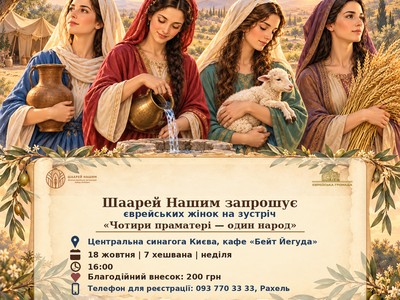
The Shaare Nashim women's community invites Jewish women to a meeting"Four foremothers — one people"Place: Kyiv Central Synagogue, Beit Yehuda CafeDate: October 18 | 7 hash | SundayTime: 16:00Charitable contribution: 200 UAHRegistration phone: 093 770 33 33, RachelWe will be glad to see you at a warm women's meeting in an atmosphere of unity, inspiration and communication.

🌙 Rosh Chodesh Mar-Heshwan
Community
The molod of the month will be on Sunday, October 11/ 30 Tishrei, at 09:43 and 2 halakim (seconds).Rosh Hodesh will last two days:on Sunday and Monday.It is customary on this Sabbath, before the morning Shaharit prayer, to read the entire book of Tehilim.Minyan for reading Tegilim in the Central Synagogue of Kyiv — at 8:30.Shabbat shalom!May the month of Mar Hashvan be healthy, calm and joyful for all of us.

Today is 28 Tishrei 5787.
Community
Sabbath Eve, Weekly Bereshit, Shabbat BereshitIom-yom“And you shall walk according to My laws… and I will give your rains at the proper time…”The study of the Torah and the fulfillment of the commandments is like a wedding ring that the Holy, Blessed One has betrothed to the people of Israel, taking upon Himself the obligation to nourish them and provide them with everything they need.Shabbat, 29 Tishrei 5787Iom-yomThe blessing on the rainbow is spoken in her honor, not because of doubts about her nature.One of the residents of Medzhybizh had a dispute with another citizen. While in the synagogue in the presence of Baal Shem Tov, he exclaimed in anger that “he would tear his abuser like a fish.”Baal Shem Tov ordered the students to join hands and stand next to him with their eyes closed. He put his holy hands on the shoulders of two of his closest disciples. Suddenly, the disciples trembled with horror: they saw with their own eyes how that man in the spirit world tears apart his opponent like a fish.This is a clear proof that every inner force inevitably generates a consequence and action: whether in a material form or in a spiritual one, which only subtler and sublime sensations are able to perceive.Source:Lubavitcher calendar

Our dates: 2 hashwans
Community
📌Hashvan 2, 5672 (October 24, 1911) — Rabbi Sholom-Dov-Ber (the fourth Lubavitcher Rabbi, Rabbi Rashab) founded the Torat Emet yeshiva in Hebron.To create a yeshiva, Rabbi Sholom-Dov-Ber sent to Erez-Israel students of the Lubavitcher yeshiva "Tomhey tmimim" Alter Simkhovits, Hillel Priyutkin, Tsvi-Hirsh Katsev, Yezhezkel Feigin, Nachman-Menachem Karasik, Avraham-Eli Osherov and Israel-Zalman Asnas, as well as their mentor, Rabbi Shlomo-Zalman Gevlin.The Yeshiva began its work, but a few years later, with the outbreak of World War I, when Russia and Turkey, which owned Eretz Israel, found themselves on opposite sides of the front, all holders of Russian passports had to leave the country.source: chabad.odessa

Our dates: 3 hashwans
Community
🔖3 Hashvanah 5627 (October 12, 1866) — Yorzayt (anniversary of the departure from this world) Rabbi Yehuda-Lejb from Kopys.Rabbi Yehuda-Lejb (also known by the acronym Maharil) was the son of the third Lubavitcher Rabbi, Rabbi Zemach-Tzedek. He was born in 1807, the second son of Rabbi Tsemakh-Tzedek, and during the ceremony of circumcision with a sandak (a person holding a baby in his arms) was his great-grandfather — Alter Rebbe. Rabbi Yehuda spent his childhood years next to his beloved grandfather, the second Lubavitcher Rabbi Miteler Rebbe, who taught him Tori and Hasidut.After the departure from this world of his father, the third Lubavitcher Rabbi, Rabbi Yehuda left Lubavitches and settled in the town of Kopys, where he led a group of Hasidim. Rabbi Maharil had thousands of followers (the so-called Kopi Chabadniks), although he himself headed them for only two months — Elul and Tishrei. On the feast of Simhat Torah, he fell ill, and on 3 hashvans, half a year after his father's departure, Rabbi Yehuda-Leib also departed from this world.The 🔖3rd hash of 5611 (October 9, 1850) — yorzait (anniversary of the departure from this world) Rabbi Israel Friedman, a rabbi from Ruzhin.Rabbi Israel Friedman, the great-grandson of Rabbi Dov-Ber from Mezhyrich (known as Mezhyrich Magid), was born in 1797 in the town of Pogrebyshche near Kyiv. Already in his early youth, Rabbi Israel chose the town of Ruzhyn (in Hebrew it was called Ryzhyn) as his residence. The court of the Ruzhinsky Rebbe (that is, his honor and property) was not inferior to most of the princely courts of Europe at that time in terms of splendor and splendor - Rabbi Israel kept numerous servants and traveled in a luxurious carriage pulled by four horses. However, despite such a demonstrative lifestyle, the Ruzhinsky Rebbe was a universal favorite (in particular, he was friends with the third Lubavitsky Rebbe, Rabbi Tsemach-Tzedek), and he was forgiven for everything. It was said that "The Ryzhiner Rebbe, of course, walks in golden boots, but these boots have no soles, so he steps on the snow with his bare feet."In 1838, Rabbi Israel was accused by the authorities of ordering the execution of two informers. The trial lasted a year and a half, hundreds of Jews were arrested and tortured, and 80 people appeared before the court. Six community leaders were sentenced to life imprisonment, others to exile in Siberia. The Ruzhinsky Rebbe was under arrest for almost two years; the lawyers did everything to prove his innocence in the case, and after the conclusion of the investigation, he was released, but left under police supervision, because the authorities suspected him of intending to become a Jewish ruler. The Rebbe moved to Chisinau, where the local governor was more sympathetic to the Jews, then moved to Iasi, and from there to the Bukovina town of Shatsk. So he moved from city to city until, after numerous efforts of his supporters, on December 20, 1845, Emperor Ferdinand I allowed him to live in Sadagora (Sadigur) in Bukovina (now Sadagora is one of the districts of Chernivtsi). The Hasids purchased the Golden Stream estate near the city for him. He built himself a luxurious mansion and once again began to lead a luxurious lifestyle. The Ruzhinsky Rebbe did a lot for the residents of Eretz Israel, in particular, he provided funds for the construction of the Tiferet Israel synagogue in the Jewish quarter of the Old City of Jerusalem.Rabbi Yisrael Friedman is buried in Sadygur. The sons of Ruzhynskyi Rebbe founded Hasidic dynasties in other towns, becoming the ancestors of Sadigur and Boyan Hasidismsource: chabad.odessa
Underground 📜 legend and “agent” Rebbe
Community
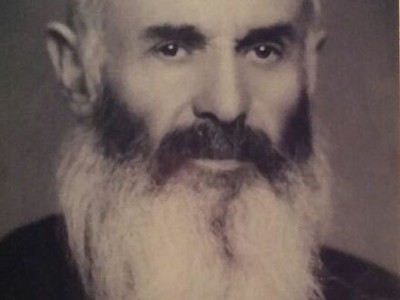
Some people live a life that would be enough for a few adventure novels. The story of Rabbi Simkh Gorodetsky (5663-5744) is a chronicle of incredible self-sacrifice, secret operations, death sentences, miraculous salvation and uncompromising loyalty to his people.🕵️♂️Secret Messenger of the Sixth Rebbe and the Underground NetworkSimkha was born in 5663, 27 Menachem-Ava, in Bobruisk, in the family of the rivers Mordechai-Lejba and Reizl Gorodetsky. In 5683, when the Soviet regime launched a brutal campaign to eradicate Jewish tradition, Rabbi Rayatz gave Rabbi Simcha an extremely important commission — to become an envoy.His task was to travel around Jewish communities throughout the Soviet Union, raise funds for the Tomhei Timim underground network, uncover hidden mikvahs, and organize Torah lessons. He moved under false names, constantly changed routes and risked his freedom every day.📜 Amazing meeting in EkaterinoslavDuring one of his trips, Simkha visited the house of Chief Rabbi Katerynoslav — Rabbi Levi-Itzhak Schneerson, the father of the seventh Rebbe. Rabbi Levi-Yitzchak led him to the door of the room of his eldest son, the future Lubavitcher Rebbe, and showed him how he was immersed in a deep study of the Torah.“Remember this image!” said Rabbi Levi-Yitzchak.Decades later, coming to the Rebbe in New York for a personal audience, Rabbi Simcha remembered this meeting and told the Rebbe how he had seen him in his youth at school.Mission in Samarkand: Saving Jewry in UzbekistanLater, Rabbi Rayats sent Rabbi Simkh to Samarkand. Rebbe Rashab's envoys Rabbi Shlomo-Yehuda-Leib Eliezerov and Rabbi Chaim Nahe acted there a few years before him.In Samarkand, Rabbi Simkha launched a large-scale underground activity:*Created headers for the children of Bukhara Jews.*Constructed mikvahs in private homes so that they could not be detected by organ agents.*Organized material and spiritual assistance for thousands of refugees arriving in Central Asia.⚖️ Sentence to death, 25 years of Gulag and salvationRabbi Simkh's vigorous activity could not go unnoticed by the Soviet special services for long. The NKVD arrested him several times. He was subjected to brutal interrogations, trying to find out the names of other members of the Chabad underground, but he did not extradite a single person.At the last trial, he was sentenced to the most severe sentence — shooting.However, a real miracle happened: at the last moment, the highest authority replaced the shooting for 25 years of strict regime camps in the Siberian Gulag. He served his sentence in extremely difficult conditions until 5713, when, after Stalin's death, he received amnesty and was released.He later described all his experiences, trials and miracles in his famous autobiographical book **"The Jewry of Silence"** (*Yahadut ha-Dmama *), which became a valuable historical document on spiritual resistance in the USSR.🏢 New Life: Kfar Chabad and Yeshiva for Bukhara JewsIn 5724, Rabbi Simkh Gorodetsky managed to get permission and leave the USSR. Immediately upon arrival, he first flew to New York — to the Lubavitcher Rebbe.Having settled in Kfar Chabad, he did not retire, but with renewed vigor joined the community service:1. Becoming secretary of Vaad, Radi Kfar-Habad.2. Managed the mutual aid fund, gemakh, and engaged in spiritual mentoring for new repatriates.3. Helped thousands of Bukhara Jews settle in a new place.4. In the 5730s, he became one of the main founders of the yeshiva for Bukharian Jews in Kfar Chabad.🕊️ The last "Lechaim" from the RebbeIn 5740, before the feast of Passover, Rabbi Simkha married a widow from Tashkent for the second time.On the eve of Yom Kippur in 5744, Rabbi Simcha was in Brooklyn and received the Leki from the Rebbe himself.Only a day after returning from New York, 30 Tishrei 5744, Rabbi Simcha Gorodetsky left this world at the age of 80. He was buried on the Mount of Olives in Jerusalem.Rabbi Simcha Gorodetsky remained in the memoryof the people as a symbol of unbreakable faith, courage and complete dedication for the sake of every Jew.sourceLubavitcher calendar]